
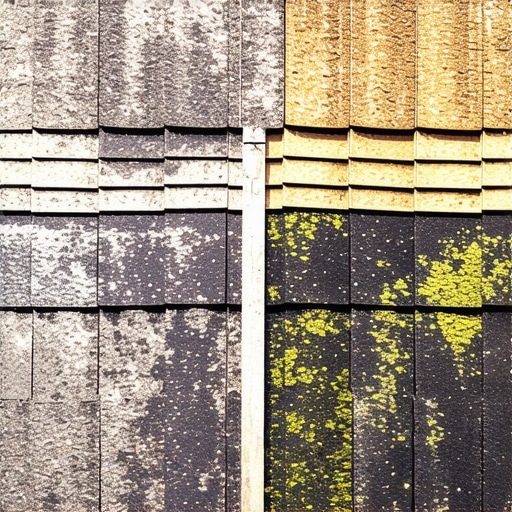
The Forensic Inspection: More Than Just Black Streaks
Walking on that roof felt like walking on a sponge. I knew exactly what I’d find underneath before I even pulled my pry bar. The homeowner was complaining about those ugly black streaks—the ones that look like someone poured motor oil over the ridge vent. But those stains weren’t just an eyesore; they were the visual symptoms of a structural terminal illness. As a forensic roofer with twenty-five years of grime under my fingernails, I can tell you that by 2026, we are going to see an explosion of roof staining that will make the last decade look clean. Most roofing companies won’t tell you why because they want to sell you a wash or a quick replacement. I’m here to explain the physics of the failure.
“A roof is only as good as its flashing, and its longevity is dictated by the chemistry of its granules.” – Old Roofer’s Adage
Reason 1: The Limestone Filler Trap in Modern Shingles
The primary reason you see those black streaks—technically a cyanobacteria called Gloeocapsa Magma—is that modern asphalt shingles are less about asphalt and more about crushed rocks. To save money, manufacturers have spent the last decade increasing the ratio of limestone filler in the shingle mat. Limestone is essentially a buffet for algae. In the humid Southeast, where the air is thick enough to drink, these organisms latch onto the limestone and begin a slow-motion feast. By 2026, the ‘covid-era’ roofs—those slapped together during the 2020-2022 building boom—will have reached the five-year mark where the initial surface oils have oxidized away, exposing the limestone beneath. When you hire local roofers, ask them about the limestone content. Most won’t know the answer, but the ones who do are the ones worth your money. The mechanism here is simple: moisture clings to the porous limestone particles, creating a micro-aquarium for algae to thrive even during a dry spell.
Reason 2: The Exhaustion of Antimicrobial Copper Granules
Manufacturers try to fight the algae by mixing in copper-coated granules. Through a process called ionic exchange, every time it rains, a tiny amount of copper ions is released, which acts as a biocide to kill off the Gloeocapsa Magma. However, this is a finite resource. By 2026, many of the ‘Algae Resistant’ (AR) warranties will be reaching their limit. Think of it like a battery that slowly loses its charge. Once those copper ions stop leaching, the algae takes over with a vengeance. We are seeing a massive surge in staining because the atmospheric salt in coastal areas and the increased UV radiation in the Southwest are stripping that copper coating faster than the laboratory tests predicted. When the copper is gone, you’re left with a naked shingle that is defenseless against the spores. I’ve seen 40 squares of shingles turn black in a single season once that chemical threshold was crossed.
Reason 3: Thermal Stratification and Ventilation Sabotage
The third reason is perhaps the most sinister because it happens from the inside out. Improper attic ventilation creates a temperature differential that makes the roof deck a literal laboratory for biological growth. If your roofing system doesn’t have a properly balanced intake (soffit) and exhaust (ridge) flow, the attic becomes a pressurized chamber of hot, humid air. This heat ‘bakes’ the shingles from the bottom up, causing the protective granules to lose their bond and slough off into the gutters. Without those granules, the shingle’s internal temperature skyrockets, often hitting 140°F to 160°F. When the sun goes down, the rapid cooling causes condensation to form not just on the surface, but deep within the shingle’s fibers. This constant ‘damp-and-dry’ cycle is the perfect breeding ground for moss and lichen, which are the more aggressive cousins of the standard black algae streaks.
“Water is patient. It will wait for you to make a mistake in your ventilation calculations before it begins to rot your substrate.” – International Residential Code (IRC) Commentary
The Physics of the Fix: Surgery vs. Band-Aids
When you see these stains, your first instinct is to call a pressure washing company. Don’t. High-pressure water is the fastest way to turn a 20-year roof into a 5-year leak. You’ll blast away the remaining copper granules and leave the shingles vulnerable. The ‘surgery’ involves more than just cleaning; it requires addressing the local roofers‘ original sins. You need to check for ‘shiners’—nails that missed the joist and are now acting as cold-conduits for frost and moisture. You need to ensure the cricket behind your chimney isn’t trapping organic debris that feeds the algae. If the staining is widespread, you’re looking at a chemistry problem that usually requires a total system replacement with higher-spec materials that use more copper or move toward a metal substrate that doesn’t provide a food source for bacteria. In the humid zones, if you aren’t using stainless nails or high-zinc flashing, you’re just inviting galvanic corrosion to join the party.