
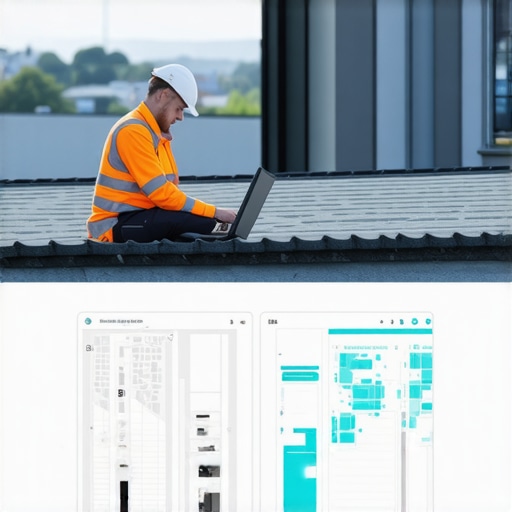
The Autopsy of a Failing Roof: Why AI Diagnostics Are Changing the Game
You find yourself sitting at the kitchen table, watching a rhythmic drip hit the hardwood. It starts as a nuisance, but to a forensic roofer with twenty-five years on the deck, that drip is a crime scene. Most local roofers will climb up a ladder, kick a few shingles, and tell you that you need a total tear-off. They are guessing. In 2026, guessing is a choice, and usually a bad one. I have spent decades identifying why roofs fail, and the reality is that the human eye is remarkably bad at seeing the physics of water migration. Walking on one particular roof last season felt like walking on a soaked sponge; I didn’t need to see the attic to know the decking was toast, but I needed to know why it happened before the new shingles went down. This is where AI-driven mapping and thermal imaging have become the only way to truly diagnose the rot before it bankrupts you.
“The roof shall be covered with approved roof coverings secured to the roof deck in accordance with the manufacturer’s installation instructions.” – International Residential Code (IRC), Section R903.1
The Physics of the Failure: Beyond the Pinhole Leak
Water is the most patient enemy you will ever face. It doesn’t just fall through a hole; it utilizes capillary action to move sideways against gravity. When a roofing company ignores the drip edge or fails to install a proper cricket behind a wide chimney, they are inviting disaster. In the cold climate zones of the North, the primary killer isn’t the rain—it is the attic bypass. This is where warm, moist air from your bathroom or kitchen leaks into the attic, hits the underside of the cold roof deck, and flash-freezes. When the sun hits that roof the next morning, you have a self-inflicted rainstorm inside your walls. AI mapping tools now allow us to use drone-mounted thermal sensors to see these heat signatures in real-time. We can literally map the thermal bridges where your insulation has failed, leading to the dreaded ice damming that turns 18-inch ice and water shield into a useless piece of rubber. If your contractor isn’t looking for [hidden decking plywood decay], they are just putting a clean shirt on a dirty body.
The Mechanical Breakdown: Shiners and Structural Rot
Let’s talk about “shiners.” In the trade, a shiner is a nail that missed the rafter and is sticking out of the plywood in the attic. In the winter, that nail becomes a frost-magnet. It collects condensation until it grows a literal ice cube, which then melts and rots the wood from the inside out. When we use AI to map these failures, we aren’t just looking for missing shingles; we are looking for the structural integrity of the entire assembly. A square (100 square feet) of shingles weighs roughly 240 pounds. If you have three layers of old asphalt up there because some “trunk slammer” didn’t want to pay the disposal fee, you are looking at thousands of pounds of dead weight on a compromised frame. This is why many [roofing services identify 4 signs you need a full tear-off] rather than a simple overlay. The AI doesn’t lie about the deflection in the rafters or the moisture content of the OSB.
Thermal Shock and the 2026 Diagnostic Standard
Modern shingles are engineered to be a system, not just a product. The sealant strip requires a specific thermal threshold to bond. If a crew installs them in 20-degree weather without hand-sealing, those shingles will flap in the first spring windstorm. Using AI mapping, we can identify “chatter” patterns in the shingle layout that indicate the bond hasn’t set. This is often the result of [improper roof nailing], where nails are driven too high, missing the “common bond” area and turning the shingle into a sail. A forensic inspection catches these local roofers‘ mistakes before the warranty period expires. We also see the impact of [poor underlayment] choices where a cheap organic felt was used instead of a high-performance synthetic. Synthetic felt doesn’t absorb water; organic felt does. When it gets wet, it wrinkles, and those wrinkles translate through the shingle, leading to [shingle buckling in 2026] that ruins your curb appeal and your waterproofing.
“A roof is only as good as its flashing.” – Old Roofer’s Adage
The Band-Aid vs. The Surgery: Making the Call
You have two choices when the AI map shows a failure: the Band-Aid or the surgery. The Band-Aid is a tube of caulk and a prayer. The surgery is a systematic replacement of the failed components. Forensic mapping often reveals that the leak isn’t where the water is dripping. Because of the roof’s pitch, a leak at the ridge can manifest as a ceiling stain ten feet away. This is why we check the [ridge vent sealing] and the valley transitions. A valley is a high-volume water channel; if the flashing isn’t woven correctly or if the metal is pinched, it becomes a reservoir. If you are hiring [local roofers to spot shingle lifting], ensure they are using high-resolution imagery to document the lifting. If they find that the [roofing company is cutting corners], it is usually in the spots you can’t see from the driveway—like the starter strip or the intake ventilation. In the end, the cost of an AI-enhanced inspection is a fraction of the cost of replacing your rafters because you let a slow leak turn your plywood into oatmeal. Don’t wait for the ceiling to fall; map the failure while it’s still just a heat signature.