
The Forensic Autopsy: Walking the Sponge
Walking on that roof felt like walking on a sponge. I knew exactly what I would find underneath before I even pulled my hammer. It was a late October morning in the Pacific Northwest, the kind where the air smells like damp cedar and old diesel. I was standing on a twenty-year-old three-tab roof that looked decent from the curb, but my boots were sinking two inches into the substrate with every step. The homeowner thought he just needed a few shingles replaced near the chimney. He was wrong. What he had was a systemic failure of the structural deck, a silent rot that had been chewing through his plywood for a decade. This is not just a leak issue; it is a structural integrity crisis that most local roofers miss because they are too busy looking at the surface and not the physics of the assembly. When you hire roofing companies that only care about the shingle count, they ignore the fact that the wood beneath is the skeleton of your home. If the skeleton is soft, the skin doesn’t matter.
“A roof is only as good as its flashing.” – Old Roofer’s Adage
Mechanism Zooming: Why Plywood Turns to Mush
To understand decay, you have to understand the chemistry of the board. Most modern homes use CDX plywood or OSB (Oriented Strand Board). These are essentially wood fibers or veneers held together by resins and glues. When moisture is introduced—not just from a hole in the roof, but from interstitial condensation—the glue begins to hydrolyze. This is the mechanism of failure. In a cold climate, warm, moist air from your shower or kitchen migrates into the attic. If your ventilation is choked, that moisture hits the cold underside of the roof deck and turns into liquid water. This is the ‘Attic Bypass’ effect. The water doesn’t just sit there; it is sucked into the end-grains of the plywood through capillary action. Once the moisture content of that wood stays above 20% for a prolonged period, the fungal spores wake up and start eating the lignin. That is when your structural deck becomes a petri dish.
Sign 1: The ‘Rusty Shiner’ and Thermal Bridging
The first sign of hidden decay isn’t usually visible on the wood itself, but on the fasteners. In the trade, we call them shiners. These are nails that missed the rafter and are sticking out of the plywood in the attic space. During a proper roof inspection, I look for rust streaks on these nails. A rusty nail is a smoking gun. It tells me that the nail is acting as a thermal bridge, pulling cold from the outside and causing attic moisture to condense on the metal. That water then drips onto the plywood or wicks into the hole, rotting the wood from the inside out. If you see hundreds of orange-streaked nails in your attic, your decking is likely compromised, even if the shingles look brand new. Many roofing outfits will just nail over this, but a forensic pro knows those nails won’t hold in rotted wood; they will just pull out like a tooth from a diseased gum.
Sign 2: The Differential Deflection (The Soft Step)
When I am up on a square (100 square feet of roofing), I am looking for differential deflection. This is the fancy way of saying one part of the roof moves while the part next to it doesn’t. Plywood is layered. When it decays, the layers delaminate. You might see a slight dip between the rafters, or a ‘hump’ where the edge of one sheet has swollen and pushed up against its neighbor. This is often caused by a lack of H-clips or improper spacing during the original install. Without a 1/8-inch gap for expansion, the boards buckle, creating a valley for water to pool under the shingles. If you ignore this, you’ll eventually deal with rotted fascia boards and sagging eaves, which costs double to fix later. A seasoned pro can feel this through their boots—it’s a dull, thudding sensation rather than the sharp, solid ‘crack’ of a healthy deck.
Sign 3: Granule Loss and ‘Cupping’ in Protected Areas
Physics dictates that heat rises. In a poorly vented attic, the heat builds up at the ridge. This cooks the shingles from the bottom up. But more importantly, it causes the plywood to ‘off-gas.’ You will notice that shingles in certain areas start to cup or curl prematurely. Why? Because the plywood underneath is expanding and contracting at a different rate than the asphalt. This creates mechanical stress on the starter strip and the field shingles. If you see shingles that look like they are ‘lifting’ or losing granules in a specific pattern that follows the seams of the plywood sheets, you have a moisture-trap scenario. You might think you just need new shingles, but if you don’t address the attic venting, the next roof will rot out in half the time.
“The building envelope must be designed to manage both liquid water and water vapor.” – International Residential Code (IRC)
The Fix: The Surgery vs. The Band-Aid
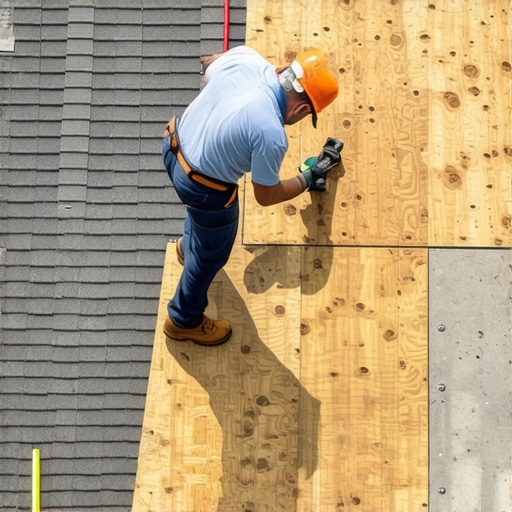
Most roofing companies will offer you a ‘recovery’—which is just a fancy word for a nail-over. They’ll put a second layer of shingles over your old ones. This is the ‘Band-Aid’ that kills houses. It traps the existing moisture and adds thousands of pounds of weight to a deck that is already turning into oatmeal. The only real solution for plywood decay is ‘The Surgery’: a full tear-off down to the rafters. We pull every sheet of CDX that shows a hint of black mold or delamination. We check the cricket behind the chimney and the valley flashing for signs of bypass. We look for signs of improper nailing from previous crews who used too much pressure on their pneumatic guns, blowing the nail heads right through the wood. Replacing a few sheets of plywood during a job is expected; replacing the whole deck because you waited too long is a financial disaster. Don’t let a ‘trunk slammer’ tell you the wood is ‘fine’ without seeing it. If they aren’t taking photos of the deck after the shingles are off, they are hiding something. Real local roofers will show you the rot because we want you to see why the bill just went up. We aren’t being greedy; we’re keeping your roof from caving in during the next heavy snow. Check your drip edge, look for those rusty shiners, and for heaven’s sake, stop hiring the cheapest guy in the truck. You get the roof you pay for, and a cheap roof is just an expensive mistake waiting to happen.