
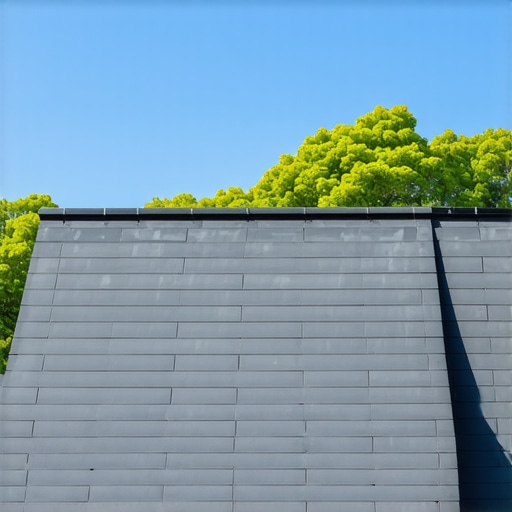
The Stone Renaissance: Why 2026 is the Year Local Roofers Return to Slate
You can smell a failing asphalt roof before you even set up the ladder. It’s that cloying, oily scent of baking petroleum and granules shedding into the gutters like black sand in an hourglass. For thirty years, roofing companies have pushed the ‘disposable’ model—slapping up thirty-year shingles that curl in twelve. But as I stand on a job site in the freezing rain of the Northeast, looking at a stack of Vermont Greys, it’s clear the tide is turning. By 2026, the ‘buy once, cry once’ philosophy is winning. Property owners are tired of the cycle of decay, and the forensic evidence points toward one conclusion: stone is back.
My old foreman used to say, ‘Water is patient. It will wait for you to make a mistake.’ He’d stand there with a cigarette dangling, pointing a callused finger at a valley where the flashing didn’t quite meet the counter-flashing. He knew that gravity isn’t your only enemy; capillary action is the real killer. Water doesn’t just fall; it climbs. It sucks itself upward between tight layers of material, defying physics to rot out your plywood deck from the inside out. In this climate, where ice dams are a seasonal certainty, that patience from the water usually outlasts the patience of the homeowner.
The Cold Reality of Thermal Bridging and Ice Dams
In the North, we don’t just worry about rain; we worry about the phase change. When heat escapes your attic bypass—those tiny holes around light fixtures and plumbing stacks—it warms the roof deck. The snow melts, runs down to the cold eaves, and freezes solid. This creates a dam. The water behind that dam has nowhere to go but up and under your shingles. On a standard asphalt roof, that water hits the felt paper, finds a shiner (a nail that missed the rafter), and begins its slow, rhythmic drip onto your drywall.
“A roof is only as good as its flashing.” – Old Roofer’s Adage
Slate handles this differently. Because it is a natural stone, it possesses a thermal mass that asphalt can only dream of. When local roofers install slate with the proper three-inch head-lap, they are creating a labyrinth that water struggle to navigate. We aren’t just talking about shedding water; we are talking about managing hydrostatic pressure. A square of slate (that’s 100 square feet for the uninitiated) weighs anywhere from 800 to 1,500 pounds. That weight, combined with the natural texture of the stone, breaks the surface tension of the water, forcing it to follow the path of least resistance—straight down to the gutters, not into your insulation.
The Anatomy of a Forever Roof: Why Materials Matter
When you call roofing companies for an estimate, they love to throw around the term ‘Lifetime Warranty.’ Let me tell you a secret: that warranty is usually pro-rated and covers the material, not the labor to tear it off when it fails. Most asphalt shingles are nothing more than fiberglass matting soaked in oil and covered in rocks. As the sun beats down, the oil evaporates. The shingle becomes brittle. It cracks. It’s a chemical failure, not a mechanical one.
Slate is a mechanical system. It is stone, held by copper or stainless steel nails. The stone itself can last 200 years. What fails is usually the ‘jewelry’—the flashing and the fasteners. I’ve seen roofs where the slate was still perfect, but the previous ‘trunk slammer’ used galvanized nails. Those nails rusted through in forty years, leaving the slates to slide down like a deck of cards. That’s why we insist on copper. Copper doesn’t just resist corrosion; it develops a patina that seals the entry point of the nail. It’s a symbiotic relationship between metal and stone.
The Forensic Autopsy of the ‘Cheap’ Alternative
I recently did a tear-off where the homeowner had gone with the lowest bidder three years prior. The plywood underneath looked like wet oatmeal. You could push a finger right through it. The culprit? Lack of a cricket behind the chimney. Without that small, gabled diversion, water was pooling in a dead spot, soaking the wood until it lost all structural integrity. A ‘cheap’ roof isn’t cheap when you have to replace the rafters. This is why the movement in 2026 is toward specialized local roofers who understand the physics of water diversion, not just the speed of a nail gun.
“The roof shall be covered with a weather-resistant covering in accordance with this code.” – International Residential Code (IRC) R903.1
The code is the bare minimum. If you’re only building to code, you’re building the worst house you’re legally allowed to build. Slate goes beyond the code. It addresses the thermal bridging that occurs when heat transfers through the rafters. By using a heavy stone covering, you’re creating a more stable temperature profile for the entire structure. It’s an ancient solution to a modern problem of rising energy costs and material waste.
The 2026 Shift: Sustainability and Value
Why the comeback now? Because the math is finally catching up with the marketing. In 2026, the cost of petroleum-based products has skyrocketed, narrowing the price gap between high-end synthetic or asphalt products and natural slate. When you factor in that a slate roof might last through four generations of owners, the cost per year is pennies compared to the ‘cheaper’ alternatives. Furthermore, the environmental impact of dumping tons of asphalt shingles into landfills every fifteen years is becoming a social liability that many homeowners are no longer willing to accept.
When you’re looking at roofing companies, ask them about their experience with ‘Slaters’ hammers’ and ‘rippers.’ If they look at you like you’re speaking a foreign language, keep walking. You need a craftsman who understands that every piece of stone is different. You need someone who knows how to hand-trim a slate to fit into a valley without cracking the surrounding tiles. This isn’t a job for a crew that’s paid by the square; it’s a job for a team that’s paid for precision.
The Cost of Waiting
The worst time to fix a roof is when you need one. By the time you see a brown spot on the ceiling, the damage is already five years old. The mold has already started in the dark corners of the attic. The structural headers are already softening. The comeback of slate is a return to sanity. It’s an acknowledgment that our homes should be built to last longer than our cars. If you’re planning on staying in your home, or if you want to hand down a legacy, look at the stone. It’s patient, it’s heavy, and it’s the only thing standing between you and the inevitable persistence of the weather.
This article hits the nail on the head regarding the resurgence of slate roofing and its importance in long-term home preservation. I’ve personally witnessed how properly installed slate roofs can stand the test of time, especially when paired with copper fasteners and meticulous craftsmanship. The detail about thermal mass helping manage ice dams resonates with my experience in the Northeast, where insulation and material choice are critical. One thing I’ve noticed is that many homeowners hesitate at first due to higher initial costs, but when considering longevity and reduced maintenance, it’s truly an investment. It’s also interesting how the environmental impact of asphalt shingles is becoming a bigger concern; landfills are filling up fast with outdated roofing materials. Have others noticed local markets shifting toward more skilled, craftsmanship-driven roofing, or is it still mostly a niche? I believe that combining old-world techniques with modern knowledge could really change the future of roofing.
Reading this article really underscores the timeless value of slate roofs in a world increasingly conscious of sustainability and long-term investment. I’ve worked on a few historic homes here in the Midwest, and the craftsmanship involved in installing these roofs truly makes a difference—especially when using copper fasteners, as you pointed out. It’s fascinating how thermal mass plays such a crucial role in managing ice dams; this detail highlights how ancient techniques remain relevant today in modern roofing. I also appreciate the emphasis on water diversion and proper water management, which is often overlooked in favor of quick installations. One challenge I’ve encountered is balancing the higher upfront cost of quality slate and craftsmanship with homeowners’ expectations for affordability. How do others navigate this conversation, especially when clients are hesitant about the initial investment but may not fully grasp the savings over decades? Are there effective ways to illustrate long-term value that resonate with clients today?