
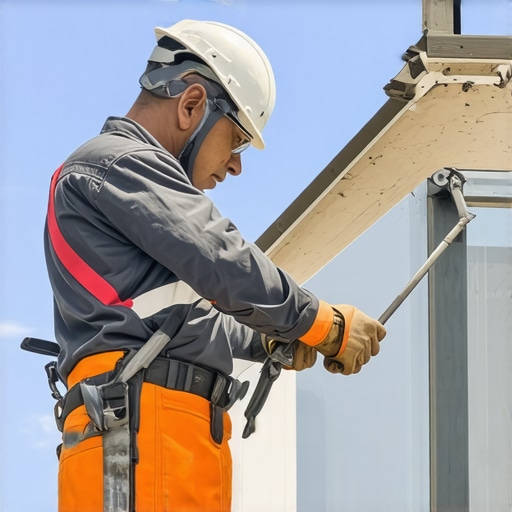
The 3:00 AM Rhythmic Drip: A Forensic Post-Mortem of the Chimney Leak
It starts with a sound you can’t ignore. It’s a rhythmic, hollow tink-tink-tink echoing down the flue or, worse, the soft splat of water hitting the drywall in your living room. Most homeowners call local roofers and ask for a quick patch. But after twenty-five years of pulling up shingles, I can tell you that a patch is just a funeral for your bank account. To understand why your roof is failing, you have to look at the physics of the counter-flashing—the metal armor that bridges the gap between your roof and your masonry. If that metal isn’t right, the water isn’t just leaking; it’s being invited in.
“A roof is only as good as its flashing. Without proper termination, the most expensive shingle in the world is just a decorated sponge.” – Old Roofer’s Adage
My old mentor, a man we called Greasy Pete, used to stand on a 10-pitch roof in a downpour just to watch how the water moved. He’d say, “Water is patient. It doesn’t have a job or a mortgage. It will wait decades for you to make a 1/16th-inch mistake, and then it will rot your house from the inside out.” Pete was right. In my two decades as a forensic roofing investigator, I’ve seen more damage caused by a single missed shiner (a nail that missed the rafter) or a poorly bent piece of copper than by any hurricane. We are entering an era where roofing companies are moving faster than ever, often skipping the specialized metal work that keeps a house dry. As we look toward the 2026 standards, the gap between ‘code-compliant’ and ‘actually waterproof’ is widening.
1. The Surface-Mount Sin: Why Caulk Is Not a Structural Component
The first thing I look for when I step onto a roof is how the metal meets the brick. Most budget-conscious local roofers use what we call ‘surface-mount’ counter-flashing. They take a flat piece of aluminum, screw it into the brick, and run a bead of caulk along the top. In the trade, we call this the ‘Caulk-and-Walk.’ In the temperate, humid climate of the Mid-Atlantic, where we see 100-degree summers and 10-degree winters, that caulk is doomed. Thermal expansion and contraction will tear that seal apart within two seasons. A 2026-grade installation requires a ‘reglet’ cut—a deep groove sawed into the mortar joint where the metal is physically tucked in. If you don’t see that metal disappearing into the brick, your roofer didn’t flash your chimney; they just taped it.
2. Capillary Action: The Physics of the Sideways Leak
Water doesn’t just fall down; it moves sideways and upward through capillary action. Imagine two pieces of glass pressed together with a drop of water between them—the water spreads. This is exactly what happens when counter-flashing isn’t ‘hemmed.’ A quality roofer will fold the bottom edge of the metal back on itself. This creates a drip edge that forces water to fall off the metal and onto the shingles. Without that hem, surface tension pulls the water behind the flashing, where it hits the unprotected sub-roofing. I’ve seen squares of plywood turned into a mushy gray pulp because a roofer forgot a half-inch fold of metal. It’s not just a leak; it’s a slow-motion demolition of your structural integrity.
“Flashings shall be installed in a manner that prevents moisture from entering the wall and roof through joints and at intersections of different materials.” – International Residential Code (IRC) R903.2
3. The Origami of the Corner: Where Most Local Roofers Fail
The corners are where the men are separated from the boys. Most roofing companies will just ‘overlap and goop.’ They overlap two pieces of metal and fill the gap with a tri-polymer sealant. A forensic investigator looks for a ‘soldered’ or ‘brazed’ corner, or at the very least, a properly stepped ‘kick-out’ flashing. If the corner isn’t integrated into the masonry, water will find its way into the valley where the roof meets the wall. I once investigated a home where the homeowner had paid for three separate repairs. Each time, the local roofers just added more silicone. When I finally tore the wall open, the 2×4 studs had the consistency of wet cardboard. The physics of water at a 90-degree intersection requires a mechanical diversion, not a chemical one.
4. Material Fatigue and the Galvanic Scale
In 2026, we’re seeing more ‘designer’ metals, but if your roofer doesn’t understand the galvanic scale, they’re building a battery on your roof. When you put aluminum flashing in contact with the pressure-treated wood of a new deck or certain types of fasteners, an electrochemical reaction occurs. The metal literally dissolves. I’ve walked on roofs where the flashing looked perfect from the ground, but when I touched it, my finger went right through. It had been eaten away by the very chemicals meant to preserve the wood. Real experts use stainless steel or thick-gauge copper with compatible fasteners to ensure that the house lasts longer than the mortgage.
5. The Missing Cricket: A Geometry Problem
If your chimney is wider than 30 inches, the code requires a cricket—a small peaked roof structure behind the chimney to divert water. Yet, I see dozens of roofs every year where local roofers simply skipped it. Without a cricket, water ponds behind the chimney. This creates hydrostatic pressure. As the water sits, the weight of the pool forces moisture through the microscopic pores of the shingles and under the flashing. It’s like leaving your house in a bathtub. If you look behind your chimney and see a flat area, you don’t have a roof; you have a drainage problem that will eventually cost you five figures in interior remediation.
The Surgery vs. The Band-Aid
When you’re hiring roofing companies, don’t ask for a quote; ask for a detail drawing of their counter-flashing. If they look at you like you have two heads, move on. A ‘Band-Aid’ repair—smearing more goop on a gap—is a temporary fix that masks a permanent problem. The ‘Surgery’ involves removing the surrounding shingles, grinding out the mortar joints, and installing new, heavy-gauge metal that is mechanically integrated into the structure. It’s expensive, it’s loud, and it’s the only way to sleep when the clouds turn black. Don’t let a ‘trunk-slammer’ tell you that caulk is a lifetime solution. In the world of forensic roofing, we know that the only thing ‘lifetime’ about a cheap repair is how long you’ll be paying for the damage it causes.