
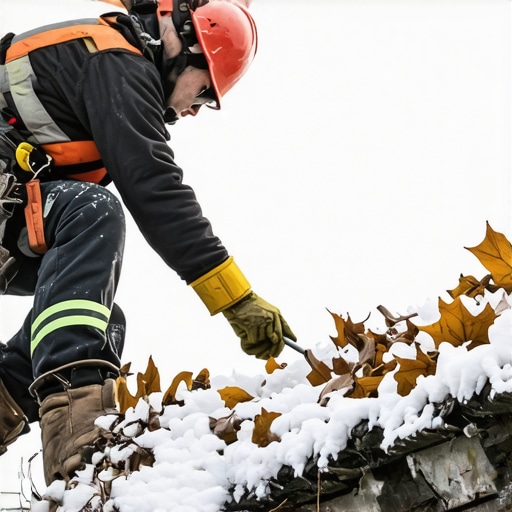
The Anatomy of a January Disaster: Why Your Ceiling is Bleeding
It starts with a faint, rhythmic thump-drip behind the drywall while you’re trying to sleep. You ignore it, hoping it’s just the house settling in the 10-degree cold. By morning, there’s a tea-colored stain spreading across your master bedroom ceiling. Most homeowners call roofing companies in a panic, thinking they have a hole in their roof. But as a forensic roofer who has crawled through a thousand soggy attics, I can tell you: your shingles are probably fine. Your physics, however, are a mess. What you’re looking at is the aftermath of an ice dam—a physical blockade of frozen misery caused by heat escaping your living space, melting the snow pack, and sending water back up under the shingles via capillary action. This is where roof raking comes in, but if you do it wrong, you’re just exchanging a leak for a structural failure or a trip to the ER.
“In climate zones where the ground snow load is 30 psf or greater, ice barriers shall be installed… to a point at least 24 inches inside the exterior wall line of the building.” – International Residential Code (IRC) R905.1.2
My old foreman, a man who had more scars than teeth, used to say, ‘Water is patient. It will wait for you to make a mistake.’ He was usually talking about flashing, but it applies to snow removal too. When you stand on the frozen tundra of your front lawn and pull a metal rake across your eaves, you are engaged in a high-stakes game of tug-of-war with your home’s primary defense system. If you aren’t careful, you’ll strip the granules right off your asphalt, leaving the fiberglass matting exposed to the brutal UV rays that still hit even in February. Let’s look at the forensic reality of how to clear snow without murdering your roof.
1. The Physics of the ‘Grit Strip’: Never Scrape to the Surface
The most common mistake local roofers see isn’t the snow left behind—it’s the damage caused by over-zealous raking. Your shingles are coated in ceramic-fired granules. These aren’t just for color; they are the armor that protects the asphalt from thermal shock and UV degradation. When you drag a rake head—especially a metal one—directly against the shingle, you are essentially using a giant piece of 40-grit sandpaper on your roof. Always leave two to three inches of snow on the roof. Think of it as a buffer zone. You aren’t trying to make the roof look pretty; you are trying to reduce the weight and the melt-source for ice dams. If you see black or grey ‘sand’ in your gutters come spring, you’ve raked too hard and shortened your roof’s lifespan by five years in a single afternoon.
2. The ‘Avalanche Zone’ and the Physics of Gravity
I’ve seen guys pull a rake and get buried under three squares of heavy, wet snow in seconds. Snow doesn’t fall; it slides as a monolithic block. If you are standing directly below the eaves, you are the landing pad. 2026 safety standards emphasize the ‘Offset Stance.’ You should be standing as far back from the drip edge as your rake extension allows. If you feel yourself pulling the rake towards your chest, you’re in the kill zone. Use the length of the pole to maintain an angle that keeps you in the clear. And for the love of your rafters, never, ever climb a ladder to rake. A ladder on icy ground is just a vertical sled waiting for a reason to slide.
3. Respect the Drip Edge and the Starter Course
The most vulnerable part of your roof is the first six inches. This is where your drip edge, your fascia, and your starter course of shingles live. This is also where the ice dam is at its thickest and heaviest. If you hack at the ice with the edge of the rake, you risk prying up the shingle or, worse, bending the metal drip edge. Once that metal is bent upward, it creates a ‘shelf’ that actually encourages water to run behind your gutters and rot out your rafter tails. In my 25 years, I’ve replaced more rotten fascia boards due to rake damage than I have due to actual weather wear. Use a rake with rollers or ‘bumpers’ that keep the blade elevated above the shingle surface.
“A roof is only as good as its flashing, and its lifespan is determined by the hands that touch it after the install.” – Old Roofer’s Adage
4. The Silent Threat: Power Lines and Thermal Bridging
Most people are looking up at the snow, not the wires. Most roof rakes are made of aluminum—a fantastic conductor. In the winter, lines can sag under the weight of ice. One stray swing of a 20-foot pole into a service drop and you aren’t just a homeowner; you’re a circuit. Beyond the electrical danger, consider the ‘why’ of the snow. If you see snow melting in specific ‘stripes’ on your roof, that’s thermal bridging. Your heat is escaping through the rafters. Raking is a temporary fix, a Band-Aid for a chest wound. If you have to rake more than twice a year, your real problem is attic ventilation and a lack of R-value in your insulation. Local roofers can clear the snow, but a forensic expert will tell you to seal your attic bypasses first.
5. Directional Integrity: Don’t Fight the Lap
Shingles are installed from the bottom up, overlapping like fish scales. This is designed to shed water running downward. When you rake, you are pulling with the grain. However, if you try to push the rake back up the roof to clear a higher spot, and you catch the lip of a shingle, you are creating a ‘shiner’ or a lifted tab. This breaks the sealant strip (the thermal bond that keeps shingles down in high winds). Once that bond is broken in freezing temperatures, it will not re-seal until the mercury hits 60 degrees. That means for the rest of the winter, that shingle is a sail waiting for a gust of wind to rip it off. Always lift the rake off the surface when moving it back up the roof.
The Cost of Neglect vs. The Cost of Aggression
Ignoring a massive snow load leads to structural deflection and ice dams that can tear gutters clean off the house. But aggressive, uneducated raking leads to ‘bald’ shingles and compromised sealant strips. If you’re seeing crickets blocked by snow or valleys filled to the brim, it’s time to act, but do it with the precision of a surgeon, not the brute force of a demolition crew. If the ice is already thick, put the rake away and call roofing companies that specialize in low-pressure steam removal. Chipping at ice with a hammer or a rake is a guaranteed way to buy yourself a new roof long before you intended to.