
The January Midnight Drip: A Forensic Autopsy of the Ice Dam
You hear it before you see it. A steady, rhythmic tink, tink, tink against the drywall of your master bedroom ceiling while the outside temperature is a bone-chilling twelve degrees. Most homeowners reach for a bucket, but as someone who has spent twenty-five years tearing apart failed systems, I know that drip is just the final stage of a slow-motion architectural murder. Walking on that roof felt like walking on a sponge despite the freeze; I knew exactly what I would find underneath before I even pulled my pry bar. The plywood was delaminated, the insulation was a sodden, grey mat of fiberglass, and the rafters were beginning to bloom with black mold. This is the reality of the northern climate when your roof becomes a glacier.
“Ice dams are formed by a complex interaction among the building heat loss, snow cover, and outside air temperatures.” – NRCA (National Roofing Contractors Association)
The Physics of Failure: Why Your Roof is Melting Itself
To understand why you are standing in the snow with a rake in 2026, you have to understand the thermal war happening in your attic. It starts with a thermal bypass—a fancy way of saying your expensive heated air is leaking into the attic like a sieve. This heat rises to the peak, warms the roof deck, and melts the bottom layer of snow. That meltwater trickles down the slope until it hits the eaves, which are stone-cold because they hang over the exterior of the house. The water freezes instantly, creating a literal dam of ice. Now, here is the mechanism zoom: water is patient. As more snow melts, the pool behind the dam grows. Through capillary action, that water is pulled upward, defying gravity, crawling under the shingles, and finding every shiner—those missed nails that missed the rafter—to wick moisture directly into your structural timber. By the time you see the spot on your ceiling, the wood has been soaking for days.
Tip 1: The Roof Rake is a Scalpel, Not a Sledgehammer
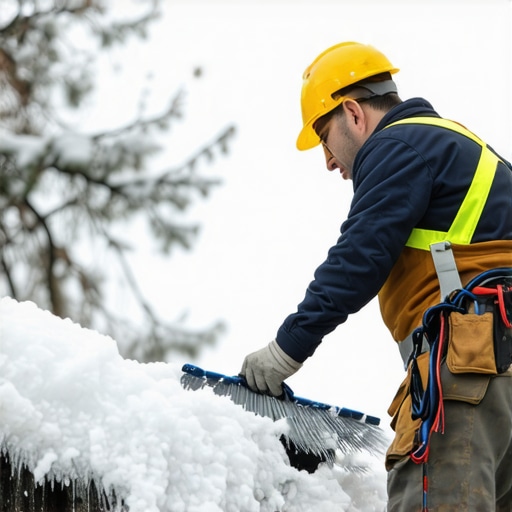
When you see local roofers or homeowners franticly swinging a metal rake at their eaves, they are often doing more damage than the ice itself. Asphalt shingles are covered in ceramic-coated granules. These granules are the only thing protecting the bitumen from UV radiation. If you scrape that rake across the surface with too much pressure, you are stripping the shingles naked. In 2026, with the increasing volatility of winter storms, you cannot afford to lose that protective layer. Always leave an inch of snow on the roof. You aren’t trying to clear the deck; you are just trying to relieve the weight and the water source. If you hit the shingle, you’ve gone too far.
Tip 2: Identify the Attic Bypass Before the Next Storm
Stop looking at the roof and start looking at your light fixtures. Most ice dams are caused by unsealed recessed lights, plumbing stacks, or attic hatches. These are the highways for warm air. If you don’t seal these, you can rake until your arms fall off, but the physics of the melt will never stop. I have seen countless “cheap” roofing companies install a beautiful new square of shingles without ever mentioning ventilation. That is a crime. Without a balanced intake at the soffit and exhaust at the ridge, your roof is essentially a slow cooker.
Tip 3: The Ice & Water Shield Mirage
Many contractors will tell you that a double layer of ice and water shield makes your roof bulletproof. That is marketing nonsense. While a high-quality membrane is essential, it is a secondary defense.
“A roof is only as good as its flashing and its ability to shed water, not just hold it.” – Old Roofer’s Adage
If you have water sitting behind a dam for three weeks, even the best membrane will eventually succumb to hydrostatic pressure. The membrane is a safety net, not a license to ignore your attic’s R-value. If your local roofers aren’t talking about baffles and insulation depth, they aren’t fixing the problem; they are just hiding it.
Tip 4: The Danger of the Frozen Gutter
Gutters do not cause ice dams, but they certainly help them grow. If your gutters are full of autumn debris, they trap water that would otherwise drop to the ground. This creates a massive block of ice that acts as a foundation for the dam to climb up the roof. I’ve seen gutters ripped clean off the fascia boards because they were carrying three hundred pounds of ice. Clean them before the first flake falls, or prepare to replace your entire drainage system come spring.
Tip 5: The Cost of the “Band-Aid” vs. The Surgery
Using calcium chloride pucks or heat cables is a Band-Aid. It’s a chemical fix for a physical problem. Over time, those salts will corrode your aluminum gutters and dry out your shingles. The “surgery”—properly air-sealing the attic and ensuring a continuous thermal envelope—is more expensive upfront but is the only way to stop the forensic cycle of decay. Don’t be the homeowner who pays for three repairs when one proper replacement would have lasted thirty years.