
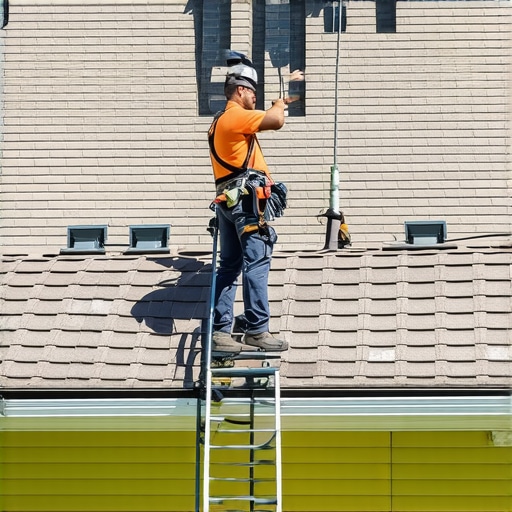
The Forensic Reality of Water Management
I’ve spent twenty-five years staring at the underside of rotted soffits and smelling the damp, earthy stench of moldy insulation. Most homeowners think a roof is just shingles, but the real failure happens at the edges. When water leaves your shingles, it enters a high-stakes physics experiment. If your local roofers aren’t obsessed with the pitch of your gutters, they aren’t roofers—they’re just guys with hammers and a prayer. My old foreman, a man who had calluses thicker than a three-tab shingle, used to say, ‘Water is patient. It will wait for you to make a mistake, and then it will rot your house from the inside out while you’re sleeping.’ He was right. I’ve seen million-dollar homes in the suburbs where the master bedroom ceiling collapsed because a gutter installer didn’t understand the difference between a 1/16th and a 1/8th inch slope. We are talking about hydraulic capacity, surface tension, and the sheer weight of stagnant water bowing out aluminum brackets until they fail.
Tip 1: The 1/4-Inch Per 10-Feet Rule is a Minimum, Not a Goal
In the trade, we see guys use a bubble level and call it ‘good enough.’ In 2026, with the increased intensity of micro-burst storms, ‘good enough’ is a recipe for a flooded basement. The pitch needs to be aggressive enough to overcome the surface tension of the water. If the slope is too shallow, the water hangs out. It pools. It collects grit from the shingles—those little ceramic granules that wash off every year. This sediment creates a dam. Now you have a five-gallon bucket of water hanging off your fascia board. At 8.34 pounds per gallon, that weight adds up fast. I’ve walked onto jobs where the gutter was sagging so hard it had ‘shiners’—nails that had pulled straight out of the rafter tails because the weight exceeded the fastener’s shear strength. You need a consistent, laser-verified drop to ensure that debris is flushed, not just the water.
“Gutters and downspouts shall be permitted to be used for the collection and disposal of water from roofs, provided that such systems are designed to withstand the expected snow and rain loads.” – International Residential Code (IRC) R801.3
Tip 2: Mastering the Drip Edge/Fascia Interface
The biggest crime local roofing companies commit is the gap. If the gutter is pitched correctly but tucked behind the drip edge incorrectly, water will use capillary action to travel backward. It’s a phenomenon where liquid defies gravity to move into tight spaces. It crawls up behind the gutter, onto the fascia, and starts the slow process of wood rot. You won’t see it for three years. Then, one day, you lean a ladder against the gutter and the whole thing crumbles. Every roofing system must treat the transition from the starter shingle to the gutter as a single, unbreakable waterproof seal. We use specialized flashing that extends into the gutter trough to ensure that even in a wind-driven rain, the water has no choice but to go into the downspout. If your contractor isn’t talking about the ‘kick-out flashing’ or the ‘drip edge overlap,’ they’re setting you up for a five-figure repair bill down the road.
Tip 3: Thermal Expansion and the 50-Foot Limit
Aluminum moves. On a hot summer day, a 50-foot run of seamless gutter can expand by half an inch or more. If your installer pinned that gutter tight at both ends without an expansion joint, the pitch you paid for is going to warp. The metal will ‘oil can’—it buckles and creates a high spot in the middle of the run. Now, instead of water flowing toward the downspout, it’s trapped in two stagnant pools on either side of the buckle. In the winter, that water freezes, expands, and rips the hangers right out of the wood. For 2026, we are seeing more high-performance alloys that require specific torque-controlled fasteners. You can’t just zip a screw in and hope for the best. You have to allow the system to breathe. We call this ‘floating’ the gutter, and it’s a skill that separates the pros from the trunk slammers who just bought a gutter machine on Craigslist.
“A roof is only as good as its flashing and its ability to shed water away from the foundation.” – Old Roofer’s Adage
Tip 4: The Downspout Vacuum Effect
Pitch isn’t just about the horizontal run; it’s about the vertical exit. If the downspout is too small for the square footage of the roof, the gutter will back up regardless of the pitch. Think of it like a funnel. If you pour water in faster than the neck can handle, it overflows. But there’s a second issue: air. A properly pitched gutter system needs to avoid ‘glugging.’ When water fills the entire diameter of a downspout, it creates a vacuum that can actually slow the drainage. In 2026, we are recommending 3×4 inch oversized downspouts as a standard for any roof valley over 20 feet long. The valley is the ‘river’ of your roof; it concentrates all that volume into a single point. If your local roofers aren’t calculating the ‘catchment area’ in squares before they size your drainage, they are just guessing. And guessing leads to foundation erosion.
Tip 5: Substrate Integrity and Bracket Geometry
You can have the perfect pitch, but if the fascia board is soft, the whole system is a ticking time bomb. Before any gutter goes up, we do a forensic check of the rafter tails. If there’s any ‘punky’ wood, it has to be cut out and replaced. We use heavy-duty hidden hangers with a threaded screw, not those old-school spikes and ferrules that pull out the first time a bird lands on the gutter. The geometry of the bracket matters. It needs to hold the gutter at a specific angle so that the front lip is slightly lower than the back. Why? Because if the gutter overflows during a massive storm, you want the water to spill over the front, away from your house, rather than over the back and into your attic. That’s a trade secret that saves homes. If your roofer isn’t checking the ‘level’ of the fascia itself, the pitch will always be a struggle. We don’t just follow the roofline; we correct the roofline’s mistakes.
This post really highlights how critical proper gutter installation is, especially with the increased weather variability we’re experiencing in 2026. I agree that even a slight miscalculation in pitch or the choice of fasteners can lead to costly repairs years down the road. I was curious about the mention of high-performance alloys for gutters; has anyone here had experience with specific brands or materials that stand out in terms of expansion and contraction management? Personally, I’ve seen some success with seamless copper gutters in high-heat areas, though the initial cost is definitely higher. It’s fascinating how much engineering goes into what seems like a simple system—like the floating gutters concept. I’d love to hear about any innovative materials or techniques others have used to improve longevity and performance in demanding climates. Overall, this article emphasizes that a thorough forensic approach—checking fascia and ensuring proper bracket geometry—is key to avoiding disaster.