
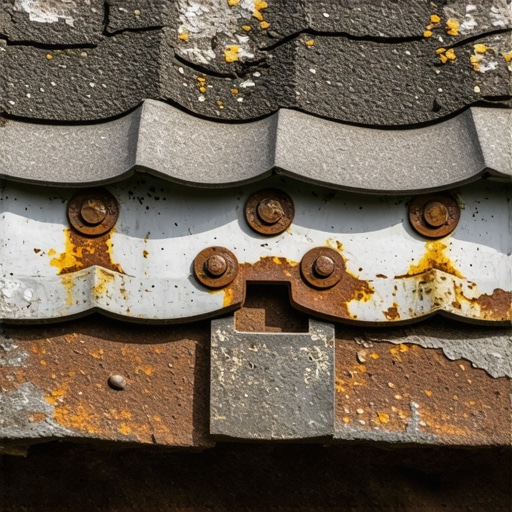
The Anatomy of a Failing Fastener: A Forecast for the Southeast Coast
I remember standing on a steep-slope clay tile roof near the Savannah shoreline about fifteen years ago. My old foreman, a man who had more tar under his fingernails than blood in his veins, used to say, ‘Steel is a temporary guest in a salt-air home. If you don’t invite it properly, it leaves through the front door of the ceiling.’ He was right then, and his words are haunting the industry now as we look toward the 2026 fallout. We are seeing a massive surge in what I call ‘Premature Oxidation Syndrome.’ It is the result of using sub-par electro-galvanized nails in environments where only stainless steel belongs. When you hire local roofers, you aren’t just paying for shingles; you are paying for the physics of the metal holding them down.
The Physics of the ‘Bleeding’ Shingle
Fastener rust isn’t just a cosmetic brown streak. It is a chemical divorce. In our humid, salt-heavy air, the zinc coating on cheap nails sacrifices itself to protect the steel core. Once that zinc is gone, the moisture starts the feast. This is where capillary action becomes the enemy. Water doesn’t just fall; it climbs. It sucks itself into the tiny gaps between the shingle and the nail head. Once there, it sits in a dark, hot, 140-degree environment, accelerating the oxidation process until the nail shank shrinks. When the shank shrinks, you lose your withdrawal resistance. Basically, your roof is no longer attached to the deck; it’s just sitting there by gravity and luck.
“Fasteners for asphalt shingles shall be long enough to penetrate through the roofing materials and not less than 3/4 inch into the roof sheathing.” – International Residential Code (IRC) R905.2.5
Sign 1: The Tell-Tale Rust Weep
The first sign of the 2026 fastener crisis is the ‘weep.’ Look at your eaves and valleys. If you see vertical amber or reddish-brown streaks starting from the butt-edge of a shingle and running down toward the gutter, your fasteners are dissolving. This is the iron oxide being washed out by the rain. In roofing, this is the equivalent of a blood trail. By the time you see the streak on the outside, the nail head is likely half its original thickness. Roofing companies that cut corners in 2020 are going to be busy defending their warranties in 2026 because those nails are reaching their breaking point right now.
Sign 2: The ‘Shiner’ Shadow in the Attic
If you want the truth, go to the attic with a high-lumen flashlight. Look for ‘shiners’—those are the nails that missed the rafter and are sticking through the plywood. In a healthy roof, these should look metallic or slightly dull. In a failing roof, they look like fuzzy orange caterpillars. This rust occurs because of thermal bridging. The cold nail tip meets the warm, humid attic air, causing condensation to form directly on the metal. This moisture then travels up the nail, rotting the plywood from the inside out. When you see this, the structural integrity of your local roofers‘ work is officially compromised.
Sign 3: Shingle Chatter and the ‘Wind Flap’
Have you ever heard your roof ‘clatter’ during a mild afternoon breeze? That is shingle chatter. When fasteners rust, they lose their ‘bite’ in the OSB or plywood deck. The hole in the wood actually expands as the rust eats the surrounding fibers. This creates a loose fit. During high-wind events—which are frequent for those of us in the coastal Southeast—the shingles lift just enough to vibrate. This vibration breaks the sealant strip, or the ‘thermal bond,’ between shingle layers. Once that bond is gone, your roof is a ticking time bomb for the next tropical depression. Most roofing companies won’t tell you that the nail failed before the wind even blew.
Sign 4: Displacement of the Drip Edge
Fasteners aren’t just in your shingles; they are in your flashing and drip edges. When the nails holding your drip edge rust out, the metal begins to kick out or sag. This creates a gap where wind-driven rain can be pushed up under the first course of shingles. This is a classic forensic failure point. I’ve seen ‘squares’ of roofing peeled back like a banana skin because the perimeter fasteners turned to dust. If your drip edge looks wavy or has pulled away from the fascia board, the ‘bones’ of the roof are failing.
“The choice of fastener material is the most significant factor in determining the long-term performance of a roof system in coastal environments.” – National Roofing Contractors Association (NRCA)
Sign 5: The Spongy Deck Walk
As a forensic investigator, I can feel a fastener failure through my boots. When I walk a roof and it feels ‘bouncy’ or ‘spongy,’ it’s often not the wood itself that is rotten—yet. It’s the fact that the fasteners are no longer cinching the layers together. Without that compression, the roof system loses its monolithic strength. You are essentially walking on a deck where the ‘glue’ has been replaced by dust. If you feel movement under your feet, call local roofers immediately for a drone or physical inspection. Waiting until 2026 means you are waiting for the wood to turn to ‘oatmeal,’ at which point a simple re-nailing job becomes a full deck replacement.
The 2026 Solution: Beyond Galvanized
If you are planning a replacement to avoid these rust issues, stop looking at standard galvanized nails. You need 304 or 316-grade stainless steel. Yes, they cost three times as much per square, but they are the only thing that survives the salt-air battery. Don’t let a contractor tell you ‘hot-dipped’ is just as good in a high-salt zone; it’s a half-measure that will leave you with the same streaks in a decade. You also need to ensure your roofing professional uses a cricket behind large chimneys to prevent water from pooling near the most vulnerable fastener clusters. Protecting your home starts with the smallest piece of hardware on the job site. Don’t let a two-cent nail ruin a twenty-thousand-dollar investment.