
The Anatomy of a Slow Motion Disaster
You smell it before you see it. That damp, earthy stench of an attic that has been breathing swamp water for six months. It starts as a faint discoloration on the ceiling, maybe a yellowish ring that looks like a coffee stain, right near the kitchen skylight or the HVAC unit. Most homeowners call local roofers thinking they have a ‘shingle leak.’ But I’ve spent twenty-five years crawling through fiberglass insulation and sweating on hot decks, and I can tell you: it’s almost never the shingles. It’s the curb flashing.
Walking on that roof felt like walking on a sponge. I knew exactly what I’d find underneath—the kind of rot that makes a homeowner’s stomach drop into their shoes. The client had hired one of those roofing companies that promises a ‘new roof in a day’ back in 2024. They slapped down three thousand square feet of laminate shingles but didn’t bother to rebuild the curb for the solar tubes. Now, two years later, the OSB decking was so saturated you could put a finger through it. This wasn’t a storm event; this was physics taking its revenge on laziness.
“Flashing is the most important part of any roofing system. It is the transition between the roof membrane and the building components that penetrate it.” – National Roofing Contractors Association (NRCA) Manual
Why Curbs are the Weakest Link
A curb is essentially a box that raises a rooftop element—be it a chimney, a skylight, or a heavy HVAC unit—above the water line of the roof deck. In our climate, where we deal with alternating bouts of torrential rain and high humidity, that curb acts like a dam. Water rushing down the roof hits the uphill side of the curb and has to be diverted. If your roofer didn’t install a cricket—a small peaked structure to redirect water—that moisture just sits there, looking for a way in. Through capillary action, water can actually travel upward under a loose piece of metal, pulling itself into the structure like a straw drawing liquid. This isn’t just a leak; it’s a structural bypass.
Sign 1: The ‘Mastic Monster’ (Cracked Sealant)
If you climb up there and see thick, black, goopy tar smeared around the base of your skylight, you’re looking at a ticking time bomb. In the trade, we call that ‘bull.’ It’s a temporary fix used by ‘trunk slammers’ who don’t know how to bend metal. By 2026, the intense UV exposure in our region will have baked the essential oils out of that mastic, leaving behind a brittle, cracked shell. These micro-fissures act as funnels. When the temperature drops at night, the metal curb expands and contracts, widening those cracks. If you see ‘alligatoring’ in the sealant, the flashing has already failed; the water just hasn’t found its way to your dining room table yet.
Sign 2: The Telltale Rust Line and Galvanic Corrosion
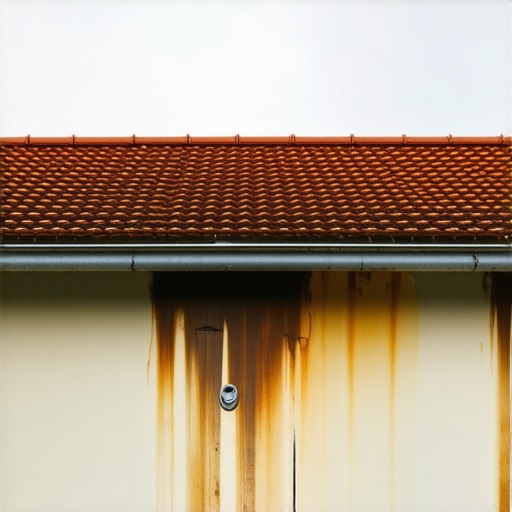
Look at the base of the metal where it meets the shingles. Is there a streak of orange or reddish-brown? Most roofing companies use galvanized steel because it’s cheap. But in high-moisture environments, or if they used the wrong nails, you get galvanic corrosion. This is a chemical reaction between two dissimilar metals. If a roofer used copper flashing with galvanized nails, or if the salt in our air has begun to eat through the zinc coating, the metal becomes porous. Once the metal is pitted, surface tension allows water to dwell in those pits, eventually eating a hole straight through to the wood. I’ve seen squares of perfectly good shingles ruined because a five-dollar piece of flashing rusted out.
Sign 3: Counter-Flashing Separation
Proper curb flashing is a two-part system: the base flashing that goes under the shingles and up the wall, and the counter-flashing that hangs over it like a skirt. Because of the thermal shock we experience—140°F on the roof during the day, dropping forty degrees after a thunderstorm—these materials move. If the counter-flashing isn’t properly regleted into the curb or secured with high-grade fasteners, it will pull away. A gap as thin as a credit card is enough for wind-driven rain to be forced upward and over the top of the base flashing. Once it’s behind the metal, it’s a straight shot into your attic.
“Roofing assemblies shall be designed and installed to prevent water from entering the building through the roof covering.” – International Residential Code (IRC) R903.1
Sign 4: The ‘Shiner’ and Improper Fastener Logic
A ‘shiner’ is a nail that missed the rafter or was driven in crooked, leaving the shank exposed. In curb flashing, we see this when guys get lazy with their nail guns. If you see nail heads backing out of the flashing, it’s a sign of thermal pumping. The wood underneath is damp, causing it to swell and shrink, which slowly ‘spits’ the nail out. Once that nail head is raised, water follows the shank down like a highway into the decking. Any local roofer worth their salt should be using ring-shank nails or screws with neoprene washers for curbs, but many still use standard smooth-shanks that have zero holding power in 2026’s weather patterns.
Sign 5: Localized Algae and the ‘Dead Valley’ Effect
If you notice a dark green or black stain specifically on the downhill side of a curb, you have a drainage problem. This indicates that water is ‘pooling’ or ‘ponding’ behind or around the curb long after the rain has stopped. This constant moisture softens the granules of the shingles, leading to premature bald spots. Eventually, the water will find a valley or a seam in the underlayment. In our region, the constant dampness leads to fungal growth that can eat through the adhesive bond of your shingles, making them easy prey for the next wind storm.
The Forensic Fix: Surgery vs. Band-Aids
When I find these failures, I tell the homeowner the truth: you can’t fix this with a caulk gun. A proper repair requires ‘the surgery.’ We have to strip the shingles back at least two feet around the curb, remove the failed metal, and inspect the deck for rot. We then install a high-temp ice and water shield—a self-adhering membrane that seals around every nail—before custom-bending new heavy-gauge flashing. We don’t use ‘bull’; we use mechanical seals and proper overlaps. It’s more expensive than a tube of silicone from the big-box store, but it’s the only way to ensure you aren’t calling us back in six months when the next ‘once-in-a-century’ storm hits.
Protecting Your Investment
Don’t be fooled by ‘lifetime warranties’ that only cover the material and not the labor or the flashing. Most material warranties are void if the flashing wasn’t installed according to manufacturer specs. When you are vetting local roofers, ask them specifically how they handle curbs. If they don’t mention crickets, counter-flashing, or membrane integration, move on. You’re not just buying shingles; you’re buying a dry house. Don’t let a poorly flashed curb turn your home into a forensic scene. Keep an eye on those five signs, and if you see them, act before the mold takes over.