
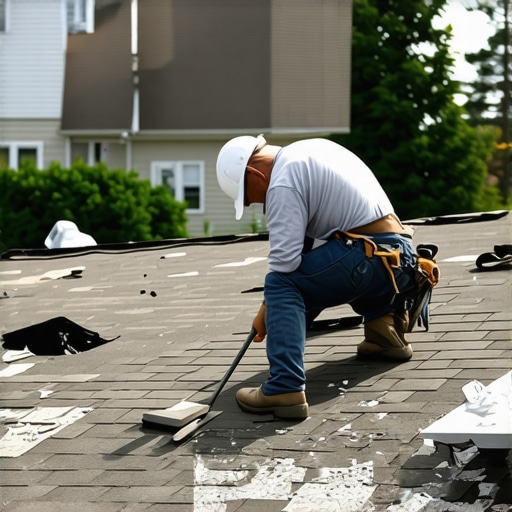
The Foreman’s Warning: Why Your Roof Is Failing Before It’s Even Installed
My old foreman used to say, ‘Water is patient. It will wait for you to make a mistake.’ He spent forty years chasing leaks in cities like Buffalo and Boston, and he never once saw a roof fail because the shingles were bad. It was always the human element. Today, the industry is flooded with sales reps who have never swung a hammer, pitching estimates that look professional but are structurally hollow. When you look at quotes from local roofers in 2026, you aren’t just looking at a price tag; you are looking at a forensic blueprint of how your home will either breathe or rot over the next decade. If you don’t know how to spot the omissions, you’re just paying for a temporary lid, not a roofing system.
“A roof is only as good as its flashing.” – Old Roofer’s Adage
Red Flag 1: The Substrate Shell Game and ‘Inspect on Tear-Off’ Clauses
The most common trap in modern roofing estimates is the vague treatment of the roof deck. A contractor walks the perimeter, maybe pokes a shingle, and writes ‘replace plywood as needed at $100 per sheet.’ This is a massive red flag. In cold climates, the heat from your home rises into the attic. If your ventilation is poor, that heat meets the cold underside of the roof deck, creating a micro-climate where condensation thrives. Over years, the resins holding your OSB or plywood together delaminate. The wood becomes soft, almost like a damp biscuit. A veteran investigator knows that a ‘spongey’ feel underfoot during the estimate means the substrate is compromised. If the estimate doesn’t include a specific count for deck inspection or fails to mention the structural integrity of the cricket—that small peaked structure behind your chimney designed to divert water—you are heading for a change-order nightmare. They’ll get the shingles off, see the rot, and suddenly your ‘cheap’ roof costs five grand more.
Red Flag 2: The ‘Ice and Water’ Half-Measure
In the Northeast, the enemy isn’t just rain; it’s the ice dam. When snow melts on the upper parts of the roof and refreezes at the cold eaves, it creates a dam. Liquid water then backs up behind that ice, sitting over the shingles. This is where capillary action takes over. Water moves sideways and upward, defying gravity, slipping under the shingle tabs. Your estimate must specify the use of a self-adhering polymer-modified bitumen membrane—commonly called Ice and Water Shield. If the roofer only quotes for the minimum 36 inches required by code, they are cutting corners. On a low-slope roof or a home with deep eaves, 36 inches doesn’t even clear the interior wall line. You need two courses. If they aren’t talking about the ‘thermal bridging’ at the eave, they aren’t roofing experts; they are just shingle stickers.
Red Flag 3: Vague Flashing and ‘Reusing’ Metal
Flashing is the most technical part of the job, and it’s where 90% of failures occur. I’ve seen 2026 estimates from roofing companies that simply state ‘replace flashing.’ That tells me nothing. Are they using 26-gauge galvanized steel? Are they using copper for the valleys? Or are they planning to ‘inspect and reuse’ the old, rusted aluminum? Reusing flashing is like putting old tires on a new Ferrari. The old nail holes are still there, the metal is fatigued, and the sealants have dried out. Look for ‘step flashing’ on sidewalls and ‘counter-flashing’ on chimneys. If they don’t mention grinding out a mortar joint to tuck the metal in properly, they are going to ‘caulk and walk.’ Caulk is a temporary sealant that shrinks under UV exposure; a mechanical lock is the only thing that keeps a house dry for thirty years.
“The primary purpose of a roof is to shed water rapidly and prevent its accumulation on the surface.” – NRCA Roofing Manual
Red Flag 4: The Ventilation Lie and Attic Bypasses
Most local roofers focus on the outside, but the life of your roof is determined by the inside. If your estimate doesn’t include a calculation of Net Free Venting Area (NFVA), run. In a cold climate, your attic needs to stay at the same temperature as the outside air. If it’s too warm, you get ice dams. If it’s too humid, you get mold. A common scam is installing a ridge vent without ensuring the soffit vents are clear. This creates a vacuum that pulls air—and moisture—up from your living space, a phenomenon known as the stack effect. I’ve walked into attics where the rafters were covered in white frost because the ‘new’ roof didn’t account for attic bypasses. If they aren’t looking at your intake vents, they are setting your new shingles up to blister and ‘fish-mouth’ within five years.
Red Flag 5: The Fastener Fraud and the ‘Shiner’ Epidemic
The physics of a nail are simple until you add wind and frost. In 2026, many contractors are moving toward high-speed pneumatic nailers without adjusting their depth. This leads to ‘over-driven’ nails that cut through the shingle or ‘under-driven’ nails that stick up and eventually wear a hole through the shingle above it. But the real red flag is the ‘shiner.’ This is a nail that misses the rafter and hangs exposed in the attic. In the winter, that cold steel nail head becomes a magnet for moisture. It collects frost, which melts in the afternoon sun, dripping onto your insulation. Over a thousand nails, that’s a lot of water. A quality estimate will specify a 6-nail pattern for high-wind areas and the use of hot-dipped galvanized nails. If they are using cheap electro-galvanized fasteners, they will rust through long before the shingles wear out.
The ‘Lifetime’ Warranty Trap: Labor vs. Material
Don’t be fooled by the ‘Lifetime’ sticker. Most roofing companies are selling you a manufacturer’s warranty that only covers material defects. If the roofer misses a square of shingles or high-nails the starter strip, the manufacturer won’t pay a dime. You need to see a ‘Workmanship Warranty’ that lasts at least ten years. If the company has only been in business for two years but offers a 25-year labor warranty, do the math. They’ll be gone, rebranded under a new name, before your first leak appears. You want a contractor who understands the chemistry of the asphalt—how the granules protect the bitumen from UV radiation—and who treats the installation like a surgical procedure.
This post highlights some critical points that homeowners often overlook when getting roofing estimates. I totally agree that a detailed inspection clause should be standard, especially concerning the integrity of the roof deck and the cricket behind chimneys. In my experience, I’ve seen too many cases where poor ventilation was the culprit behind early shingle failure, even when the installation looked perfect from the outside. It makes me wonder, how many homeowners actually ask for detailed ventilation calculations during their estimate? Also, the mention of reusing flashing really hit home—I’ve replaced a lot of flashing just because it was reused and rusted out, leading to leaks down the road. Has anyone here found that insisting on a detailed scope of work, including all flashing details, made a real difference in the long-term performance of their roof? Would love to hear more about how others are approaching this level of scrutiny before signing on the dotted line.
Reading this post really made me think about how often homeowners focus solely on the initial cost without fully understanding what the estimate covers. My experience aligns with the idea that a good roofing system involves much more than just shingles; it’s about proper ventilation, quality materials, and attention to detail during installation. For instance, I once had a contractor try to reuse old flashing, which I declined, and for good reason—new flashing with proper sealing and materials made a big difference in preventing leaks down the line. Also, proper attic ventilation turned out to be a game-changer in avoiding future ice dams and mold issues, which many forget to include in their estimates. I wonder, how many homeowners are even aware of what to ask about ventilations or flashing specifications? It’s such a complex process, and I believe detailed discussions upfront can save a lot of trouble later. Has anyone here ever had a project where insisting on detailed specs significantly impacted the longevity and performance of their roof?