
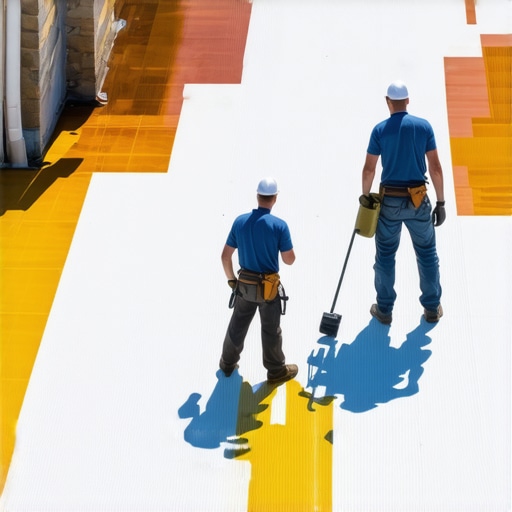
The Scorched Metal Reality: Why Most Coatings Fail Before the Check Clears
Walk onto a corrugated metal roof in the high desert at 2:00 PM in July, and you aren’t just looking at a building component; you are standing on a literal frying pan. I’ve seen surface temperatures hit 165°F, hot enough to melt the soles of cheap work boots. Most local roofers will try to sell you a bucket of white paint and call it a ‘cool roof system,’ but as someone who has spent two and a half decades investigating structural failures, I can tell you that a ‘cheap’ coating is just a slow-motion disaster. When we talk about 2026 technology, we aren’t just talking about aesthetics. We are talking about molecular cross-linking that survives the brutal cycle of thermal shock.
My old foreman, a man who had more scars from tin-snips than I have stories, used to pull me aside when he saw me rushing a seam. He’d say, ‘Water is patient, kid. It will wait years for you to make one mistake, and then it’ll move in and rot the deck while you’re sleeping.’ That stayed with me. In the Southwest, heat is the scout for the water. The sun bakes the elasticity out of your roof, causing the metal to expand and contract—a phenomenon we call ‘oil canning’—until the fasteners back out or the seams pop. Once that seal is broken, the next monsoon season doesn’t just bring rain; it brings a forensic audit of every shortcut your roofing companies took.
The Physics of the ‘Thermal Tug-of-War’
To understand why you need a high-performance coating, you have to look at the ‘Mechanism of Failure.’ Metal has a high coefficient of thermal expansion. This means your roof is literally growing and shrinking every single day. A standard acrylic coating from a big-box store has the elasticity of a Saltine cracker once the UV radiation hits it for three months. It cracks. Then, capillary action takes over. Water doesn’t just fall into a hole; it gets sucked upward into the lap joints of your metal panels, traveling sideways against gravity until it finds the plywood or the insulation. By the time you see a brown spot on the ceiling, the structural damage is already six months old.
“Roofing systems must be designed to accommodate the thermal movement of the materials used, particularly in environments with high diurnal temperature swings.” — NRCA (National Roofing Contractors Association) Manual
1. High-Solids Silicone: The UV Shield
In 2026, high-solids silicone remains the king of the desert. Unlike acrylics, silicone is inorganic. The sun doesn’t recognize it as ‘food,’ so it doesn’t break down the polymer chains. When we apply this, we’re looking for a minimum dry film thickness (DFT) that can bridge those micro-cracks around the fasteners. It’s ponding water resistant, which is vital if your roof has any low spots or ‘bird baths’ where water sits after a storm. If your local roofers aren’t checking the slope before quoting silicone, they’re setting you up for a ‘shiner’—a missed opportunity for a permanent fix.
2. Aliphatic Urethanes: The Impact Specialist
If your roof gets foot traffic for HVAC maintenance, or if you’re in a hail-prone corridor, urethanes are the answer. Specifically, aliphatic urethanes don’t yellow or chalk like their aromatic cousins. They are tough—think of them as a truck bed liner for your house. They handle the ‘scuff’ of a technician’s boot without tearing. This prevents the exposed metal from oxidizing, which is where the real ‘oatmeal’ rot starts in the substrate.
3. PVDF-Based Fluoropolymers: Color That Doesn’t Quit
Most coatings fade to a dull gray within three years. PVDF (polyvinylidene fluoride) coatings are for the homeowner who cares about curb appeal as much as waterproofing. These coatings use a specific resin that holds pigment better than anything else on the market. They are highly reflective, pushing that radiant heat back into the atmosphere instead of letting it soak into your 140°F attic. Reducing that thermal load isn’t just about comfort; it’s about stopping the ‘Thermal Shock’ that rips screws right out of the purlins.
4. SEBS (Styrene-Ethylene-Butylene-Styrene) Thermoplastics
This is the ‘Trade Secret’ for old metal roofs that have already seen better days. SEBS coatings are incredibly ‘stretchy.’ If your roof is ‘breathing’ heavily due to wide temperature swings, SEBS moves with it. It’s like a rubber skin that won’t snap. I’ve seen this used on commercial ‘Squares’ where nothing else would stick. It’s the closest thing to ‘surgery’ you can do to a roof without a full tear-off.
5. Nano-Ceramic Infused Acrylics
Don’t confuse these with the cheap water-based stuff. The 2026 nano-ceramic versions use microscopic ceramic spheres to create a thermal break. It’s essentially a radiant barrier in liquid form. While I’m usually cynical about ‘nano’ marketing, the forensic data shows a significant drop in interior plenum temperatures when these are applied correctly over a sound metal base.
The Warranty Trap: Don’t Get Burned Twice
Roofing companies love to throw around the word ‘Lifetime.’ In the trade, we know that a warranty is often only as good as the paper it’s printed on. A ‘Material Warranty’ only covers the bucket of goo, not the labor to fix the leak. You want a ‘System Warranty’ or an NDL (No Dollar Limit) warranty. If the coating peels because the ‘trunk slammer’ didn’t pressure wash the oxidation off first, a material warranty won’t pay a dime.
“The primary cause of coating failure is not the material itself, but the lack of proper surface preparation and adhesion testing.” — International Building Code (IBC), Section 1504
The Forensic Inspection: Before You Coat
Before you let any local roofers near your home with a sprayer, you need a forensic walk-through. Check the ‘crickets’—those small diversions behind chimneys. If they are rusted through, a coating is just a mask on a corpse. Look at the valleys. If there’s debris buildup, it’s holding moisture against the metal, creating pinholes. You can’t coat over rust and expect it to stop. You have to treat it, prime it, and then protect it. Anything less is just expensive paint. Always demand an adhesion test. If they don’t put a small patch down and try to rip it off with a scale, they don’t know if the coating will actually bond to your specific metal alloy.