
The 2026 Horizon: Why Your Roof is Failing Before Its Time
I’ve spent twenty-five years crawling through dark, suffocating attics where the air is so thick with heat and fiberglass dust you can taste it. I’ve seen thousands of residential systems, and I’m going to tell you something most local roofers won’t: your thirty-year shingle is probably going to die at year fifteen. It’s not because the product is bad; it’s because the physics of the installation were ignored. By the time 2026 rolls around, the climate shifts we’re seeing—more intense micro-bursts and radical temperature swings—will eat a poorly installed roof for breakfast.
My old foreman used to pull me aside when I was just a greenhorn lugging bundles up a ladder. He’d point to a valley and say, ‘Water is patient, kid. It’s got nothing but time. It will wait for years for you to make one sixteenth-of-an-inch mistake, and then it’ll rot this house from the inside out.’ He was right. Most roofing companies today are focused on ‘production’—getting a crew on and off your deck in eight hours. But longevity isn’t born in speed; it’s born in the details that happen after the old shingles are stripped and the bare wood is exposed.
1. The Physics of the ‘Attic Lung’: Beyond Simple Ventilation
If you want your roof to last until 2026 and well beyond, you have to stop thinking about your roof as a lid and start thinking about it as a lung. In the Mid-Atlantic and Northeast zones, the enemy is stagnant, humid air. When a local roofer tells you that you have ‘enough vents,’ they are usually guessing. A roof fails from the bottom up when the attic temperature reaches 140°F. This heat bakes the shingles from underneath, liquefying the asphalt oils and causing them to off-gas. This leads to ‘granule loss’—those little colored stones you find in your gutters. Once the granules are gone, the UV rays hit the fiberglass mat, and it’s game over.
Mechanism Zooming: Consider the ‘capillary action’ of moisture in a poorly vented space. When warm air from your shower or kitchen escapes into the attic (an ‘attic bypass’), it hits the cold underside of the roof deck. It condenses into liquid water. This water doesn’t just sit there; it travels sideways along the plywood grain, finding the shafts of your nails. It follows the nail—the ‘shiner’ that missed the rafter—and drips onto your insulation. By the time you see a brown spot on your ceiling, that plywood has been ‘oatmeal’ for three seasons.
“Attic ventilation shall be provided with an aggregate net free ventilating area of not less than 1 to 150 of the area of the space ventilated.” – International Residential Code (IRC) R806.1
To survive the next decade, you need a balanced system: intake at the soffits and exhaust at the ridge. If your roofing companies aren’t calculating ‘Net Free Venting Area,’ they aren’t roofing; they’re just shingling.
2. The War Against ‘Shiners’ and High-Nailing
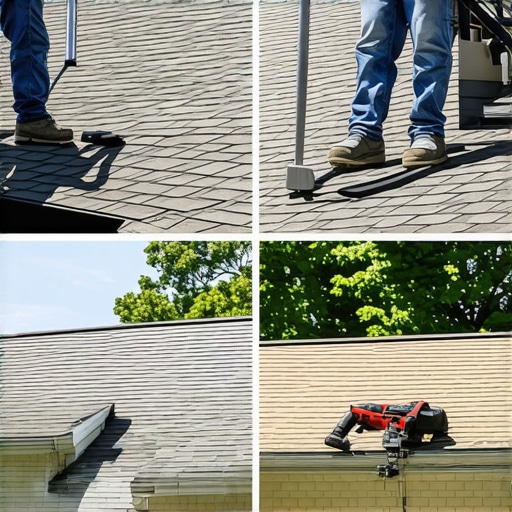
Let’s talk about the ‘Square’—that 100 square foot area of your roof. In a single square, there are hundreds of nails. If the guy on the pneumatic gun is moving too fast, he’s going to ‘high-nail.’ This is the silent killer of roofs. Every shingle has a narrow ‘common bond’ zone where the layers overlap. If the nail misses that strip, the shingle isn’t actually attached to the roof; it’s just hanging there by friction and a prayer.
When the wind picks up, these high-nailed shingles flap. You won’t see it from the ground. But that flapping breaks the sealant strip. Once that seal is broken, wind-driven rain gets driven upward under the shingle. This is where the physics of hydrostatic pressure comes in. Water gets pushed into the nail hole, and because the nail wasn’t driven flush, it creates a tiny gap. That gap is a highway to your bedroom ceiling. A local roofer who cares will show you their ‘stagger pattern’ and ensure every nail is flush—not ‘over-driven’ (cutting the shingle) and not ‘under-driven’ (creating a bump that wears the shingle above it).
3. The Secondary Water Resistance (SWR) Mandate
In 2026, we’re going to see more ‘ice dams’ in the North and ‘monsoon-level’ rain in the South. The standard 15-lb felt paper is a relic of the past. It tears easily and it’s not waterproof; it’s water-resistant. If you want a roof that lasts, you need a synthetic underlayment and, more importantly, a robust application of ‘Ice & Water Shield.’
This is a self-adhering membrane that ‘heals’ around the nail. If a roofing company only puts one three-foot course at the eaves, they are doing the bare minimum. To truly protect the structure, that membrane needs to extend at least 24 inches inside the warm wall line. Why? Because when snow melts and hits the cold gutter, it refreezes, creating a dam. The water backs up under the shingles. Without a secondary barrier, that water is going into your soffits and rotting your fascia boards. It’s the difference between a roof that lasts 12 years and one that lasts 30.
4. The Geometry of Failure: Crickets and Flashing
The most dangerous place on a roof isn’t the steep pitch; it’s where two roofs meet, or where a chimney breaks the plane. We call these ‘dead valleys’ or ‘water traps.’ If your chimney is wider than 30 inches, the code requires a ‘cricket’—a small peaked structure behind the chimney to divert water. I’ve torn off hundreds of roofs where the local roofer just gobbed five gallons of roofing cement (we call it ‘black butter’) behind the chimney instead of building a cricket.
“A roof is only as good as its flashing. While the shingles shed the water, the flashing directs it.” – NRCA Manual
Roofing cement dries out. It cracks under UV radiation. Proper flashing—specifically ‘step flashing’ where each shingle has its own piece of bent metal—allows for the house to expand and contract. Houses are living things; they move. If your flashing is rigid or made of cheap plastic, it will snap. We use copper or heavy-gauge aluminum because they handle ‘thermal shock.’ When the sun hits a roof, it can go from 70°F to 150°F in an hour. That expansion creates massive stress at the joints. If the geometry isn’t right, the roof fails.
The ‘Lifetime’ Warranty Trap
Don’t be fooled by the ‘Lifetime’ stickers on the bundles. That warranty covers the material, not the labor. If a ‘trunk slammer’ installs it wrong, the manufacturer will laugh you off the phone. Your best bet for 2026 is finding roofing companies that have been in the same zip code for longer than the warranty they’re offering. You want someone who understands the local micro-climate—whether it’s the salt air of the coast or the heavy ice of the mountains. Stop looking for the lowest bid and start looking for the forensic details. If they don’t talk about ‘ventilation flow’ and ‘fastening zones,’ walk away. Your home is too expensive to be a training ground for amateurs.