
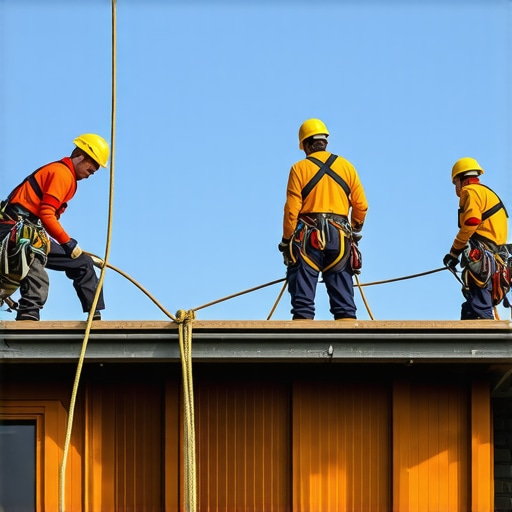
The Sound of a 180-Pound Mistake
I was standing in a driveway in the humid thick of a Florida morning when I heard it. Not the rhythmic thud-thud-thud of a nail gun, but the sharp, sickening crack of an anchor point ripping out of 7/16-inch OSB. Then the silence. That silence is the loudest thing you will ever hear on a job site. For twenty-five years, I have been the guy called in to perform the autopsy on failed roofing systems, but more and more, I am looking at the failures of the people standing on them. If you think the safety ropes hanging off your eaves are just for show, or that any ‘local roofer’ with a truck knows how to tie off, you are gambling with your own liability. By 2026, the standards for fall protection are shifting, and most roofing companies are still using gear that belongs in a museum.
My old foreman used to say, ‘Water is patient, but gravity is greedy. It will wait for you to make one mistake and then it takes everything.’ He was right. When we talk about 2026 roof safety ropes, we aren’t just talking about a piece of braided nylon. We are talking about a kinetic energy management system that has to survive the brutal UV radiation of a tropical climate and the corrosive salt air that eats galvanized steel for breakfast. Most crews I see today are using gear that has been baked in the back of a van to 140°F for three summers straight. That rope isn’t a lifeline; it is a fuse waiting to snap.
“The primary purpose of a fall arrest system is not just to stop a fall, but to do so in a way that minimizes the force applied to the body and the structure.” – National Roofing Contractors Association (NRCA) Safety Manual
The Forensic Autopsy of an Anchor Point
Let’s zoom in on the physics. A standard ‘shiner’—that’s a nail that misses the rafter and just hangs in the air—is a roofing sin, but a ‘shiner’ in a safety anchor is a death sentence. When a local roofer installs a temporary anchor plate at the ridge, they are often using 16d nails or lag screws. In the Southeast, where the humidity turns plywood into something resembling a wet Saltine cracker over time, those fasteners don’t have the withdrawal resistance they did on day one. Capillary action pulls moisture into the nail holes, rotting the wood fibers around the steel. When a worker slips, the dynamic load isn’t just their weight; it’s a focused spike of energy that can reach 1,800 pounds of force. If that anchor is nailed into water-damaged decking, it’s coming out.
The 2026 Standard: Why UV-Degraded Poly-Ropes are Dead Weight
The first tip for 2026 is understanding material fatigue. We are seeing a move toward higher-density polyethylene blends that resist the intense UV radiation found in coastal regions. In places like Houston or Miami, the sun literally cooks the plasticizers out of standard safety lines. You can tell a dead rope by the feel—it’s stiff, it leaves a chalky residue on your hands, and it lacks the ‘spring’ required to absorb a fall. A ‘dead’ rope transfers 100% of the impact to the worker’s spine and the roof’s cricket. By 2026, many insurance carriers will require dated, color-coded lifelines that prove the gear hasn’t been in the sun for more than 12 months. If your roofing companies are using gray, frayed ropes, they are using 2010 tech in a 2026 world.
Hardware Corrosion and the Salt Air Factor
Second, we have to talk about the ‘Silent Snap.’ In tropical zones, the snap hooks and carabiners on these ropes are constant victims of galvanic corrosion. Most cheap gear uses zinc-plated steel. In salt-heavy air, that zinc sacrificial layer vanishes in months, leaving the structural steel to rust from the inside out. I’ve seen hooks that looked fine on the outside but snapped like a twig under load because the pivot pin had seized and corroded. The 2026 standard for local roofers near the coast should be nothing less than stainless steel or triple-action locking gates that are inspected weekly, not once a decade.
“Fall protection must be provided at elevations of four feet in general industry workplaces, five feet in shipyards, six feet in the construction industry and eight feet in longshoring operations.” – Occupational Safety and Health Administration (OSHA) Standard 1926.501
The Physics of Vertical Lifelines and the 30-Degree Rule
Third is the geometry of the swing. Most local roofers think if they are tied to something, they are safe. But if they move too far horizontally from their anchor—past the 30-degree mark—they create a ‘pendulum’ hazard. If they fall, they don’t just go down; they swing violently into the gable end or a brick chimney. Forensic analysis of accidents often shows that it wasn’t the fall that killed the worker, but the swing into a vertical obstruction. The 2026 safety protocols demand redirected anchors and the use of ‘rope grabs’ that are specifically rated for the pitch of the roof. A 12/12 pitch requires a completely different friction coefficient than a 4/12 walk-on.
Suspension Trauma and the Rescue Plan
Finally, the tip that most roofing companies ignore: the rescue plan. Stopping the fall is only half the battle. If a roofer is hanging in a harness for more than 15 minutes, the leg straps act as tourniquets, pooling blood in the legs and starving the brain—this is suspension trauma. In 2026, a compliant local roofer must have ‘trauma straps’ on every harness, allowing the fallen worker to stand up in their own gear to relieve the pressure. If the crew doesn’t have a mechanical advantage rescue kit on-site, they aren’t a professional outfit; they are a liability waiting to happen on your property.