
The Autopsy of a Silent Killer: Why Your Attic is Rotting Right Now
If you are reading this, you probably noticed a stain on the drywall that looks like a tea-colored bruise. You called a few local roofers, and they probably did a ‘tailgate estimate’—they stood in your driveway, looked up for thirty seconds, and told you that you need a whole new roofing system. They didn’t even pull out a ladder. That’s not an inspection; that’s a guess. I’ve spent twenty-five years investigating why roofs fail, and I can tell you that by the time you see water on your ceiling, the battle has been raging for months, if not years. Water is a patient predator. It doesn’t just fall through a hole; it creeps, it wicks, and it hides in the physics of surface tension.
Walking onto a roof in a damp November morning last year, I felt the deck give way beneath my boot like a wet sponge. I didn’t need to see the leak from the inside to know what was happening. The homeowner was convinced the shingles were fine because they still had granules. But underneath, the OSB had the structural integrity of a soggy cracker. That’s the forensic reality of modern roofing companies that cut corners. They focus on the ‘jewelry’—the shingles—and ignore the skeletal structure underneath. In the industry, we call this ‘putting a tuxedo on a corpse.’
“Water is the most common cause of deterioration in building materials. Its presence in any form—liquid, vapor, or solid—can lead to the rapid failure of roofing components.” – National Roofing Contractors Association (NRCA)
The Physics of Failure: How 2026 Roof Water Defies Gravity
To understand how to detect water, you have to understand Capillary Action. This is the phenomenon where liquid flows in narrow spaces without the assistance of, or even in opposition to, external forces like gravity. Most people think water only moves down. Wrong. If two shingles are pressed too tightly together without a proper offset, or if a local roofer drove a ‘shiner’—a nail that missed the rafter and hangs exposed in the attic—water will climb that nail or crawl between those shingle layers through surface tension. It moves sideways across the deck until it finds a seam in the plywood. Then, it’s in.
Then there is Hydrostatic Pressure. When snow sits on your roof and the heat from your poorly insulated attic melts the bottom layer, that water is trapped behind a dam of ice at the eave. This water isn’t just sitting there; it’s being pushed upward under the shingles by the weight of the snow above it. If your roofing contractor didn’t install a high-quality ice and water shield at least six feet up from the eave, that water is going to find its way into your soffits and rot out your fascia boards before you ever see a drop in the living room.
[IMAGE_PLACEHOLDER]
Method 1: The Thermal Ghost – Detecting the Invisible Heat Sink
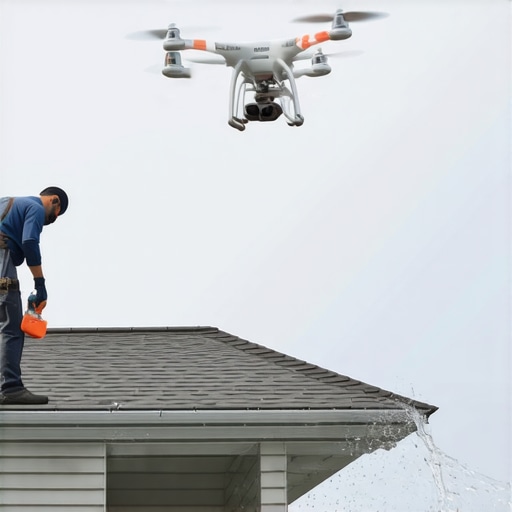
The first way to detect water in 2026 isn’t with your eyes; it’s with thermal signatures. Water has a high thermal mass, meaning it holds onto heat much longer than dry wood or fiberglass insulation. Professional roofing companies now use FLIR (Forward-Looking Infrared) cameras during the ‘golden hour’—just after sunset. As the roof cools down, the dry areas lose heat quickly. However, the areas where the insulation is soaked or the plywood is damp will glow like a neon sign on the camera screen. This is the only way to find ‘The Ghost’—the leak that only happens during driving rain and disappears before the sun comes up. If you are hiring local roofers, ask if they use thermography. If they laugh, show them the door. You’re looking for a forensic expert, not a shingle-slapper.
Method 2: The Structural Sponge Test – Detecting Deck Delamination
You can detect a lot by the way a roof ‘feels’ under a weighted walk. A healthy roof deck should feel rigid. When I walk a square (that’s 100 square feet in trade talk), I’m looking for ‘deflection.’ If the plywood is delaminating—meaning the glues have failed due to constant humidity—the wood fibers separate. This creates a springy, soft sensation. This often happens near the valleys or around the chimney cricket. The cricket is that small peaked structure behind a chimney designed to divert water. If it was framed poorly, water pools there, creating a micro-swamp. If you feel a dip, the wood is already gone. You aren’t just looking at a shingle repair; you’re looking at a structural ‘surgery’ to replace the rot before it hits the rafters.
Method 3: The Flashing Autopsy – Where 90% of Leaks Begin
Stop looking at the shingles. Shingles are just the skin. The flashing is the bone. I once investigated a mansion where three different roofing companies had tried to fix a leak. They all just smeared more ‘bull’ (roofing cement) on the problem. When I tore it back, I found they had used ‘step flashing’ that wasn’t actually stepped. They’d used a single long piece of L-metal. In a climate with thermal expansion and contraction, that metal buckled, creating a funnel right into the wall cavity.
“A roof is only as good as its flashing. Without proper integration of metal and membrane, the most expensive shingle in the world is useless.” – Old Roofer’s Adage
To detect water here, look for ‘shiners’ in the attic near the walls. If you see a nail head that looks rusted or has a white ‘halo’ of mold around it, you’ve found your culprit. That nail is a bridge for moisture. Even if it’s not dripping, it’s ‘sweating’ every morning. This is called an attic bypass, where warm air from your house hits that cold nail, condenses, and drips into your insulation, destroying your R-value and inviting black mold to the party.
The Band-Aid vs. The Surgery: Why Waiting Costs Triple
Most homeowners want the Band-Aid. They want a tube of caulk and a ‘see you later.’ But in roofing, a Band-Aid usually just traps the water inside the assembly. If you have trapped moisture, the sun hits the shingles, heats that water into steam, and the steam expands, causing ‘blisters’ on your shingles. This literally cooks the roof from the inside out. Choosing local roofers who understand the ‘whole house’ approach—ventilation, insulation, and shedding—is the difference between a 30-year roof and a 7-year headache. Don’t wait for the ceiling to fall. If you suspect water, the damage is already underway. Get a forensic inspection, find the physics behind the failure, and fix it right the first time.