
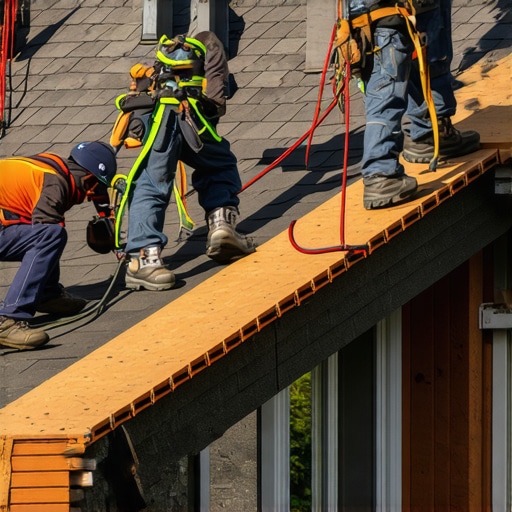
The Smell of a $20,000 Mistake
I can usually smell a failing roof before I even set up the ladder. It’s a thick, cloying scent—the smell of wet, decaying OSB and the damp earthiness of black mold blooming behind a fascia board. Most roofing companies will tell you that a leak starts with a missing shingle or a hail hit. They’re wrong. In my twenty-five years as a forensic roof investigator, I’ve found that the slow death of a home usually starts at the very edge, with a piece of metal thin as a soda can. We’re talking about the drip edge. By 2026, the building codes in our wet, freezing northern corridor have tightened, yet local roofers are still out here installing metal like it’s 1995. I’m tired of seeing homeowners pay for a new square of shingles only to have their eaves rot out five years later because some ‘trunk slammer’ didn’t understand the physics of surface tension.
“A roof is only as good as its flashing.” – Old Roofer’s Adage
My old foreman, a man who had calluses thicker than the shingles we were laying, used to tell me every morning: ‘Water is patient, kid. It doesn’t need a hole; it just needs an invitation. It will wait for you to make a mistake, and then it will move in and stay forever.’ He was talking about capillary action. When rain hits the edge of your roof, it doesn’t just fall off into the gutter like a waterfall in a commercial. Because of surface tension—the same force that lets bugs walk on ponds—water wants to cling to the underside of the shingle. Without a properly profiled drip edge, that water performs a U-turn. It travels backward, underneath the starter course, and begins to saturate the edge of the plywood deck. Once that wood gets thirsty, it’s game over. It wicks that moisture deep into the attic, where it meets 140°F heat in the summer, creating a literal greenhouse for wood-destroying organisms.
Tip 1: The Physics of the Hem and the ‘Kick-Out’ Gap
By 2026, we are seeing a shift toward heavier gauge, factory-painted aluminum drip edges, but the installation remains the weak link. Most local roofers nail the metal flush against the fascia board because it ‘looks cleaner.’ That is a death sentence for your paint and your wood. A forensic-grade installation requires a minimum 1/2-inch gap between the vertical leg of the drip edge and the fascia. This creates a physical break that gravity uses to snap the surface tension of the water. Furthermore, if your roofer isn’t using a ‘hemmed’ edge—a small outward fold at the bottom of the metal—they are inviting water to crawl back up. Think of the hem as a ‘drip point.’ It forces the droplet to become too heavy to cling to the metal, forcing it to fall into the center of the gutter. If I see a roofer installing flat, unhemmed flashing, I know I’m looking at a future repair job. I’ve spent countless hours in attics looking at ‘shiners’—those missed nails that bypassed the rafter—only to realize the moisture wasn’t coming from the nail at all, but from the eave wicking water upward like a sponge.
Tip 2: The Underlayment Sandwich (Code R905.2.8.5)
The 2026 standards for local roofing are clear, yet the sequence of layers is still a point of confusion for many roofing companies. Listen closely: at the eave (the bottom), the drip edge goes on before the Ice and Water shield. At the rake (the sides), the drip edge goes on after the underlayment. Why? Gravity. At the eave, you want the waterproof membrane to lap over the top of the metal so that any water that gets past the shingles hits the membrane and slides onto the metal and out. If the metal is on top of the membrane, the water hits the edge of the metal, slips underneath it, and rots your deck. I once tore off a roof where the contractor had reversed this. The plywood had turned to a substance resembling cold oatmeal. I could push my finger through the deck into the soffit below. The homeowner thought they had a ‘lifetime’ roof, but the ‘pro’ had built a water-funneling machine instead of a weather barrier.
“R905.2.8.5 Drip edge. A drip edge shall be provided at eaves and gables of shingle roofs. Adjacent segments of drip edge shall be lapped a minimum of 2 inches.” – International Residential Code (IRC)
Tip 3: Metallurgy and the Galvanic Trap
We are seeing more high-end roofing companies move toward copper or specialized alloys for 2026. However, if you mix your metals, you’re starting a chemical fire. In our humid climate, putting an aluminum drip edge in direct contact with copper-treated lumber or using galvanized nails to fasten a copper edge creates galvanic corrosion. The metals literally eat each other. I’ve inspected roofs only three years old where the drip edge had turned into a white, powdery crust that crumbled in my hand. You need stainless steel fasteners for premium metal installs. And don’t get me started on ‘crickets.’ If your roof has a chimney or a wide dormer, and your roofer didn’t install a cricket—a small peaked structure to divert water—no amount of drip edge will save you. The water will pool, the hydrostatic pressure will rise, and the water will find its way behind your flashing faster than a politician finds a camera.
The Forensic Conclusion: Don’t Buy a ‘Square,’ Buy a System
In the trade, we talk about ‘Squares’—100 square feet of roofing. Most people call three roofing companies and ask for the price per square. That is the wrong question. You should be asking about their drip edge profile, their overlap specs (should be 2 inches minimum), and how they handle the transition at the corner. A real roofer doesn’t just butt the metal together at the corner; they snip, fold, and miter it so there’s no entry point for wind-driven rain. If you see them reaching for a tube of caulk to ‘seal’ a gap in the metal, fire them. Caulk is a temporary fix for a permanent problem. A properly installed 2026-spec drip edge relies on geometry, not chemistry, to keep your house dry. Don’t wait until you’re sitting at your dining table watching water drip from the light fixture. The cost of a proper edge is pennies compared to the cost of a structural repair. Be the homeowner who knows the difference between a roof that looks good and a roof that actually works.