
The Anatomy of a Post-Storm Failure
You hear it before you see it. That rhythmic drip-thud hitting the hardwood in your living room at 3:00 AM. In the Southeast, when the wind starts screaming at 80 miles per hour, your roof isn’t just a lid on a box; it is a pressurized membrane under siege. I have spent twenty-five years climbing ladders in the wake of these messes, and most of what I see is the result of ‘trunk slammers’ who think six nails per square is a suggestion rather than a code requirement. When the wind gets under the leading edge of an unsealed shingle, it creates a lever. Physics doesn’t care about your warranty; it only cares about the uplift rating.
Walking on that roof the next morning felt like walking on a sponge. I knew exactly what I would find underneath before I even pulled a single pry bar. The decking had lost all structural integrity because the previous crew had ignored the secondary water resistance. The water hadn’t just come through a hole; it had migrated horizontally via capillary action, pulled along the underside of the felt by the pressure differential between your hot attic and the cooling rain. This is the forensic reality of roofing in a tropical climate: the water is patient, and it is looking for the ‘shiner’—that nail the installer missed and left sticking through the plywood, acting as a perfect conductor for moisture to rot your rafters from the inside out.
“The roof shall be covered with approved roof coverings secured to the building or structure in accordance with the provisions of this code.” – International Residential Code (IRC) R905.1
Step 1: Immediate Stabilization and the Tarping Myth
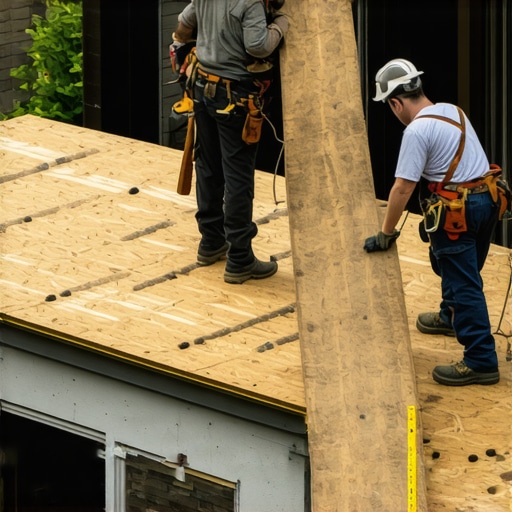
Most local roofers will show up with a blue poly-tarp and a box of cap nails. That is a Band-Aid on a gunshot wound. If you have a gaping hole from a downed branch or a failed valley, a simple tarp will fail the moment the next gust of wind creates a vacuum. True emergency boarding involves structural plywood. You have to bridge the span of the rafters. If the decking is soft, you are looking at signs of decking rot that existed long before the storm hit. We use 5/8-inch CDX plywood to bridge the gap, fastened directly into the meat of the truss.
We have to talk about the mechanism of the seal. When we board up, we aren’t just blocking the hole. We are creating a temporary watershed. This means the top edge of your boarding or tarp must be tucked under the course of shingles above the damage. If a contractor just nails a piece of wood over the hole and caulks the top, they are an amateur. Gravity will win. The water will hit that top edge, pool, and then find the path of least resistance—which is usually your insulation. You need a contractor who understands how to handle high wind risk by mechanically fastening the perimeter of the patch to prevent ‘ballooning’—where wind gets under the patch and rips it off like a sail.
Step 2: Managing the Structural Load and Moisture Migration
Once the hole is covered, the real forensic work begins. You have to check the cricket—that small peaked structure behind the chimney. If the storm shifted the masonry or tore the flashing, a board-up on the main slope won’t save you. Water will bypass the board and run down the chimney stack. This is where we see the most damage in 2026. Homeowners think they are safe because the visible hole is covered, but the hydrostatic pressure of standing water in a compromised valley is still pushing liquid into the building envelope.
I have seen situations where the emergency boarding was done so poorly that it actually trapped moisture inside, turning the attic into a sauna. This leads to rapid mold growth. A professional crew will evaluate if the storm scars have affected the ventilation. If your ridge vents are choked with debris or the board-up blocks the airflow, your shingles will cook from the inside out the moment the sun comes back. We are looking for structural shifting. If the rafters have bowed under the weight of a fallen limb, simply slapping a board over it is dangerous. We have to shore up the interior before we can even think about the exterior.
Step 3: The Transition to Permanent Repair
Emergency boarding is a race against the clock. In the Southeast, the salt air and humidity start attacking exposed wood within hours. Your local roofers should already be pulling the data for the permanent fix while the hammer is still swinging. This involves navigating the 2026 insurance landscape. You aren’t just fighting the weather; you’re fighting the adjuster. You need a paper trail that shows the boarding was a necessary ‘mitigation of loss’ as required by your policy.
“A roof is only as good as its flashing, and an emergency repair is only as good as the man who understands where the water goes next.” – Old Roofer’s Adage
Before the permanent replacement starts, ensure your contractor is managing permit filing correctly. Many ‘storm chasers’ will skip the permit for the emergency work, which can lead to a nightmare when the city inspector shows up for the final roof sign-off. The transition from a boarded-up mess to a square of new, high-performance asphalt or metal requires a clean tear-off. We don’t just patch over the emergency board. We rip it all back to the rafters, replace the compromised OSB or plywood, and start fresh with a self-adhering underlayment that acts as a true secondary water barrier. This is the difference between a roof that lasts thirty years and one that fails during the next afternoon thunderstorm.
The Cost of Hesitation
If you leave a board-up in place for more than fourteen days, you are asking for trouble. The UV rays degrade the adhesives in the temporary tapes, and the wood starts to warp. I have walked onto jobs where the homeowner waited a month, and by then, the ‘repair’ had caused more damage than the original storm. The water had found its way around the edges of the patch, soaked the header beams, and started the slow process of structural decay. Don’t be the person who tries to save a few hundred bucks on the emergency call only to spend ten thousand on mold remediation and drywall replacement later. Get a forensic-minded pro out there, get the plywood down right, and get your house back under a real lid.