
The 140-Degree Nightmare: Why Your Roof Fails Before the Panels
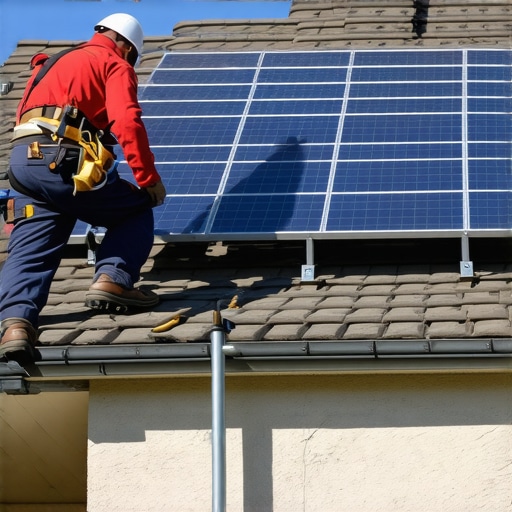
You see them everywhere now. Shiny blue and black rectangles blanketing rooftops from Mesa to El Paso. As a guy who has spent two and a half decades peeling back layers of scorched asphalt and rotted OSB, I can tell you that the solar revolution has a dirty little secret. Most local roofers and solar installers aren’t talking about what happens to your roof deck when you bolt a metal radiator to it. My old foreman used to say, ‘Water is patient. It will wait for you to make a mistake.’ In the Southwest, heat is even more patient. It cooks the life out of your shingles until they’re as brittle as a saltine cracker, and then the monsoon winds come to finish the job. If you’re looking at roofing companies to prep for a solar install in 2026, you aren’t just buying a roof; you’re buying a structural system that has to survive a literal pressure cooker. [image_placeholder_1]
The Physics of Thermal Shock and Solar Integration
When you install solar brackets, you are creating a permanent bridge between your home’s skeleton and the brutal exterior environment. In our desert climate, we deal with thermal expansion on a scale that would make a New England roofer weep. A steel rail can expand and contract significantly between a 115-degree afternoon and a 50-degree night. If your local roofers aren’t accounting for that movement, those lag bolts are going to ‘waller out’ the pilot holes in your rafters. This is where Mechanism Zooming reveals the truth: the constant microscopic shifting of the bracket creates a gap in the sealant. Once that seal is compromised, capillary action takes over. During a heavy downpour, water doesn’t just fall; it’s pulled sideways under the shingle, following the bolt threads directly into your attic insulation.
“Roof systems shall be designed and installed to resist the wind loads as specified in Section 1609 of the International Building Code.” – International Residential Code (IRC)
By 2026, the standards for solar mounting are shifting toward fully integrated mechanical flashings. The ‘old way’ of just squirtin’ some goop—what we call ‘mookie’ in the trade—around a bolt is a one-way ticket to a moldy ceiling. You need to understand that the UV radiation in the Southwest eats standard caulking for breakfast. Within three years, that flexible seal becomes a hard, cracked husk that offers zero protection. When you’re vetting roofing companies, you need to be the forensic investigator of your own home.
The Material Truth: Asphalt vs. The Sun
Most folks opt for architectural shingles because they’re affordable. But under a solar array, the rules change. The area under the panels actually stays cooler, while the surrounding shingles bake. This creates a temperature gradient that can lead to thermal stress cracking. If you’re hiring local roofers, you have to ask about the granule loss. Those little rocks on your shingles aren’t just for looks; they’re the only thing protecting the petroleum-based mat from being vaporized by the sun. Once the granules are gone, the shingle is ‘dead.’ Adding solar brackets to a roof that’s already at its half-life is a fool’s errand. You’ll be paying five grand just to take the panels off when the roof fails two years later.
Question 1: Are You Using Integrated Deck-Level Flashing?
Don’t let them give you a vague answer. In the trade, we see too many ‘shiners’—nails or bolts that missed the rafter entirely. If they’re just drilling through the shingle and filling the hole with sealant, kick them off the job site. A professional roofing setup for 2026 requires a flashing plate that slides up under the course above. It should be a mechanical barrier, not a chemical one. You want to see an L-foot bracket that is elevated, allowing water to flow freely down the valley and around the penetration without damming up debris. If water can’t move, it finds a way in. It’s that simple.
Question 2: How Do You Manage Galvanic Corrosion?
This is where the ‘cheap’ roofing companies get caught. When you mix different metals—like an aluminum solar rail and a galvanized steel bracket—and add a little moisture (even just morning dew), you get a battery. An electrochemical reaction occurs that eats the metal away. If they aren’t using stainless steel fasteners or ensuring the metals are compatible, your mounting system will literally dissolve over a decade. I’ve walked on roofs where I could snap a bracket with my bare hands because of galvanic corrosion. You need to hear them mention ‘stainless’ or ‘anodized’ without you prompting them.
Question 3: What Is the Load-Path Verification Process?
A solar array is a giant sail. When those 70-mph gusts hit, they’re trying to rip the roof right off the house. The brackets are the only thing holding it down. Your local roofers must verify that every single lag bolt is buried deep in the center of a rafter. I’ve seen ‘trunk slammers’ hit the plywood decking and call it a day. That might hold for a week, but the first time a real storm rolls through, that panel is going to become a kite, taking a square of shingles with it. Ask them if they use a pilot-hole bit and how they verify the ‘bite’ into the wood. If they don’t talk about ‘structural integrity’ or ‘rafter centers,’ they aren’t roofers; they’re just guys with drills.
“A roof is only as good as its flashing.” – Old Roofer’s Adage
The ‘Lifetime’ Warranty Trap
Don’t get suckered by the ‘Lifetime Warranty’ stickers. Read the fine print. Most of those warranties are voided the second an unauthorized third party (like a solar tech) drills a hole in the roof. This is why you must hire roofing companies that have an in-house solar division or a long-standing partnership with an installer. You want a single point of accountability. If the roof leaks, you don’t want the roofer blaming the solar guy and the solar guy blaming the roofer while your living room ceiling is sagging like a wet paper bag. You need a water-tightness certificate that covers the penetrations, not just the shingles.
Final Word from the Deck
2026 is going to see a lot of new regulations regarding ‘Solar Ready’ construction. But codes are just the minimum. If you want a roof that actually lasts thirty years under the desert sun, you have to look past the sales pitch. Look for the guy who talks about flashing, ventilation, and thermal movement. Look for the guy who’s cynical about ‘miracle sealants.’ Because at the end of the day, physics doesn’t care about your warranty. Physics only cares about gravity and the relentless patience of water. Pick your local roofers like your house depends on it—because it does.