
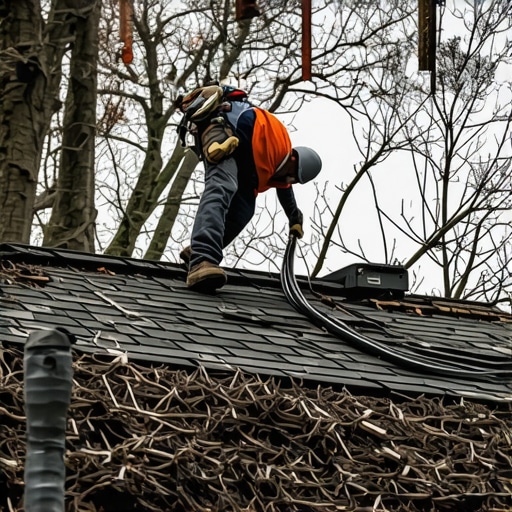
The Anatomy of a Failure: Why Your Roof Lost the Fight
If you are staring at a tea-colored stain spreading across your vaulted ceiling like an ink drop in a glass of water, you’re already late to the party. By the time that water hits your drywall, it has already navigated the labyrinth of your attic, bypassed the fiberglass insulation, and sat for weeks soaking into your rafters. I’ve spent twenty-five years on steep-slope decks, and if there is one thing I know, it’s that wind damage is never just about the shingles you see lying in your driveway like discarded playing cards.
Walking on a wind-scoured roof after a storm in the Gulf Coast region always feels the same. I remember one specific forensic inspection where walking on that roof felt like walking on a sponge. Every step had a sickening give to it. I didn’t even need to pull my pry bar to know what I’d find. Underneath those high-def architectural shingles, the ‘trunk slammers’ who installed the previous layer had missed the nail line on every third shingle. They were ‘shiners’—nails driven too high, missing the double-thickness of the shingle mat entirely. When the 2026 winds kicked up, those shingles didn’t just blow off; they became sails, catching the air and vibrating until the nail heads ripped right through the asphalt like a thumb through wet cardboard.
“A roof is only as good as its flashing, and its wind resistance is only as robust as its mechanical fastening pattern.” – Old Roofer’s Adage
The Physics of the ‘Lift-Off’
Local roofers often talk about wind speeds, but they rarely talk about aerodynamic lift. When a 70-mph gust hits the side of your house, it doesn’t just push. It accelerates as it moves over the ridge, creating a low-pressure vacuum on the leeward side. This is the Bernoulli effect in action. That vacuum wants to suck the shingles right off the plywood. If your roofing companies didn’t use a six-nail pattern or forgot the starter strip at the eaves, that vacuum wins every single time. It starts with ‘tab flutter’—the sound of shingles flapping against each other—and ends with a catastrophic failure of the sealant bead.
Fix 1: The Surgical Sealant Injection
The fastest way to stop further rot is hand-sealing. This isn’t just about squirting some cheap caulk under a flap. We’re talking about a high-grade SBS-modified bitumen adhesive. In the heat of a 140°F attic, the wood expands; in the cool of a Gulf night, it shrinks. If your shingles have lost their factory seal due to wind-driven debris, you need to manually apply three one-inch diameter spots of sealant per tab. Don’t go overboard; if you create a solid line of caulk, you trap capillary water behind the shingle, which will rot the mat from the inside out. You have to leave ‘weep holes’ for the roof to breathe.
Fix 2: The Starter Course Extraction
The biggest mistake I see local roofers make is skipping the dedicated starter strip. They just flip a regular shingle upside down and call it a day. That’s a rookie move. A true starter course has the sealant bead right at the eave line to prevent the wind from getting a fingernail under the edge. If your eaves are peeling back, the fix isn’t just more nails. We have to peel back the first square of material, install a heavy-gauge drip edge, and then set a true starter strip in a bed of flashing cement. This creates a mechanical lock that can withstand 130-mph uplift ratings.
Fix 3: The Gable-End Reinforcement
The ‘rake’ or the gable end of your roof is the frontline of the war. This is where wind vortexes are most violent. Most roofing companies leave too much overhang. If your shingles hang more than an inch past the drip edge, the wind has leverage. The fix involves trimming the shingles back to a half-inch overhang and installing ‘rake-edge’ flashing that overlaps the top of the shingle. This forces the wind to blow over the roof rather than under the shingles. It’s the difference between a plane taking off and a car staying on the road.
“Fasteners shall be driven flush with the shingle surface and shall not be over-driven or under-driven.” – International Residential Code (IRC) R905.2.5
The Hidden Enemy: Galvanic Corrosion
In coastal areas, we deal with salt air that eats standard galvanized nails for breakfast. I’ve seen squares of shingles slide off a roof because the nails literally turned to dust inside the wood. If you’re doing a repair in 2026, you demand stainless steel ring-shank nails. They cost triple, but they don’t disappear. When I’m investigating a failure, I look for those rust streaks coming from under the laps. That’s the sign of a roof that was built to fail.
The Cost of Hesitation
Water is patient. It will wait for you to make a mistake, and it will find the one ‘shiner’ nail you missed. If you ignore the wind-lifted tabs on your valley or around your cricket, you aren’t just risking a leak; you’re risking the structural integrity of your trusses. Mold doesn’t care about your insurance deductible. It starts growing within 48 hours of moisture intrusion. A ‘fast fix’ now saves you a $30,000 ‘total surgery’ later. Don’t let a salesperson in a clean polo shirt tell you it’s just ‘cosmetic.’ If the seal is broken, the roof is broken. Period.