
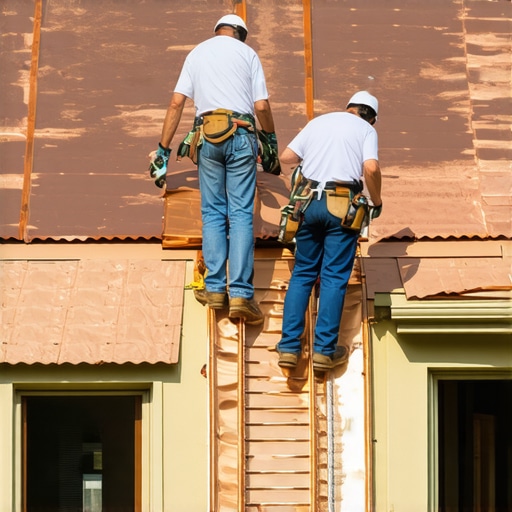
The High Cost of Cheap Metal
Most roofing companies are currently engaged in a race to the bottom. They compete on price, which means they are cutting corners on the one thing that actually keeps your house dry: the flashing. If you are looking at a quote from local roofers and it doesn’t specify the gauge and material of your valleys and chimney transitions, you aren’t buying a roof; you are buying a future headache. I have spent twenty-five years crawling through damp attics, and I can tell you that a shingle rarely fails first. It is the metal that gives up. That is why the 2026 standards for heavy-gauge copper flashing are becoming the benchmark for anyone who actually plans on living in their home for more than a decade.
“A roof is only as good as its flashing.” – Old Roofer’s Adage
My old foreman used to say, ‘Water is patient. It will wait for you to make a mistake.’ He would stand over us while we worked a chimney, making sure every bend was perfect. He knew that water doesn’t just fall; it creeps. It uses capillary action to defy gravity, pulling itself upward between layers of metal and felt if the seal isn’t absolute. When we talk about 2026 copper flashing, we are talking about moving away from the ‘caulk-and-walk’ culture of modern roofing. We are talking about materials that respect the physics of a storm.
1. The Self-Healing Chemistry of Patina
The first benefit of upgrading to 2026-spec copper is its chemical resilience, particularly in high-humidity zones where salt air or constant rain turns galvanized steel into a rusted lace within years. Unlike aluminum or coated steel, copper does not degrade when exposed to the elements; it transforms. When oxygen and moisture hit that surface, a sacrificial layer of copper carbonate—the patina—forms. This isn’t just an aesthetic choice for high-end architecture. That green or deep brown skin is a biological and chemical shield. It stops oxidation in its tracks. While cheap local roofers will try to sell you on ‘triple-coated’ steel, remember that a single scratch during installation exposes the raw iron. Once that happens, the ‘red death’ of rust starts eating your roof from the inside out. Copper doesn’t have that weakness. It is the same material all the way through, meaning even a deep scratch from a fallen branch will simply patina over and seal itself.
2. Malleability and the End of the ‘Shiner’
One of the biggest issues with modern roofing is the ‘shiner’—a nail that misses the structural member or is driven through the flashing in a way that creates a direct leak path. In the 2026 copper installation standards, the focus shifts to integrated joinery. Copper is incredibly malleable compared to the stiff, brittle alloys used in standard ‘drip edge’ kits. This matters when you are dealing with a complex cricket—that small peaked structure behind your chimney designed to divert water. A skilled roofer can shape copper to follow the exact contours of your roof deck, creating a custom-fit barrier that doesn’t rely on massive globs of polyurethane sealant. When you use copper, you can solder the joints. A soldered joint is a molecular bond; it is two pieces of metal becoming one. No amount of ‘lifetime’ caulk can compete with a soldered copper valley. When local roofers use cheap aluminum, they have to rely on mechanical overlaps and tape, which eventually fail when thermal expansion causes the metal to buckle and pull away from the fasteners.
3. Thermal Stability and Stress Management
Roofing materials live in a brutal environment. In the heat of a summer afternoon, your roof deck can hit 160 degrees Fahrenheit. By midnight, it might drop to 70. This constant ‘breathing’—the expansion and contraction of materials—is what kills most roofs. Steel and aluminum have high thermal expansion coefficients, meaning they move a lot. If they are pinned down too tightly by roofing companies who don’t understand the trade, they will eventually ‘oil-can’ or tear at the nail holes. Copper, especially the 20-ounce weight favored in 2026 specs, has a unique relationship with heat. It dissipates thermal energy rapidly and possesses a structural ‘memory’ that allows it to cycle through these temperature swings without becoming brittle.
“The roof shall be covered with a weather-resistant membrane… and flashing shall be installed at wall and roof intersections, at gutters and wherever there is a change in roof slope or direction.” – International Residential Code (IRC) R903.2
If you look at the Square of shingles being installed on your neighbor’s house, you’ll probably see thin, pre-painted aluminum. It looks fine today. But in five years, the paint will chalk, the metal will thin, and the ‘trunk slammer’ who installed it will be long gone. Choosing copper means you are investing in a 50-year solution. It prevents the rotting fascia boards and the moldy insulation that occur when water migrates under the ‘apron’ of the roof. Don’t let a contractor talk you out of it because it’s ‘too expensive.’ Ask them how much a new ceiling in your master bedroom costs. That is the real price of cheap flashing.