
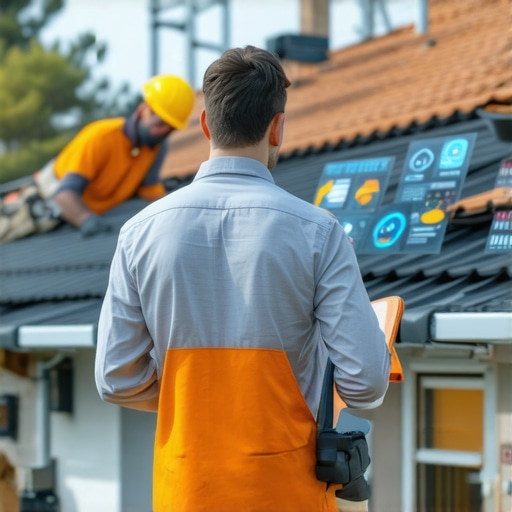
The Hum of the Machine vs. The Rot in the Deck
Walking on that roof felt like walking on a sponge. I knew exactly what I’d find underneath before I even pulled my pry bar from my belt. It was a cold Tuesday morning, the kind where your breath hitches in the air, and the shingles are covered in a fine glaze of frost. The homeowner stood on the driveway, looking up with a face full of hope, but the forensic reality was already written in the way my boots sank. Underneath those shingles, the plywood had the structural integrity of wet cardboard. Why? Because a ‘trunk slammer’ three years ago didn’t understand the physics of an attic bypass, and now the wood was shouting what the homeowner couldn’t see. But as we move toward 2026, the industry is shifting. The cynical old-timers like me are being joined by drones and neural networks that can spot that rot long before it becomes a ‘sponge walk.’
Roofing companies are increasingly leaning on Artificial Intelligence to stop the bleeding—both for their bottom line and your bank account. In the cold corridors of the North, from the wind-whipped streets of Boston to the frozen plains of Minnesota, the enemy is always the same: thermal bridging and the silent creep of ice dams. AI doesn’t just look at a roof; it analyzes the heat signature of a building. When we talk about local roofers using tech, we aren’t just talking about fancy iPads. We are talking about computer vision that can identify a shiner—that missed nail that acts as a conduit for frost—from a drone feed fifty feet in the air.
“A roof system’s performance is highly dependent on the environment and the interaction between the building’s interior and exterior.” – NRCA Manual
The Physics of Failure: Why AI Sees What Humans Miss
Let’s talk about the mechanism of failure. In a cold climate, your roof isn’t just a lid; it’s a thermal regulator. When warm air leaks from your living room into the attic—what we call an attic bypass—it hits the underside of the cold roof deck. This creates condensation. This moisture doesn’t just sit there; it initiates a process of delamination in the plywood. By the time you see a brown spot on your ceiling, the war is already lost. AI-driven thermal imaging allows roofing companies to map these ‘hot spots’ with surgical precision. Instead of guessing where the insulation is failing, the AI highlights the exact coordinates where heat is escaping. This is how we cut repair costs in 2026. Instead of a full tear-off, which might cost you twenty thousand dollars, we perform ‘surgical’ repairs on the specific square of roofing that is actually failing.
Then there is the capillary action. Water is a sneaky devil. It doesn’t just run downhill; it can pull itself uphill through tight spaces between shingles if the pitch is wrong or the starter strip is botched. AI modeling now simulates wind-driven rain patterns against a specific house’s geometry. It tells us that, based on the last five years of local weather data, your specific valley is going to fail in twenty-four months because of the way the wind swirls around your neighbor’s gable. This isn’t crystal ball stuff; it’s probabilistic forecasting that roofing professionals are using to move from reactive ‘fix it when it leaks’ to proactive maintenance.
The 2026 Shift: From Trunk Slammers to Data Scientists
The old way of doing things involved a guy with a ladder and a ‘good enough’ attitude. But ‘good enough’ is why I spend half my life fixing rotted fascia boards. By 2026, the roofing industry will use AI to automate the estimation process, which removes the human error that leads to mid-project ‘surprises’ and price hikes. When local roofers use AI to scan a roof, they get a millimeter-accurate map of every cricket, every vent pipe, and every flashing detail. This means the material order is perfect. No more over-ordering shingles that end up in a landfill, and no more under-ordering that leaves a roof open to the elements for an extra three days while we wait for the supply house.
“Protection against the accumulation of moisture in the attic or under-floor space shall be provided by sensible ventilation.” – International Residential Code (IRC)
Moreover, AI is tackling the ‘warranty trap.’ Most ‘lifetime warranties’ aren’t worth the paper they are printed on because they require perfect installation—something rarely achieved in the real world. AI quality control systems now allow roofing companies to verify every single nail strike via high-resolution photos processed through an algorithm. If a nail is high, or if it’s a shiner, the system flags it instantly. This ensures the manufacturer’s warranty is actually valid, saving the homeowner from a legal nightmare when the shingles start shedding granules five years early.
The Cost of the ‘Free’ Roof and How AI Protects You
We’ve all seen the storm chasers who show up after a hail hit, promising a ‘free’ roof. Their goal is volume, not quality. They ignore the ice & water shield requirements or skip the drip edge to save a few bucks. AI is becoming the homeowner’s best defense here. Insurance adjusters are now using the same AI tools to verify damage. In 2026, if you try to claim a roof is ‘totaled’ based on a few cosmetic bruises, the AI will likely kick it back. Conversely, if there is legitimate structural compromise that a human eye might miss, the AI ensures it’s documented. For local roofers, this transparency builds trust. You aren’t just taking my word for it; you are looking at a data-backed report that shows the exact state of your R-value and the integrity of your roof’s secondary water resistance.
Ultimately, the smell of rotting plywood is a smell I’d like to encounter less often. It represents a failure of craft and a failure of foresight. AI in 2026 is simply the newest tool in the forensic roofer’s kit. It doesn’t replace the need for a man who knows how to swing a hammer, but it ensures he’s swinging it in the right place. By catching thermal bridging, predicting capillary leaks, and ensuring perfect nail placement, we aren’t just repairing roofs; we are extending the life of the home. And in this trade, longevity is the only metric that matters.
This post really opened my eyes to how advanced AI is becoming in the roofing industry. I’ve always been curious about how drone technology and thermal imaging are actually used in regular maintenance or repairs, beyond just marketing. The idea of ‘surgical’ repairs based on pinpoint heat signatures sounds like a game-changer, especially in colder climates where hidden moisture and insulation issues can cause lasting damage. I wonder how well these AI systems can adapt to older, more complex roof structures that have multiple layers and unconventional designs. Has anyone had experience with AI diagnostics revealing problems that traditional inspections missed? I think combining this tech with good craftsmanship could significantly improve the durability of roofs and ultimately save homeowners a lot of money long-term.