
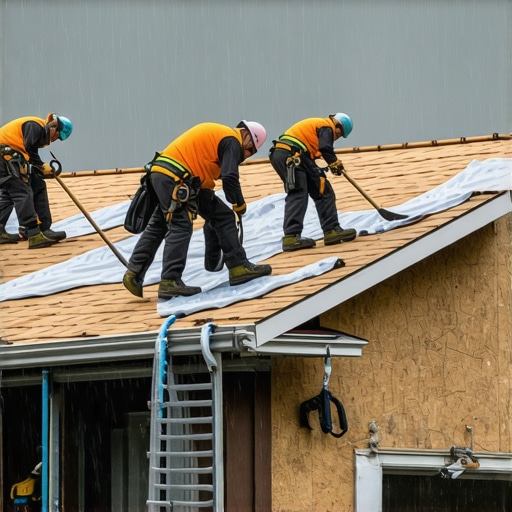
The Forensic Reality of a 2026 Storm Breach
My old foreman used to tell me, “Water doesn’t just fall; it searches for your sins.” He was right. After twenty-five years of pulling up water-logged plywood and tracking the path of destruction from a single missing shingle, I’ve seen that the biggest sins happen in the first hour after the storm stops. By 2026, the frequency of high-velocity wind events has forced roofing companies to evolve past the old ‘blue tarp and a prayer’ method. If your local roofers are still just tossing a plastic sheet over your ridge and nailing 1×2 wood strips directly through your remaining shingles, they aren’t fixing your problem—they are creating ten new ones for the insurance adjuster to argue about.
“The roof shall be covered with approved roof coverings secured to the building or structure in accordance with the provisions of this code.” – International Residential Code (IRC) R903.1
The Physics of the Failure: Why Your Roof is Currently a Sieve
When a storm rips a square of shingles off your deck, the damage isn’t just the missing asphalt. It’s the sudden change in hydrostatic pressure. In the humid, salt-heavy air of coastal regions, water doesn’t just drop into a hole; it uses capillary action to crawl horizontally under the surrounding shingles. This is where the ‘Mechanism Zooming’ comes in. Think about surface tension—that sticky property of water. As wind-driven rain hits the edge of a damaged area, it hitches a ride on the underside of the existing felt paper, traveling three, four, even six feet away from the initial impact point. By the time you see a brown circle on your ceiling, the water has already saturated the insulation and started feeding the mold spores in your attic rafters. This is why 2026 standards for roofing emergency response focus on ‘encapsulation’ rather than just ‘covering.’
The Anatomy of a Professional Tarp Job
Professional local roofers who know their trade won’t just slap a tarp down. They look for the ‘high point.’ A tarp must always be tucked under the ridge cap or run over the peak of the roof to prevent water from simply running behind the top edge of the plastic. If a roofer starts nailing through your good shingles to secure the tarp, fire them on the spot. We call those ‘shiners’—nails that miss the mark or create new leak points. In 2026, the elite crews use sandbag-weighted systems or adhesive-backed membranes that grip the granules without penetrating the deck. These membranes are designed to withstand UV radiation for up to 90 days, which is vital when the supply chain for new shingles is backed up after a major event.
The ‘Trunk Slammer’ Trap: Don’t Let the Panic Cost You $20k
After a big blow, the ‘trunk slammers’ come out in force. These are the guys with a ladder, a roll of cheap poly-tarp, and a silver tongue. They’ll charge you $1,500 for twenty minutes of work that will fail the next time the wind hits 30 mph. A real roofing professional understands ‘Uplift Ratings.’ When wind moves over the peak of your house, it creates a vacuum on the leeward side. This low-pressure zone literally tries to suck the tarp off the roof. If the tarp isn’t properly battened down or weighted, it will flap. That flapping sound isn’t just annoying; it’s the sound of the tarp acting like sandpaper, grinding the remaining granules off your good shingles and destroying their UV protection. You’ll end up needing a full replacement when a simple repair might have sufficed.
“A roof is only as good as its flashing and its temporary defense during a crisis.” – Old Roofer’s Adage
Forensic Investigation: What Happens Under the Tarp
In the 2026 landscape, forensic roofing involves looking at the ‘Secondary Water Resistance’ (SWR). If your local roofers didn’t install a high-quality ice and water shield during the original build, the tarp is your only line of defense. I’ve walked onto roofs where the plywood felt like a wet sponge because the previous ’emergency’ crew didn’t account for the valley. Water converges in those valleys with incredible force. A tarp that isn’t properly ‘weaved’ into the valley will act as a dam, backing water up under the shingles on the opposite slope. It’s a surgical process, not a demolition job. When you’re vetting roofing companies, ask them how they handle the ‘Starter Strip’ and the ‘Drip Edge’ during a temporary wrap. If they look at you like you’re speaking Greek, keep looking for a veteran who knows that the details are what keep the ceiling dry.
The Insurance Game: Documentation is Your Shield
Don’t let a contractor touch your roof without a camera in their hand. Every forensic roofer knows that the ‘before’ photo is worth more than the ‘after.’ You need photos of the impact, the direction of the shingle lift, and the specific cricket or chimney flashing that failed. In 2026, insurance adjusters are looking for any excuse to deny a claim based on ‘improper mitigation.’ If you don’t tarp the roof, they’ll say you allowed the interior damage to happen. If you tarp it poorly, they’ll say the tarp caused the damage. It’s a tightrope walk. You need a contractor who understands the IRC codes and can document that the emergency tarping was done to ‘prevent further damage’ as per the policy requirements. This is the difference between a smooth claim and a two-year legal battle over rotten rafters and ruined drywall.