
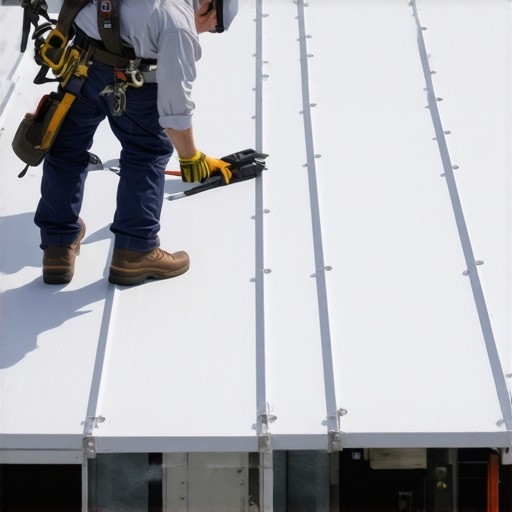
The Forensic Scene: A Ghost in the Attic
Walking on that metal roof felt like walking on a drum skin that was about to burst. From the ground, the client saw a sleek, silver finish—the kind of aesthetic that 2026 homeowners are paying a premium for. But beneath my boots, I felt the unmistakable ‘give’ of a substrate that had been weeping for months. I knew exactly what I’d find underneath before I even pulled a single fastener. When I finally peeled back a section of the transition flashing, the smell hit me: the cloying, damp stench of rotted OSB that had essentially turned into wet tobacco. This wasn’t a material failure; it was a failure of physics at the seam level. This is the reality most roofing companies won’t tell you: a metal roof is a living, breathing organism that expands and contracts with every sunrise. If your local roofers aren’t accounting for that movement in the seam design, you aren’t buying a roof; you’re buying a very expensive sieve.
The Physics of the 2026 Seam: Why Mechanical Locks Fail
In the trade, we talk about ‘oil canning’ as an aesthetic nuisance, but the real devil is thermal expansion. A 50-foot run of 24-gauge steel can move over half an inch as it heats from a cool morning to a 140°F afternoon. If that metal is pinned down by rigid fasteners or a poorly crimped seam, something has to break. Usually, it’s the sealant or the clip itself. Most roofing companies are still stuck in 2010, using basic single-lock standing seams that rely on a 90-degree fold. By 2026, the industry standard has shifted toward the 180-degree double-lock, but even that isn’t the whole story. We are now seeing the integration of high-viscosity, non-skinning butyl sealants injected directly into the female leg of the panel before it ever leaves the brake. This isn’t just a barrier; it’s a hydrostatic gasket that allows the metal to slide while maintaining a vacuum-tight seal against wind-driven rain. When water hits a seam, capillary action tries to pull that moisture upward into the lap. Without a continuous, unbroken bead of sealant, that water eventually finds a ‘shiner’—a missed or poorly driven nail—and begins the slow process of eating your decking from the inside out.
“A roof is only as good as its flashing, and a metal roof is only as good as its ability to move without screaming.” – Old Roofer’s Adage
The Material Truth: Gauge, Coating, and the Myth of ‘Lifetime’
I’ve spent 25 years watching ‘Lifetime Warranties’ vanish into the ether when a company goes bankrupt or blames ‘acts of God.’ If you want a roof that actually lasts until 2076, you have to look at the chemistry of the seam. We’re moving away from cheap polyester finishes and toward PVDF coatings like Kynar 500. Why does this matter for the seam? Because when you fold metal at a tight radius, the coating can microscopically crack. In salt-air environments—like what we see in many coastal roofing projects—those micro-fissures are the entry point for galvanic corrosion. 2026 roofing companies are now utilizing ‘floating’ clips. These clips are two-piece assemblies that allow the roof pan to move independently of the structure. If your contractor is still ‘pinning’ the eaves with exposed fasteners, they are creating a ticking time bomb. Every time that metal moves, it’s sawing through the fastener’s neoprene washer. Eventually, that hole becomes a leak. It’s not a matter of if, but when.
[image_placeholder_1]
Mechanism Zooming: The Micro-Dynamics of Water Ingress
Let’s talk about the ‘drag load.’ This is the force of snow, ice, or even heavy rain pulling on the seams as it slides toward the gutter. In the old days, we just put more screws in. Today, forensic roofing reveals that over-fastening is the primary cause of seam failure. When the panel is restricted, it buckles. This buckling creates ‘fish-mouths’ in the seam—tiny gaps where the metal has pulled away from the sealant. Once a fish-mouth forms, the roof is compromised. Wind-driven rain can be pushed upward at pressures exceeding 40 PSF (pounds per square foot), forcing water through a gap no thicker than a business card. This is why the 2026 standard requires a continuous cleat at the eave. A cleat allows the panel to hook onto the edge of the building without being pierced by a single screw. It’s clean, it’s expensive, and it’s the only way to ensure the roof doesn’t unzip during a high-wind event. Most local roofers will skip the cleat because it takes an extra hour per square to install. That hour is the difference between a 50-year roof and a 10-year repair cycle.
“Roofing assemblies shall be designed to resist the design wind pressures… and shall be installed in accordance with the manufacturer’s instructions.” – International Building Code (IBC) Section 1504.1
How to Vet 2026 Roofing Companies
If you’re interviewing roofing companies, stop asking about the price per square and start asking about their seaming equipment. If they pull out a hand crimper for a 200-square job, show them the door. Professional outfits in 2026 use robotic, self-propelled seamers that apply a consistent 200 foot-pounds of torque to every inch of the rib. This ensures that the butyl sealant is compressed evenly, creating a true monolithic barrier. Ask them about their ‘thermal movement’ calculations. If they look at you like you have three heads, they aren’t forensic-level pros; they’re just shingles-slingers who bought a roll-former. A real pro will talk to you about ‘drag plates’ and ‘expansion joints.’ They’ll explain how they handle the ‘cricket’ behind the chimney to ensure water isn’t just diverted, but managed. In this trade, water is patient. It will wait years for a seal to dry out or a clip to fatigue. Your only defense is a seam that was engineered, not just installed.
The Cost of the ‘Cheap’ Alternative
I’ve spent more time in 140°F attics than I care to admit, usually looking at the underside of a ‘cheap’ metal roof. What I see most often is ‘under-deck condensation.’ Because metal is a highly conductive material, it gets cold fast. If the roofing companies didn’t install a high-temp ice and water shield (not the cheap sand-surface stuff, but the synthetic, self-healing membranes), the underside of that metal will sweat. That sweat drips onto the rafters, feeds the mold, and rots the structure while the metal on top still looks brand new. This is why the seam and the underlayment are a single system. You cannot have one without the other. In 2026, the best roofers are using ‘breatheable’ synthetic underlayments that allow trapped moisture to escape while still acting as a secondary water barrier. It’s complex, it requires precision, and it’s why the ‘lowest bid’ is almost always a death sentence for your home’s equity.