
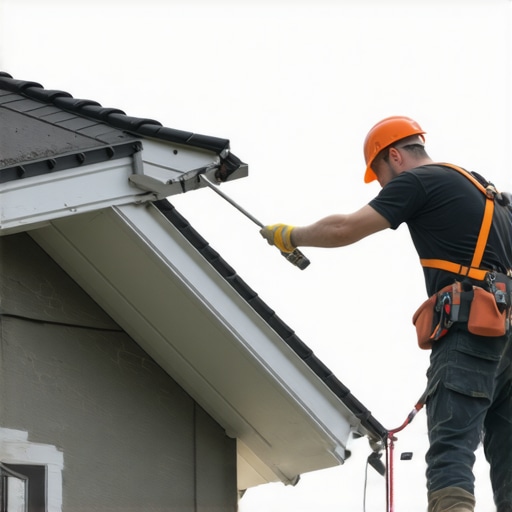
The Anatomy of a Failed Gable: A Forensic Scene
Walking on that roof felt like walking on a sponge. I knew exactly what I’d find underneath. It was a 2024 build in a high-wind corridor, but the local roofers who slapped it together treated the gable ends like an afterthought. I pulled back a single square of shingles at the rake edge, and the truth was ugly. The starter course hadn’t been set in a bed of mastic, and the ‘shiners’—those missed nails—were weeping rust into the sub-fascia. The wind had already started the slow process of peeling that roof back like a sardine can. When 2026 roofing companies talk about securing a gable end, they aren’t just talking about extra nails; they are talking about surviving a vortex.
The Physics of the Gable Failure: Why the Rake is Your Roof’s Weakest Link
To understand why roofing is evolving, you have to understand the physics of failure. Most people think a roof fails because the wind blows ‘down’ or ‘across.’ In reality, a gable end is a victim of negative pressure. As wind hits the windward wall of a house, it travels up and over the peak. This creates a low-pressure zone—a vacuum—directly over the gable overhang. This is the Bernoulli principle in action, and it is the reason your shingles want to take flight. If the edge isn’t sealed, the wind catches the underside of the shingle, and the resulting leverage can pull a 2-inch ring-shank nail right through the plywood. We call this ‘unzipping.’ Once the first shingle goes, the rest follow in a catastrophic chain reaction. The 2026 standards focus on this ‘rake edge’ because that is where the fight is won or lost.
“A roof is only as good as its flashing.” – Old Roofer’s Adage
Mechanism Zooming: Capillary Action and the Hidden Rot
It’s not just the wind. It’s the water. When rain hits a gable end, it doesn’t just run off; it clings. Through capillary action, water moves sideways, defying gravity to find a way under the drip edge. If your roofing companies didn’t install a proper D-style drip edge with a 1/2-inch kick-out, that water is wicking directly into the barge board and the ends of the rafters. I’ve seen 20-year-old homes where the gable outriggers were so soft I could poke a screwdriver through them. By 2026, the industry has shifted toward ‘fully adhered’ rake edges. This means the underlayment isn’t just tacked down; it’s fused to the deck, creating a secondary water barrier that keeps the wood dry even when the shingles are compromised. This is the difference between a roof that lasts and one that turns into a liability after five years.
The 2026 Security Protocol: Integrated Sheathing and Structural Screws
The days of just using a few extra nails at the gable are over. The International Residential Code (IRC) has pushed for better continuous load paths, and 2026 roofing practices reflect that. We are seeing the rise of integrated sheathing systems where the water-resistive barrier is built into the wood. But the real shift is in the fastening. Modern crews are moving away from smooth-shank nails at the perimeter and toward structural screws and ‘hurricane’ clips that tie the gable truss directly to the wall plate. This prevents ‘racking’—that slight swaying of the gable wall during a storm that causes shingles to crack and sealants to fail. If you aren’t seeing your local roofers check the bracing in the attic before they start shingling, they aren’t doing a 2026 job.
“Roofing assemblies shall be designed to resist the wind loads as specified in this code.” – IRC Building Code R905.1
The Trap of the ‘Lifetime’ Marketing Pitch
Don’t get fooled by a glossy brochure promising a ‘Lifetime Warranty.’ In the trade, we know those warranties are often written to protect the manufacturer, not the homeowner. They cover ‘manufacturing defects,’ but they rarely cover ‘improper installation,’ which accounts for about 95% of the failures I investigate. A 2026-standard installation focus on the ‘starter strip.’ This is a heavy-duty shingle strip installed specifically along the eaves and rakes. If a roofer tells you they just ‘flip a regular shingle upside down’ to make a starter, fire them on the spot. That old-school shortcut creates a hump that prevents the first course of shingles from sealing properly, leaving the gable vulnerable to the first 40-mph gust that comes along.
How to Spot a Real Professional in the 2026 Market
When you are vetting roofing companies, stop looking at the price per square and start looking at their detail work. Ask them about their ‘uplift ratings.’ A real pro will talk about ‘nailing patterns’ and ‘sealant compatibility.’ They’ll know that in high-wind zones, you need six nails per shingle instead of the standard four, and those nails must be placed exactly in the ‘common bond’ area to provide the maximum pull-through resistance. If they don’t mention the gable end specifically, they aren’t thinking about the long-term health of your home. You want someone who treats every rake edge like a fortress wall. The cost of doing it right is high, but the cost of a gable-end failure—which often involves the entire end wall of your house blowing out—is astronomical. Protecting your home means understanding that water and wind are patient; they will wait for the one shingle your contractor rushed.