
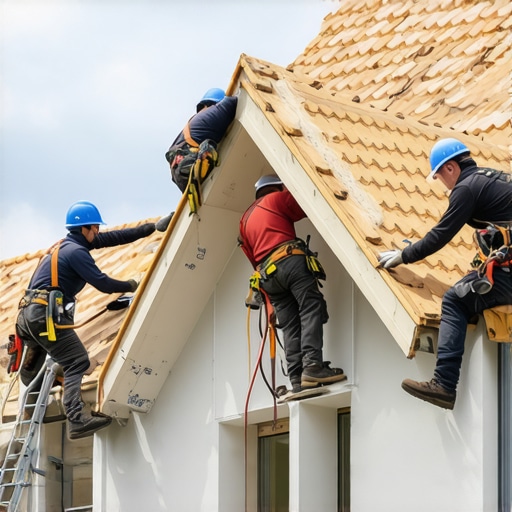
The Anatomy of a Rake Failure: Why Your Roof Edge is Screaming
Walking along the rake of a high-pitched Tudor in a wind-battered coastal town last November, the deck felt like a wet sponge under my boots. From the ground, the roof looked pristine—expensive architectural shingles, copper flashing, the works. But as a forensic investigator, I knew the smell of rotting oriented strand board (OSB) doesn’t lie. I peeled back the starter strip at the gable edge and found exactly what I expected: the wood had turned into a consistency resembling wet mulch. This wasn’t a material failure; it was a physics failure. Most local roofers treat the gable edge as an afterthought, but in the 2026 climate of increased pressure differentials and erratic storm cells, that edge is the frontline of your home’s defense.
The Mechanics of Destruction: Capillary Action and Wind Uplift
To understand why 2026 roofing companies are changing their approach, you have to understand the two-headed monster of the gable edge: Capillary Action and Bernoulli’s Principle. When rain hits the side of your house, it doesn’t just run down. Surface tension allows water to ‘climb’ between the shingles and the drip edge. This is capillary action. If your contractor didn’t provide a proper 1/2-inch overhang or used a cheap, undersized drip edge, that water is wicked directly into the fascia and the edge of the roof deck. It’s a slow-motion execution of your plywood.
“A roof is only as good as its flashing.” – Old Roofer’s Adage
Then there’s the wind. As wind hits the vertical wall of your house and shoots upward, it accelerates over the gable edge. This creates a low-pressure zone—essentially a vacuum—that tries to rip the shingles right off the deck. If the 2026 gable edge isn’t secured with specific adhesive-backed starter shingles and a rigid metal perimeter, that wind will find a ‘shiner’ (a nail that missed the rafter) and use it as a pivot point to peel your roof like an orange.
The 2026 Standard: Beyond the Minimum Code
In the trade, we talk about ‘Squares’ and ‘Crickets,’ but at the gable, we talk about Total Perimeter Integrity. The 2026 approach adopted by elite roofing companies involves a three-layer defense system. First, the Ice & Water shield isn’t just slapped on the eaves; it is wrapped over the rake edge and down the fascia by at least two inches. This creates a secondary water barrier that ensures even if the metal fails, the wood stays dry. Second, the drip edge must be a heavy-gauge (24-gauge or thicker) aluminum or steel with a ‘kick-out’ flange that forces water away from the building. Most trunk slammers use flimsy .019-gauge metal that kinks if you look at it wrong.
The Physics of the ‘Double Starter’ Technique
Why do we see so many gable failures? It’s often the nail pattern. A standard roofer might put four nails in a shingle and call it a day. A forensic-grade 2026 install requires an enhanced nailing schedule at the rake. We’re talking about nails every 6 inches within the first 12 inches of the edge. But nails alone won’t stop a 110-mph gust. The secret is the ‘Double Starter.’ By installing a specialized starter shingle both at the eave AND up the rake, you create a continuous bead of factory-applied sealant that bonds the field shingles to the perimeter. This turns the entire roof edge into a monolithic unit. When I see a roof where the shingles are flapping in a light breeze, I know they skipped the rake starter.
“Properly designed roof perimeters are the primary defense against catastrophic wind-driven rain infiltration.” – International Residential Code (IRC) Commentary
The Forensic Scene: Diagnosing Your Contractor
If you’re hiring roofing companies today, ask them about their ‘Rake-to-Fascia’ transition. If they look at you like you have three heads, move on. A professional knows that the ‘Valley’ and the ‘Gable’ are the two most common points of catastrophic failure. Look for ‘shiners’ in your attic. If you see nails poking through the thin air next to your rafters at the edge of the house, you have a structural liability. Those missed nails act as thermal bridges, attracting condensation in the winter and rotting the wood from the inside out. In a 2026 forensic-grade install, every nail at the gable edge is calculated, hitting the ‘meat’ of the lumber every single time.
The Cost of Cheapness at the Edge
Saving $500 on a ‘basic’ roof install by skipping the high-end gable security is the most expensive mistake a homeowner can make. When that rake edge fails, it isn’t just a leak; it’s a structural repair of the ladder framing and the fascia. You’re no longer looking at a roofing job; you’re looking at a framing job. As a veteran who has spent decades smelling the rot of ‘good enough’ work, I can tell you that the 2026 gable edge is where the men are separated from the boys in the roofing world. Don’t let a ‘trunk slammer’ turn your home’s most vulnerable point into a sponge.