
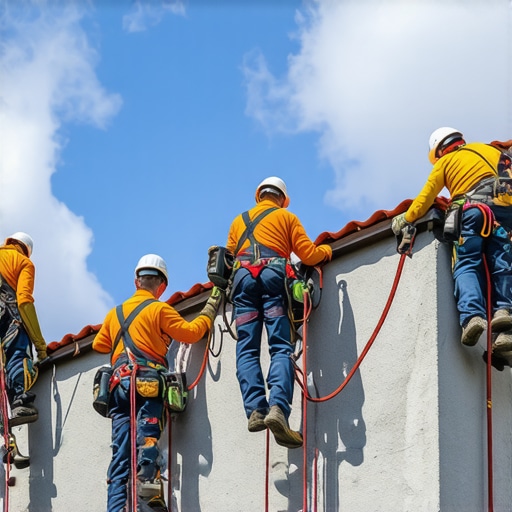
The Vertical Battlefield: A Forensic Look at High-Pitch Roofing
Stepping onto a 12/12 pitch roof at seven in the morning isn’t a job for the faint of heart; it’s an exercise in physics and friction. Walking on that roof felt like trying to navigate a greased glass mountain. I knew exactly what I’d find underneath before the first shingle was ever pried loose. The homeowner was complaining about a persistent drip over the master suite, but the ‘pros’ they hired previously couldn’t find a thing. They looked for holes. I looked for gravity. On a high slope, water doesn’t just fall; it accelerates. It gains kinetic energy, and if your local roofers haven’t accounted for the sheer velocity of runoff, that water will find a way to migrate upward through capillary action or sideways across a poorly placed starter strip.
The Physics of the Waterfall Effect
In 2026, roofing companies are finally waking up to the reality that high-slope architecture requires more than just extra harness points. When you have a roof with a steep incline, you’re dealing with the ‘Waterfall Effect.’ During a heavy downpour, the volume of water hitting the ridge is compounded by every square inch of surface area as it races toward the eaves. By the time that water reaches the bottom third of the roof, it’s a rushing torrent. If the head lap—that’s the overlap between shingle courses—isn’t precisely executed, the hydrostatic pressure of that rushing water can actually force liquid up and under the shingles. Most roofing companies ignore this, assuming gravity does all the work. It doesn’t. Wind vortices at the peak of a steep roof create low-pressure zones that literally suck water into the attic through standard ridge vents if they aren’t baffled correctly.
“Underlayment for steep-slope roof systems shall be applied in accordance with the manufacturer’s installation instructions and the requirements of this section.” – International Residential Code (IRC), Section R905
The problem is ‘shiners.’ A shiner is a nail that missed the rafter or was driven into the gap between plywood sheets. On a flat roof, a shiner is a nuisance. On a high slope, it’s a disaster. As heat rises into the attic—especially in the 140-degree summers we’ve been seeing—that metal nail becomes a condenser. Moisture in the attic air hits that cold nail (cooled by the outside breeze) and drips. Because the roof is so steep, that drip doesn’t just fall straight down; it runs down the underside of the deck, rotting out the fascia boards and the soffit from the inside out. You won’t see the damage for five years, but by then, your ‘local roofers’ are long gone, and your decking has the structural integrity of wet cardboard.
The Material Truth: Beyond the Marketing Glitz
Don’t let a salesman talk you into a ‘Lifetime Warranty’ without reading the fine print. In the world of high-slope roofing, most warranties are voided the second a contractor uses the wrong fastener pattern. For steep pitches, the standard four-nail pattern is a death sentence. You need six, sometimes eight nails per shingle, driven perfectly perpendicular to the deck. If a nail is driven at an angle, the head of the nail creates a tiny ‘ramp’ that lifts the shingle above it, breaking the thermal seal. Once that seal is broken, a 40-mph wind will catch that shingle like a sail. I’ve seen entire squares of shingles peel off a high-slope roof because the installer was too lazy to adjust their pneumatic pressure for the incline.
“A roof system’s longevity is dictated not by its primary shedding material, but by the integrity of its transition points and fasteners.” – NRCA Manual
The 2026 Standard: Underlayment and Thermal Defense
Modern roofing companies in 2026 are shifting toward high-temp synthetic underlayments. Old-school felt paper is dead—or it should be. On a steep slope, felt paper wrinkles. Those wrinkles create ‘dams’ under your shingles. In 2026, we use cross-linked polymer underlayments that grip the deck like a second skin. This is vital because of thermal expansion. Your roof isn’t a static object; it’s a living thing that expands and contracts. On a steep pitch, the weight of the shingles is constantly pulling downward. If your underlayment doesn’t have the shear strength to resist that pull, the shingles will eventually ‘slump,’ opening up gaps at the ridge. Look for local roofers who understand the ‘Cricket’—a small false roof structure built behind chimneys. On a high slope, a chimney is a dam. Without a properly flashed cricket to divert the water, you’re just waiting for a flood.
How to Vet Your Local Roofers
If you’re hiring for a high-slope project, ask to see their ‘Toe Board’ policy. If they aren’t using mechanical fall protection and are just ‘winging it’ on their boots, they’re going to rush the job. Rushed jobs lead to crooked courses and missed nails. A quality roofing outfit will treat your high-slope project like a surgical procedure, not a race. They’ll talk about ‘Starter Strips’ and ‘Drip Edges’ rather than just ‘Colors’ and ‘Financing.’ The real pros know that a roof is a system, and on a steep pitch, that system is under constant tension. Don’t settle for a ‘trunk slammer’ who gives you a quote over the phone. You need a forensic-minded contractor who actually climbs the ladder and checks the integrity of your chimney flashing and valley transitions. Anything less is just a very expensive Band-Aid.