
The Sound of a Sinking Investment: The Physics of Flat Roof Failure
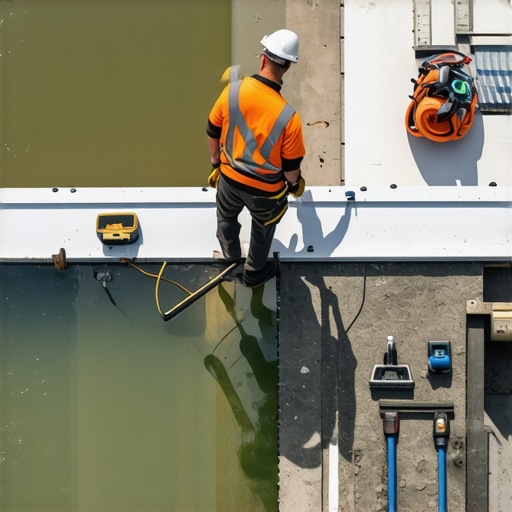
Walking on that roof felt like walking on a sponge. I knew exactly what I’d find underneath. It was a 12,000-square-foot commercial deck in the middle of a rainy season, and the center of the roof had bowed so significantly that a mallard duck had decided to make a home in the three-inch-deep basin of standing water. This isn’t just an eyesore; it is a structural ticking clock. Most roofing companies will tell you that a little water is fine, but as a forensic investigator, I can tell you that water is the ultimate solvent. It doesn’t just sit there; it attacks. When we talk about ponding—defined as water that remains on a roof for more than 48 hours—we are talking about the slow-motion collapse of your building’s primary defense system.
The Forensic Autopsy: Why Gravity Always Wins
Water weighs roughly 62.4 pounds per cubic foot. When your roof fails to achieve positive drainage, that weight begins to deflect the structural joists. This creates a vicious cycle: the water sits, the weight causes the roof to sag further, and the ‘bowl’ gets deeper, inviting even more water to collect. This is where hydrostatic pressure comes into play. Unlike a sloped roof where water sheds via gravity, a ponding roof forces water to sit against seams and flashings. Eventually, that pressure finds a ‘shiner’—a missed nail or a poorly heat-welded seam—and the capillary action begins. Water doesn’t just leak; it travels sideways through the insulation, turning your expensive R-value into a soggy, heavy mess that rots the decking from the inside out.
“Waterproofing is the result of a total system approach, where the design of the drainage system is as vital as the membrane itself.” – NRCA (National Roofing Contractors Association) Manual
The Anatomy of the Fix: Band-Aids vs. Surgery
When you call local roofers to look at a ponding issue, you’ll get two types of answers. The ‘Trunk Slammer’ will suggest a coating. They want to slop some silicone over the pond and tell you it’s ‘waterproof.’ That’s a Band-Aid on a gunshot wound. Silicone might stop the leak for a season, but it does nothing to address the structural deflection or the weight load. Real roofing involves ‘The Surgery.’ This means stripping the membrane back to the substrate to see how much of the plywood or metal deck has been compromised. We look for ‘crickets’—small peaked structures built to divert water around chimneys or curbs—and evaluate the existing sump areas around the drains.
Tapered Insulation: The 2026 Gold Standard
Modern roofing companies are moving away from flat builds entirely. The fix for a ponding roof in 2026 is almost always a custom-engineered tapered insulation system. We use blocks of polyisocyanurate (Polyiso) cut at a specific slope—usually 1/8″ or 1/4″ per foot—to create an artificial grade. It’s like building a mini-mountain range on top of your flat deck. This ensures that every drop of water is funneled toward a scupper or an internal drain. If your roofer isn’t talking about a ‘tapered layout plan’ or ‘sloped fill,’ they are just guessing with your money. We don’t guess; we use lasers to map the low spots and build the slope accordingly.
The Scupper and Drain Reality Check
Often, the problem isn’t the roof surface at all; it’s the exit strategy. I’ve seen countless ‘professional’ roofing jobs where the scupper was installed two inches above the actual roof line. It’s a physical impossibility for that water to drain. In 2026, we are seeing a shift toward oversized primary drains and secondary ‘overflow’ scuppers. The building code is clear on this, yet many roofing companies ignore it to save on plumbing costs. If your primary drain clogs with leaves and you don’t have a functional overflow, your roof becomes a swimming pool. When that happens, the structural integrity of the entire building is at risk. We’re talking about thousands of pounds of unplanned load on the trusses.
“Roof drainage systems shall be sloped to allow the flow of water to a drain or scupper to prevent accumulation.” – International Residential Code (IRC) Section R903.4
Choosing Your Battles: Material Truths
The material you choose to fight ponding depends heavily on your climate. In high-UV environments, a ponding area acts like a magnifying glass, cooking the membrane underneath and causing it to become brittle and crack. EPDM (rubber) is notorious for shrinking at the seams when submerged for long periods. TPO (Thermoplastic Polyolefin) is better but requires impeccable heat-welding. For 2026, many experts are leaning toward PVC membranes for flat areas because the seams are chemically fused, making them virtually one continuous sheet. It’s more expensive per square, but when you consider the cost of a structural failure, the price becomes irrelevant. Don’t let a salesman talk you into a ‘lifetime’ asphalt roof for a flat deck; asphalt and standing water are natural enemies. The oils in the bitumen will eventually emulsify, and the roof will dissolve like a sugar cube in coffee. If you want a roof that lasts, you invest in the engineering of the slope first and the quality of the membrane second. That is the only way to stop being a landlord to a flock of ducks and start being a building owner with a dry ceiling.