
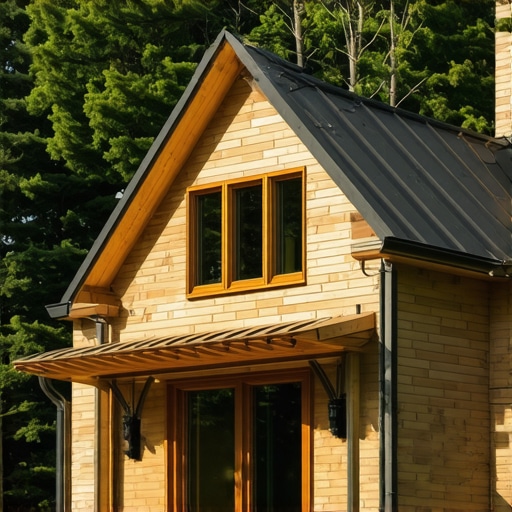
The Material Truth About the Green Roof Revolution
I have spent twenty-five years crawling over steep-slope gables and flat-deck nightmares, and if there is one thing I have learned, it is that the roofing industry loves a shiny new gimmick. Most local roofers will try to sell you the same old petroleum-based asphalt shingles because they are fast to slap down and even faster to fail. But lately, my phone has been ringing with homeowners asking about ‘recycled wood’ roofing. Now, I am a cynical man. I have seen ‘revolutionary’ materials turn into a soggy mess of delaminated pulp in less than a decade. However, recycled wood—whether we are talking about reclaimed timber shakes or advanced wood-fiber composites—is different. It is not just about being a tree-hugger; it is about physics. My old foreman used to say, ‘Water is patient. It will wait for you to make a mistake.’ In the damp, salt-heavy air of the Northeast, that mistake usually involves choosing a material that cannot breathe. Recycled wood products, specifically those engineered from post-industrial waste, offer a structural density that raw, new-growth cedar simply cannot match. When you look at a roof through a forensic lens, you stop seeing ‘curb appeal’ and start seeing a thermal envelope. Most people do not realize that the wood fibers in these recycled products have often been pressurized or infused with resins that make them nearly impenetrable to the capillary action that sucks moisture into a standard shingle. This article is not a sales pitch; it is an autopsy of why this material works and where roofing companies usually screw it up.
“A roof is only as good as its flashing.” – Old Roofer’s Adage
1. Dimensional Stability and the Death of the ‘Shiner’
The first benefit of recycled wood roofing is dimensional stability. In my career, I have seen thousands of roofs fail because of thermal expansion and contraction. In places like Boston or Buffalo, the temperature swings are brutal. A standard wood shingle will swell when it is soaked and shrink when the sun hits it. This constant movement puts immense stress on the fasteners. Eventually, you get a ‘shiner’—a nail that has been backed out of the deck by the moving wood, creating a direct conduit for water to reach the attic. Recycled wood composites are engineered to stay still. Because the fibers are oriented in a multi-directional matrix during manufacturing, they do not have a ‘grain’ that wants to curl or cup. When roofing professionals install these, they are working with a product that does not fight the nails. This stability means your flashing stays seated and your shingle lifting risks are mitigated. I have walked on thirty-year-old reclaimed wood roofs that were flatter than a pool table, while the asphalt house next door looked like a bag of potato chips. The density of these recycled fibers also prevents the common issue of plywood delamination because the shingles themselves act as a more effective thermal buffer, preventing the attic from becoming an oven that bakes the glue out of your decking.
2. High Thermal Resistance (R-Value) and Attic Physics
The second benefit is something your utility company does not want you to understand: R-value. Asphalt is essentially a thin sheet of oil and rocks. It absorbs heat and radiates it directly into your living space. Recycled wood, however, is a natural insulator. The cellular structure of wood—even when recycled—is full of tiny air pockets. These pockets slow down the transfer of heat. In a forensic investigation of a high energy bill, the roof is always the primary suspect. By using a thicker, recycled wood product, you are creating a ‘thermal break.’ This prevents the heat in your attic from escaping in the winter and keeps the summer sun from turning your upstairs into a sauna. When local roofers install these systems with proper ventilation, the result is a roof that actually pays for itself. If you are worried about energy loss, you should also look into 3 reasons to choose recycled tiles as an alternative. The physics of the ‘Mechanism Zoom’ here is simple: heat moves through solids faster than it moves through the air-trapping fibers of reclaimed wood. This insulation factor reduces the ‘thermal shock’ to the structure, which is the leading cause of premature roof failure in cold climates where ice dams are the enemy.
“The building envelope must be designed to manage moisture, not just block it.” – Building Science Axiom
3. Superior Decay Resistance Through Resin Infusion
The third benefit is the most controversial: longevity. People think ‘wood’ means ‘rot.’ But recycled wood products are often ‘over-engineered.’ Many of these shingles are made by taking wood waste, grinding it down, and mixing it with UV-resistant polymers or natural resins. The result is a material that has the soul of wood but the skin of a tank. While a cheap cedar shake will start to grow silver hair and moss within five years, recycled wood composites are often treated to be hydrophobic. This means water beads off the surface instead of soaking into the fiber. I have seen roofing companies get called back to jobs because they didn’t account for the weight of traditional wood, but recycled options are often lighter and stronger. They resist the growth of algae and fungi that eat away at the lignin in natural wood. If you see streaks on your neighbors’ roofs, that is Gloeocapsa Magma—a bacteria that eats limestone filler in asphalt. It cannot eat recycled wood composite. This resistance to biological decay is why these materials often carry warranties that actually mean something, unlike the ‘limited lifetime’ nonsense found on a bundle of cheap shingles. You won’t find yourself needing fixes for rotted roof decking nearly as often with a system that manages moisture this effectively.
The Trap: Why Your Roofer Will Try to Talk You Out of It
Here is the cynical truth: most local roofers do not want to install recycled wood. It takes longer. It requires a cricket at every chimney and a valley that is flashed with copper or heavy-duty aluminum, not just some woven shingles. They want to get in and out in a day. They don’t want to deal with the specific fastener requirements or the custom ridge caps. They will tell you it is ‘too expensive’ or ‘hard to find.’ What they really mean is that it cuts into their volume-based business model. But if you are looking for a roof that will still be there when your grandkids are paying the mortgage, you have to look past the easy choice. You have to demand a material that respects the physics of your climate. Whether you are dealing with wind-driven rain or three feet of snow, the cellular resilience of recycled wood is a formidable defense. Don’t let a ‘trunk slammer’ convince you that a 30-year asphalt shingle is the same thing; it is not. One is a temporary cover; the other is a permanent investment in your home’s envelope. If you’re seeing signs of trouble already, like hidden shingle lifting, it might be time to stop patching a sinking ship and start looking at a material that actually works with nature instead of against it.