
The Forensic Scene: When the Deck Screams
Walking on that roof felt like walking on a sponge. I knew exactly what I’d find underneath before the first core sample was even pulled. It was a sprawling 300-square warehouse in the heart of a Texas summer. The thermometer on my vest read 154°F at the surface. Every step I took on that old modified bitumen felt squishy, not because of water—at least not yet—but because the asphalt had literally reached its softening point. The oils were migrating, the granules were sinking, and the entire system was essentially cooking itself from the top down. This is the reality most facility managers miss until the ceiling starts dripping on their expensive inventory. They think a roof is just a lid. In reality, it’s a high-stakes physics experiment that many local roofers are failing to solve because they’re stuck in 1995. When we talk about commercial roofing, we aren’t just choosing a color; we are choosing how we manage thermal energy and material degradation over a twenty-year cycle.
“A roof is only as good as its flashing.” – Old Roofer’s Adage
The Physics of Thermal Shock: Why Traditional Methods Are Cracking
In the Southwest, the primary enemy isn’t rain; it’s the sun. Traditional built-up roofing (BUR) or heavy granulated cap sheets are massive heat sinks. They absorb UV radiation like a sponge absorbs water. During the day, that dark surface expands. We call this thermal expansion. At night, when the desert air drops 40 degrees in an hour, the membrane contracts violently. This is thermal shock. Over years, this cycle shears the fasteners and pulls the membrane away from the parapet walls. I’ve seen local roofers try to slap a bit of mastic on a pulling seam, but that’s like putting a band-aid on a gunshot wound. The material itself has lost its elasticity because the UV rays have shattered the polymer chains that kept it flexible. Eventually, you get a ‘shiner’—a nail or fastener that’s backed out and poked through the membrane because of this constant movement. If you’re seeing this, you’re likely looking at decking that is starting to sag from underlying heat fatigue and moisture trapped in the insulation.
The Cool Roof Anatomy: Reflection vs. Absorption
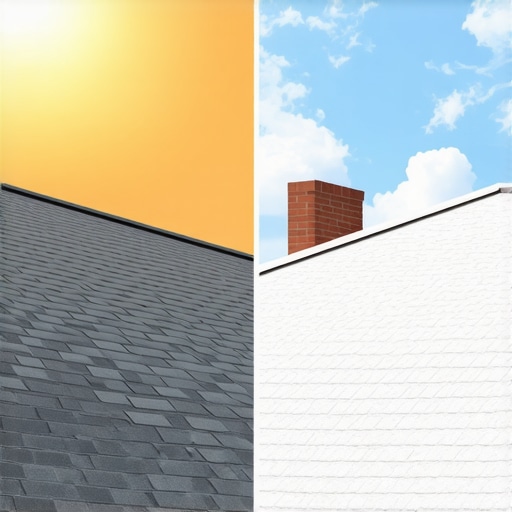
Cool roofs, typically TPO (Thermoplastic Polyolefin) or PVC (Polyvinyl Chloride), operate on a different logic. Instead of fighting the heat by being thick and heavy, they reflect it. A high-quality white TPO membrane can reflect upwards of 80% of solar radiation. While that old asphalt roof is 150°F, the cool roof next door is sitting at a comfortable 100°F. This isn’t just about saving a few bucks on the AC bill; it’s about preserving the structural integrity of the entire building. When the membrane stays cool, the adhesive stays stable and the insulation underneath doesn’t undergo ‘off-gassing’ or shrinkage. However, don’t let a slick salesman tell you it’s a ‘set it and forget it’ system. You still need a proper 2026 roof maintenance plan to ensure the seams—which are heat-welded rather than glued—aren’t being compromised by ponding water or structural settling.
[image placeholder]
Mechanism Zooming: The Capillary Action of a Failed Seam
When a traditional roof fails, it usually starts at the ‘valley’ or a transition. Water is patient. It uses capillary action to find the tiniest microscopic void in a lap seam. Once it gets under that top layer, it doesn’t just sit there. It travels sideways through the fiberboard or polyisocyanurate insulation. I’ve seen leaks that manifest 50 feet away from the actual hole. That’s why roofing companies who just ‘patch’ spots are often chasing ghosts. In a cool roof system, specifically PVC, the seams are chemically fused. If done right, the seam is actually stronger than the membrane itself. But if the crew was rushing and the welder wasn’t at the right temperature, you get ‘cold welds.’ They look fine to the naked eye, but under a probe, they pop right open. This is why you need to ask roofing companies about who is actually doing the work—is it a trained tech or a day laborer who doesn’t know a TPO welder from a hair dryer?
“The primary purpose of a roof is to shed water, but its secondary purpose is to protect the insulation that keeps the building alive.” – NRCA Manual Section 4
The Warranty Trap: Marketing vs. Material Science
I get tired of hearing about ‘Lifetime Warranties.’ In the commercial world, a 20-year NDL (No Dollar Limit) warranty is the gold standard, but it’s often used as a shield by subpar roofing companies. They install the roof poorly, then point to the manufacturer’s warranty when things go south. But guess what? Most manufacturer warranties don’t cover ‘workmanship’ after the first two years, and they definitely don’t cover ‘consequential damage.’ If your roof leaks and ruins a million dollars of electronics, the manufacturer might give you a roll of TPO to fix the hole, but they aren’t paying for your servers. This is why the forensic side of me tells you to ignore the shiny brochure and look at the ‘cricket’ design. A cricket is a small diverted built into the roof to push water toward the drains. If your roofer isn’t talking about drainage and slope, they aren’t building a roof; they’re building a swimming pool on top of your business. If you ignore the drainage, you’ll eventually see fascia paint peeling or worse, structural rot.
The Verdict: Choosing Your Method
If you are in a climate with extreme UV, the Cool Roof is the clear winner for longevity and energy efficiency. Traditional methods like BUR still have their place—specifically on roofs with heavy foot traffic or grease discharge (like restaurants)—because those systems are thick enough to handle the abuse. But for the average warehouse or office complex, the ‘old way’ is just an expensive way to bake your building. When vetting local roofers, don’t just ask for a quote per square. Ask for a thermal map of your current deck and a detailed plan on how they intend to handle the penetrations. If they don’t mention sealing roof pipes properly with pre-molded boots rather than just ‘gooping’ them with pitch, show them the door. Your roof is a system of layers, not a single sheet of plastic. Treat it like a forensic puzzle, and you might actually get twenty years out of it.