
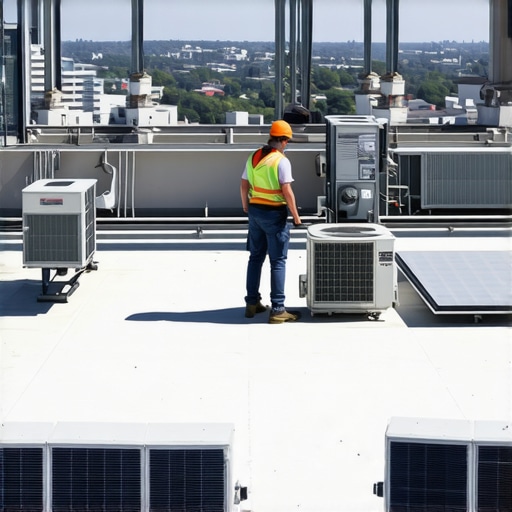
The Anatomy of a Soaked Deck: Why Your Commercial Equipment is Killing Your Roof
Walking on that roof felt like walking on a sponge. I knew exactly what I’d find underneath—not just water, but a fermented soup of stagnant rain and decomposed polyiso glue that smelled like a locker room in mid-July. I was standing on a twenty-million-dollar distribution center, and the owner was complaining about a ‘small drip’ over the server room. By the time I cut a core sample, the insulation was so heavy with moisture it literally dripped like a squeezed rag. This wasn’t a material failure; it was a human one. An HVAC contractor had dragged a compressor unit across the TPO membrane three months prior, leaving a trail of micro-tears that the naked eye would miss but the physics of hydrostatic pressure certainly didn’t.
In my 25 years of forensic roofing, I’ve seen it a thousand times. Commercial roofs are treated like a parking lot for heavy equipment. HVAC units, chillers, exhaust fans, and satellite arrays are bolted down by people who don’t understand that a roof is a living, breathing skin. When you treat that skin like a concrete slab, you’re inviting the ‘oatmeal’ effect—where your structural deck rots until it’s as soft as breakfast cereal. If you aren’t looking for signs of hidden decking decay now, you’ll be paying for a full-scale tear-off before the decade is out.
“Proper design and installation of roof penetrations are essential to the long-term performance of any roof system.” — NRCA Manual
The Physics of Failure: How Water Bypasses Your Defense
Let’s talk about Mechanism Zooming. When a heavy HVAC unit vibrates, it creates rhythmic mechanical stress. On a cold morning in the Northeast, that membrane is tight. As the sun hits it, the thermal expansion begins. But the equipment curb is anchored to the steel joists. This creates a ‘tug-of-war’ at the flashing line. If the roofer used cheap caulk instead of proper PVC seam welding, those vibrations create microscopic gaps. Through capillary action, water doesn’t just fall into the building; it is sucked sideways under the membrane. It travels 40 feet from the equipment and then finds a shiner—a missed nail or a loose fastener in the deck—and that’s where the drip starts. You think the leak is over the server room? Wrong. It’s the chiller unit three squares away.
Tip 1: The Curb is the King
Every piece of equipment needs a curb, and every curb needs to be at least 8 to 12 inches high. Why? Because in heavy snow zones, an ice dam will form around the base of the unit. As the unit radiates heat, it melts the snow, creating a localized pond. If your curb is too low, that ponding water will overtop the flashing. You need to ensure your commercial PVC seam welding is executed by a pro who understands that a curb isn’t just a box; it’s a structural penetration. If the water can’t flow around it, it will flow into it. Always install a cricket—a small peaked diverter—on the upslope side of any equipment wider than 24 inches to prevent ‘dead water’ from sitting against the flashing.
Tip 2: Isolation and Load Pathing
Stop letting tradesmen walk directly on the membrane. I don’t care if it’s 60-mil or 80-mil reinforced. A dropped wrench or a sliding toolbox is a death sentence. You need designated walkway pads that create a clear path from the roof hatch to the equipment. But here is the forensic truth: if the equipment itself is too heavy, it can compress the insulation underneath, creating a ‘bowl’ where water sits. In northern climates, this leads to thermal bridging. The cold from the steel equipment legs travels through the roof, causing warm, moist interior air to condense on the underside of the deck. Suddenly, you have signs of decking rot without a single hole in the roof. Use high-density cover boards like DensDeck to spread the load and break the thermal bridge.
Tip 3: Manage the ‘Trunk Slammer’ Service Techs
The biggest threat to your roof isn’t the weather; it’s the guy with the ‘van and a plan’ who services your AC. They leave panels off, they drop screws, and they spill refrigerant oil. Petroleum-based oils will eat through an EPDM or TPO membrane faster than acid. I’ve walked onto roofs where the membrane around a kitchen exhaust fan looked like melted chewing gum because of grease trap overflow. If you are managing a portfolio, you need project safety records that include mandatory roof protection during any mechanical service. If they don’t use a protection mat, they don’t get the contract.
Tip 4: The ‘Band-Aid’ vs. The Surgery
When a leak appears around a unit, most ‘cheap’ roofing companies send a kid with a bucket of ‘mastic’ or ‘silver goop.’ This is a Band-Aid on a gunshot wound. Mastic dries out, cracks, and traps moisture against the metal, accelerating galvanic corrosion. The ‘surgery’ involves cutting out the saturated insulation, replacing the wood or steel deck if it’s compromised, and installing new reinforced flashing. If you see your local roofers reaching for a caulking gun instead of a heat-welding tool, fire them. You’re just paying to hide the rot for another six months.
“A roof is only as good as its flashing.” — Old Roofer’s Adage
Tip 5: Venting and Air Pressure
Large commercial spaces often suffer from internal pressure imbalances. If your HVAC equipment is pulling a vacuum, it can actually suck moisture up through the laps of the roof membrane or through the wall-to-roof joints. This is especially prevalent in warehouses. Using ways to vent large warehouse seams is a smart move to equalize pressure. Without proper venting, the membrane can ‘flutter’ in high winds, which fatigues the fasteners and leads to premature failure. This isn’t just about keeping water out; it’s about keeping the roof on the building.
The Final Forensic Verdict
The cost of waiting is exponential. A $500 repair today to fix a vibrating curb flashing prevents a $50,000 deck replacement in five years. Water is patient. It doesn’t sleep, and it doesn’t care about your budget cycles. It will wait for the tiniest ‘shiner’ or the smallest abrasion from a dropped screwdriver to begin its slow, silent destruction of your asset. If your roof feels soft, if the smell of mold is wafting through the vents, or if you see the membrane ‘pillowing,’ the forensic evidence is clear: your equipment is winning, and your roof is losing. Stop the ‘trunk slammers’ and start investing in real flashing surgery.