
The Forensic Scene: Walking on a Trampoline
Walking on that roof felt like walking on a trampoline. I knew exactly what I would find underneath before we even made the first core cut. Every step I took, the TPO membrane hissed as trapped air and moisture were forced out of the saturated insulation boards below. For a veteran investigator, that spongy sensation is the first warning that the structural integrity of the building is in jeopardy. This was not a simple leak; this was a systemic failure of the metal deck substrate. In commercial roofing, the metal deck—often referred to as B-Deck or pan-decking—is the backbone of the entire assembly. When that backbone starts to rot, you are not just looking at a repair; you are looking at a potential collapse scenario. For 25 years, I have seen local roofers try to slap a patch over these problems, but you cannot patch a ghost. If the steel has lost its cross-sectional area, the game is over. Let’s look at the physics of why these decks fail and the four signs that tell you your building is on borrowed time.
“The structural integrity of the roof assembly is fundamentally dependent on the substrate’s ability to resist both live and dead loads without permanent deformation.” – NRCA Roofing Manual
1. Excessive Deflection: The ‘Birdbath’ Effect
The first sign of a compromised metal deck is what we call ‘deflection.’ In the trade, we look for ‘birdbaths’—areas of standing water that don’t drain even when the rest of the roof is dry. When a metal deck is manufactured, it is engineered with ‘flutes’—those corrugated ridges that give a thin sheet of steel its incredible load-bearing strength. The vertical ‘legs’ of those flutes are what carry the weight. However, when moisture is trapped between the insulation and the steel, it creates a high-humidity micro-environment that triggers oxidation. As the steel rusts, it thins. As it thins, those vertical legs can no longer support the weight of the rooftop HVAC units or even a heavy snowfall. The deck begins to bow. If you are walking a roof and you feel a ‘dip’ that feels more like a valley than a flat surface, the deck has likely reached its yield point. This is often caused by poor ventilation strategies for large-scale flat seams which allow internal warehouse humidity to condense on the cold steel underside in northern climates. Once the steel begins to deflect, it creates a vicious cycle: the dip collects more water, the water adds more weight, and the deck deflects further until it fails.
[IMAGE_PLACEHOLDER]
2. Visible Underside Corrosion and Scaling
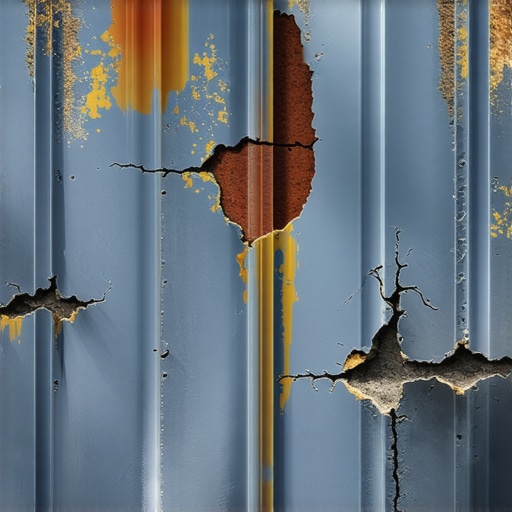
If you suspect deck damage, the first thing any reputable roofing companies should do is head inside the building and look up. You are looking for more than just a drip; you are looking for ‘scaling.’ Rust is an expansive process—iron oxide takes up to seven times the volume of the original steel. This expansion causes the factory-applied primer or galvanization to flake off in large chunks. If you see orange or reddish-brown flakes on your warehouse floor or equipment, your deck is literally shedding its structural capacity. We often see this in ‘Forensic Autopsies’ where the moisture has been driven upward from the building’s interior. In a cold climate like Buffalo or Minneapolis, warm air from the facility hits the cold metal deck. Without a proper vapor retarder, that moisture condenses and sits in the flutes. Over time, this results in structural decay of the substrate that is often hidden by the roof membrane above. If you can see light through the deck from the inside, or if a screwdriver can easily pass through the steel, the deck no longer meets building code for load requirements.
3. Fastener Back-outs and ‘Shiners’
One of the most telling signs of a failing metal deck is the ‘Jack-in-the-box’ effect. This is when the heavy-duty screws used to hold the insulation and membrane in place start to ‘back out.’ To a forensic investigator, a fastener that is pushing up against the membrane—creating a sharp ‘tent’—is a sign that the metal deck has lost its ‘pull-out’ strength. When the steel flutes rust, the hole that the screw is threaded into becomes enlarged and brittle. The constant thermal expansion and contraction of the roof then ‘pumps’ the screw upward. In the trade, we also look for ‘shiners’—nails or screws that missed the joist or were driven into a section of deck so thin they provide no resistance. If a high wind event occurs, these backed-out fasteners act like a lever, allowing the wind to peel the roof back like a sardine can. This is a major safety concern, and checking crew safety records is essential before hiring a team to perform a dangerous tear-off on a compromised deck. You cannot simply screw into rust and expect it to hold in a hurricane-force gust.
“Fasteners shall be driven into the top flange of the metal deck to ensure maximum withdrawal resistance and structural stability of the assembly.” – International Building Code (IBC)
4. Lateral Instability and Compromised Diaphragm
The final and most dangerous sign is the loss of the building’s ‘lateral diaphragm.’ In commercial construction, the metal roof deck is more than just a lid; it is a structural element that prevents the walls from leaning or buckling under wind loads. The deck is puddle-welded or mechanically fastened to the bar joists. When corrosion occurs at these attachment points, the deck is no longer ‘tied’ to the building’s skeleton. I once investigated a warehouse where the deck had rusted so severely around the perimeter that the entire roof was essentially ‘floating’ on the joists. The risk of a ‘blow-off’ or a total collapse during a heavy storm is astronomical in these cases. If you notice that the ‘crickets’—the small wedges used to divert water—are shifting or that the perimeter flashing is pulling away from the wall, it may be because the deck underneath is no longer stable. This often requires immediate action if the decking or rafters sag. Do not let a ‘trunk slammer’ convince you that a new layer of paint or a coating will fix this. If the diaphragm is compromised, you need a forensic engineer and a full deck replacement. Waiting only increases the liability and the ultimate cost of the ‘surgery’ required to save the building.