
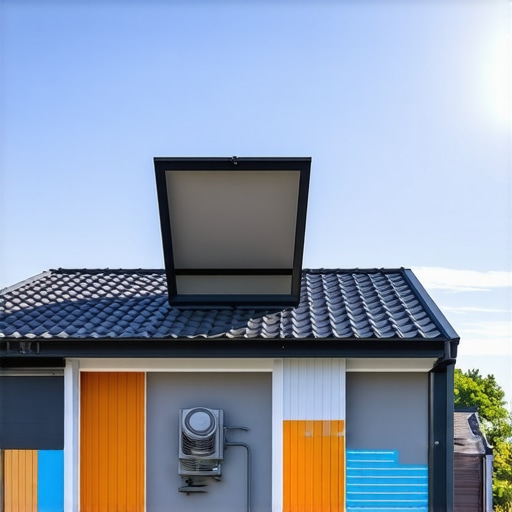
The Forensic Scene: When Your Attic Becomes an Oven
Walking on that roof felt like walking on a sponge, but not because of rot. It was the heat. In the middle of an August afternoon, I stepped onto a standard 4-on-12 pitch roof where the asphalt shingles were so soft my boots left deep indentations in the mat. I knew exactly what I’d find underneath before I even pulled a single nail. When I finally peeled back a square of material, the smell hit me first—the acrid, chemical scent of scorched bitumen. The felt paper didn’t just tear; it shattered like dried autumn leaves. This wasn’t a weather problem; it was a physics failure. The attic beneath was hitting 170°F, and the roofing companies that installed the previous system ignored the basic thermodynamics of the Southwest climate. As we look toward 2026, the building codes are getting stricter, and the ‘standard’ way of doing things isn’t going to cut it anymore. If you want your AC to survive the next decade, you need to understand why your roof is currently acting like a cast-iron skillet over a high flame.
1. The Physics of the Intake-Exhaust Balance
Most local roofers will slap a ridge vent on and call it a day. That is a fundamental mistake. Ventilation isn’t just about letting hot air out; it’s about the volume of cool air coming in. We call this the Net Free Area (NFA). If you have a ridge vent but your soffit vents are painted shut or stuffed with fiberglass batts, the ridge vent starts pulling air from the conditioned space of your home through light fixtures and attic hatches. You’re literally paying to air condition your attic. In 2026, expect to see a massive shift toward oversized intake systems.
“The attic shall be vented with a minimum net free ventilating area of 1/150 of the area of the vented space.” – International Residential Code (IRC) R806.1
This ratio is the bare minimum, yet I see ‘pros’ miss it daily. To fix this, we look at the Bernoulli principle. As wind blows over the ridge, it creates a low-pressure zone that sucks air out. If the intake isn’t sufficient, the vacuum effect forces a shiner (a misplaced nail) to become a point of condensation as moist air is dragged through the structure. You need a 1:1 balance. If you’ve got 100 square inches of exhaust, you need 100 square inches of intake at the eaves. Anything less is just thermal stagnation.
2. Radiant Barriers and the Electromagnetic War
Conduction is when your shingles touch your decking and transfer heat. Convection is the air moving. But the real killer in high-temp zones is radiation. Your roof deck absorbs the sun’s energy and radiates it downward like a broiler heating a steak. This is where most roofing companies fail their customers. They think thicker insulation is the answer. It’s not. Insulation only slows down heat transfer; it doesn’t stop it. A radiant barrier—typically a thin layer of highly reflective foil applied to the underside of the decking—reflects up to 97% of that radiant heat back out through the vents. When I do a forensic audit on a house with high cooling costs, the first thing I check is the emissivity of the attic surfaces. By 2026, integrated radiant barrier sheathing will be the gold standard for any tear-off. It prevents the attic from becoming a heat reservoir that keeps your house hot long after the sun goes down. If your roofer doesn’t talk about the Stefan-Boltzmann law, they’re just a shingle flipper, not a professional.
3. The Solar Reflectance Index (SRI) and Material Evolution
We need to stop talking about ‘colors’ and start talking about SRI. A black shingle can reach 160°F on a 90-degree day. A high-SRI ‘cool’ shingle might only hit 120°F. That 40-degree difference is the difference between your shingles lasting 20 years or 12. Thermal shock is what kills a roof. When a sudden afternoon thunderstorm hits a 160-degree roof, the rapid contraction causes the granules to pop off. I’ve seen valleys stripped of their protection in a single season because the material couldn’t handle the expansion and contraction.
“A roof is only as good as its flashing.” – Old Roofer’s Adage
While that adage usually refers to water, in 2026, we apply it to heat. We are seeing a move toward specialized pigments in shingles that reflect infrared light while still looking like traditional charcoal or bronze. If your local roofer isn’t offering Class 4 impact-resistant shingles with high SRI ratings, they are selling you yesterday’s technology for tomorrow’s climate.
4. Eliminating the Attic Bypass and Thermal Bridging
The final frontier for 2026 is the ‘attic bypass.’ These are the hidden holes—the plumbing stacks, the wire penetrations, and the gaps around the chimney or cricket. Most local roofers ignore what’s under the insulation. They think it’s the HVAC guy’s job. But a forensic roofer knows that moisture from your bathroom or kitchen leaking into the attic creates a humid environment that holds heat. Wet air is harder to cool than dry air. Furthermore, we have to address thermal bridging. Your rafters are wood, and wood conducts heat better than insulation. In high-performance roofs, we’re seeing more ‘above-deck’ insulation, where rigid foam boards are placed on top of the plywood before the shingles go on. This creates a thermal break that stops the heat from ever reaching your attic space. It’s expensive, it’s complex, and most trunk-slammers won’t touch it because it requires precise drip edge adjustments and longer fasteners. But if you’re serious about 2026 energy standards, it’s the only way to truly decouple your home from the external environment. Don’t let a contractor tell you it’s ‘overkill.’ Overkill is paying $600 a month to an electric company because your attic is a pressure cooker.