
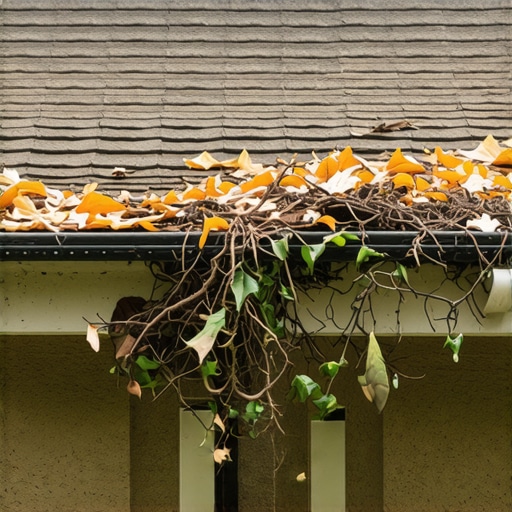
The Forensic Autopsy of a Cascading Failure
I was standing on a ladder in a driving rainstorm last Tuesday, watching a homeowner’s expensive landscaping get systematically vaporized by a waterfall coming off their roof. It wasn’t because the gutters were missing; it was because the system had fundamentally failed to manage the physics of the downpour. Most roofing companies will tell you to just ‘clean your gutters,’ but that’s like telling a smoker to just buy more tissues for their cough. By 2026, the variables have changed. We are seeing more intense micro-bursts and a higher rate of material degradation that makes the old maintenance schedules obsolete.
My old foreman used to say, ‘Water is patient. It will wait for you to make a mistake, then it will move in and start eating your house from the inside out.’ He wasn’t exaggerating. When water can’t exit through the downspout, it doesn’t just sit there. It builds weight—roughly eight pounds per gallon—and begins to find the path of least resistance. Usually, that path leads directly into your fascia board or back up under your starter course of shingles via capillary action.
Reason 1: The Asphalt Sandcastle (Accelerated Granular Loss)
The first culprit we’re seeing in this 2026 cycle is what I call ‘granular sludge.’ Roofing companies are seeing shingles that are taking a beating from increasingly erratic thermal cycling. When a roof goes from 140°F in the afternoon to a 60°F thunderstorm in twenty minutes, the asphalt expands and contracts violently. This releases the ceramic-coated granules at an accelerated rate. These granules don’t just disappear; they wash into the trough and settle at the bottom. Since they are heavy, they create a sediment layer that acts like a dam.
Once that sediment layer builds up, it traps organic debris like pine needles and maple ‘helicopters.’ Instead of washing through the downspout, the debris bonds with the granules to create a thick, heavy paste. This paste blocks the outlet, and suddenly your gutter is holding hundreds of pounds of dead weight. This is where you see the spikes pulling out of the rafter tails, leaving a ‘shiner’—a missed or pulled nail that now serves as a direct conduit for water to rot the wood behind the metal.
“Water-control is the most important factor in the design and construction of durable buildings.” – Building Science Axiom
Reason 2: Biological Micro-Dams and the Surface Tension Problem
We’ve noticed a massive uptick in lichen and moss growth on the north-facing slopes of roofs lately. This isn’t just an aesthetic issue. These organisms shed spores and physical mass into the drainage system. In 2026, many local roofers are finding that even gutters with ‘guards’ are failing because of surface tension. The biological film that grows on top of gutter covers creates a slick surface that allows water to skip right over the mesh and over the edge of the gutter entirely.
This is the physics of failure. Water has high surface tension; it likes to stick to things. When your gutters are coated in a layer of organic slime, the water follows the curve of the debris rather than dropping into the trough. This leads to water ‘wicking’ back toward the house. If your drip edge wasn’t installed with a proper kick-out or if it’s tucked too tightly against the fascia, that water is going to migrate behind the gutter. You won’t see the leak inside for months, but the plywood deck is already turning into a sponge.
Reason 3: Mechanical Fatigue and Pitch Drift
The third reason is the physical warping of the gutter system itself. Most roofing companies install gutters with a slight pitch—usually 1/16th of an inch per foot. However, after a few seasons of heavy ice loads and the weight of that granular sludge I mentioned earlier, the hangers begin to fatigue. Metal has a memory, and once it’s been stretched by a hundred-pound load of wet debris, it rarely snaps back to its original position.
This creates ‘dead spots’ in the run. Even if the gutter looks clean, water will pool in the low points. Standing water is the enemy. It leads to the oxidation of the aluminum or steel, and more importantly, it becomes a breeding ground for mosquitoes and bacteria. In a properly functioning system, the water should move with enough velocity to self-scour the trough. When the pitch is off, the velocity drops to zero, and the gutter becomes a stagnant swamp hanging off your eaves.
“A roof is only as good as its flashing and its ability to shed water away from the foundation.” – NRCA Manual Reference
The Surgery: Beyond the Band-Aid
Fixing this isn’t about a garden hose and a pair of gloves. If you’re seeing clogs in 2026, you need a forensic look at the system. We look for ‘crickets’ behind chimneys that might be diverting too much volume into a single small valley. We check the ‘valley’ transitions to ensure the water isn’t overshooting the gutter entirely. Sometimes the solution involves upsizing to a 6-inch K-style gutter to handle the increased volume of modern storms.
Don’t let a ‘trunk slammer’ tell you that a quick cleaning is all you need. If the fascia is soft or the drip edge is missing, you’re just throwing money into a leaky bucket. You need to ensure the secondary water barrier is intact and that the drainage path is clear from the ridge vent all the way to the splash block at the ground. Anything less is just waiting for the rot to set in.