
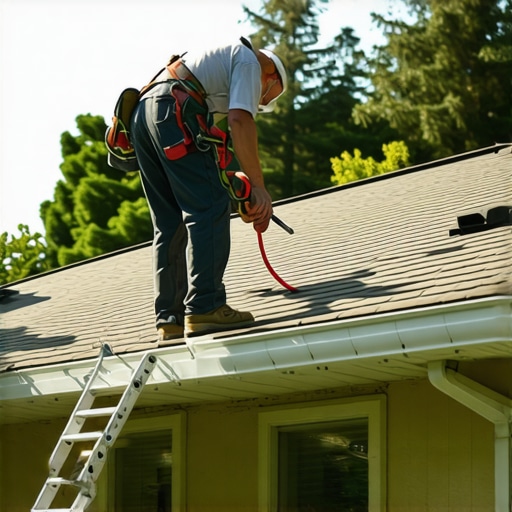
The sound isn’t a splash; it is a rhythmic, heavy thud. It is the sound of five gallons of water per minute bypassing a gutter and punching a hole in the mulch three stories below. I have spent twenty-five years on a 12-pitch roof, and if there is one thing I have learned, it is that most roofing companies do not understand fluid dynamics. They understand nailing a square of shingles, but they do not understand the war between the drip edge and the gutter. My old foreman, a man who smelled exclusively of menthol cigarettes and weathered asphalt, used to say, ‘Water is patient. It will wait for you to make a mistake.’ And in 2026, the biggest mistake local roofers are making is the gutter gap—that lethal void between the fascia board and the trough where gravity loses its grip and your house starts to rot from the inside out.
The Physics of Failure: Why Water Bypasses Your System
When we talk about roofing in a high-humidity, storm-heavy environment, we are talking about managing surface tension. Water has a natural tendency to ‘curl’ back toward the house. This is the Coanda effect in action. Without a properly installed drip edge that extends deep into the gutter, water will follow the underside of the shingle, track back across the starter strip, and run down the face of your fascia board.
“A roof is only as good as its flashing.” – Old Roofer’s Adage
I have performed forensic tear-offs where the plywood had the structural integrity of wet tissue paper. Why? Because the original installer left a half-inch gap. They figured the gutter would catch it. It didn’t. The water bridged the gap, wicked into the grain of the wood, and spent five years turning the rafter tails into compost. This is not just a leak; it is a systemic failure of the roof’s drainage architecture.
1. The ‘Tiger Stripe’ Forensics
The first way to identify a gutter gap without climbing a ladder is to look for the stripes. If you see dark, vertical streaks running down the front of your gutters, that is actually a good sign—it means the water is at least making it into the trough and overflowing. However, if those streaks are on the fascia board behind the gutter, you have a 2026-style gap. Local roofers often miss this because they are looking at the shingles, not the transition. Take a pair of binoculars. Look at the shadows. If you can see light between the metal of the gutter and the wood of the house, you are looking at a ticking time bomb. In the trades, we call this a ‘shiner’ of a different sort—a glaring error that should have been covered by a properly kicked-out flashing. That gap allows wind-driven rain to blow upward, saturating the soffit and eventually leading to mold growth in your attic. This is especially prevalent in Southeast zones where ‘Secondary Water Resistance’ isn’t just a suggestion; it is the difference between a dry home and a total loss after a hurricane.
2. The ‘Sponge Test’ on the Fascia
I once walked a roof that felt like stepping on a wet sponge. I didn’t even need to pull a shingle to know what happened. The installer had neglected the ‘cricket’ behind the chimney and, more importantly, had hung the gutters too low, creating a three-quarter-inch gap. To identify this yourself, wait for a dry day and take a long screwdriver to the underside of your eaves. If you can push that screwdriver into the wood behind the gutter with little resistance, the wood is ‘punky.’ This is the result of years of capillary action pulling water back into the fascia. The International Residential Code (IRC) is very clear about this.
“Flashings shall be installed in a manner that prevents moisture from entering the wall and roof through joints in copings, through moisture-permeable materials and at intersections with parapet walls and other penetrations through the roof plane.” – IRC Section R903.4
When roofing companies ignore the gutter-to-fascia transition, they are violating the very spirit of the code. They are leaving an air gap that functions as a vacuum, sucking moisture in every time the wind kicks up during a summer thunderstorm.
3. The Foundation Erosion Audit
If you want to know if your roof is failing, look at the ground. A gutter gap creates a ‘water curtain’ that falls straight down, bypassing the downspouts entirely. Look for a line of eroded soil or pitted concrete directly beneath your roofline. This is the ‘death of a thousand drops.’ Over time, this water saturates the foundation, leading to hydrostatic pressure that can crack your basement walls or shift your slab. Local roofers who are just ‘trunk slammers’ will tell you that your gutters just need cleaning. They are wrong. If the water is falling behind the gutter, no amount of cleaning will fix it. You need a structural fix: a heavy-gauge drip edge that is tucked under the first course of shingles and bent at a precise angle to shepherd water into the center of the trough. This prevents the ‘valley’ of your roof from becoming a fire hose that overshoots the drainage system. When I inspect a home, I look for ‘shiners’—those missed nails that have backed out. A shiner in the gutter line is a sign of thermal expansion and contraction that has pulled the gutter spikes loose, creating the very gap we are trying to avoid.
The Solution: Beyond the Band-Aid
Fixing a gutter gap isn’t about more caulk. Caulk is a temporary lie told by a contractor who wants to get paid and disappear. The only real fix is ‘The Surgery.’ This involves pulling back the first two courses of shingles, installing a wide-flange drip edge, and ensuring it has a proper ‘kick-out’ at the ends. We often see failures in the valleys where water velocity is highest. If the transition there isn’t armored with ice and water shield—even in warmer climates—you are asking for trouble. For 2026, we are seeing a shift toward larger, six-inch troughs to handle the increased frequency of heavy downpours. But even a ten-inch gutter won’t help you if there is a gap between it and the roof. You need a contractor who understands that the roof and the gutters are a single, integrated hydraulic system. If you ignore the gap, you aren’t just risking a leak; you are risking the structural integrity of your rafter tails and your home’s foundation. Don’t let a local roofer sell you a ‘lifetime warranty’ that doesn’t cover the fascia. Demand a forensic-level installation that respects the physics of water.