
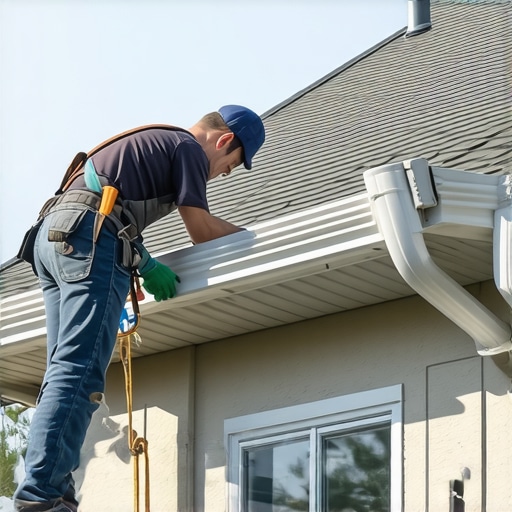
The Anatomy of a Failing Drainage System: Why Your Basement is Damp
The first thing you notice isn’t the water. It’s the smell. That heavy, earthy scent of damp concrete and mold blooming in the dark corners of a basement. I’ve spent twenty-five years on roof decks across the Pacific Northwest, and I can tell you that nine times out of ten, when a homeowner calls me about a roof leak, the roof itself is dry as a bone. The real culprit is sitting six feet below the eaves, choking on pine needles and dumping five hundred gallons of water directly against the foundation wall. Most local roofers treat gutters as an afterthought, but in my book, a roof without a functional drainage system is just a waterfall waiting to happen. In this region, where the rain doesn’t just fall—it lingers—water management is the difference between a legacy home and a structural nightmare.
The Wisdom of the Old Guard
My old foreman, a man we called ‘Pops’ who had been swinging a hammer since the Eisenhower administration, used to say, ‘Water is patient. It will wait for years just to find the one nail hole you forgot to seal.’ He’d stand on a ladder in the middle of a November downpour just to watch how the surface tension of the water behaved as it transitioned from the shingle drip edge into the trough. He taught me that roofing companies who ignore the physics of water velocity are just selling shingles, not protection. He was right. Water has a mechanical drive; it wants to get to the ground, and if you don’t give it a clear path, it will carve its own path through your fascia, your siding, and eventually, your crawlspace.
“Gutters and downspouts shall be maintained in good repair and free from obstructions. Roof water shall not be discharged in a manner that creates a public nuisance.” — International Property Maintenance Code (IPMC) 304.7
Fix #1: The Volume Crisis (Moving from 2×3 to 3×4)
Most builder-grade homes are equipped with standard 5-inch K-style gutters and 2×3 inch downspouts. This is fine for a light drizzle, but when the skies open up in a 2026-style weather event, those tiny downspouts become the bottleneck. Imagine trying to empty a bathtub through a straw. The water backs up, the weight of the gutter increases by hundreds of pounds, and the surface tension causes the water to ‘overshoot’ the gutter entirely. I advocate for 3×4 inch downspouts as the minimum standard. The cross-sectional area of a 3×4 is nearly double that of a 2×3. This isn’t just about volume; it’s about debris clearance. A 2×3 downspout can be clogged by a single wet maple leaf. A 3×4 allows that leaf to pass through, preventing the hydraulic pressure that eventually rips gutter hangers right out of the wood. When you hire roofing professionals, ask them about the drainage capacity, not just the shingle color.
Fix #2: The Kick-out Flashing Forensic Fix
If you see a stain on your siding where a roofline meets a wall, you’re looking at a slow-motion disaster. This is where capillary action becomes the enemy. Without a kick-out flashing—a simple piece of metal bent at an angle to divert water into the gutter—the water follows the line of the wall, ducks behind the J-channel of your siding, and begins to rot the sheathing. I’ve opened up walls where the plywood had the consistency of wet cardboard because a ‘trunk slammer’ skipped a $15 piece of flashing. A forensic inspection usually reveals that the water has been traveling sideways, pulled by surface tension, directly into the wall cavity. This isn’t just a leak; it’s a structural compromise that leads to thousands in mold remediation.
Fix #3: Sub-Surface Discharge and the 10-Foot Rule
A downspout that ends in a splash block is a failure of engineering. In wet climates, discharging water two feet from the foundation is just inviting hydrostatic pressure to push that water through your concrete walls. The fix for 2026 is sub-surface drainage. We’re talking about 4-inch PVC (not the cheap corrugated stuff that crushes under a lawnmower) piped at least ten feet away from the structure to a bubbler or a French drain. This moves the saturation zone away from the ‘point of load’ of your foundation. When the soil around your house becomes a soup, it loses its bearing capacity. This is why doors stick and windows crack. It’s not ‘settling’; it’s poor water management.
“A roof is only as good as its flashing and its ability to shed water away from the structure.” — Old Roofer’s Adage
Fix #4: Reinforcing the Fascia and Avoiding the ‘Shiner’
Finally, we have to look at how the gutters are attached. I’ve seen countless roofing companies drive long spikes through the gutter and into the fascia board, only to miss the rafter tails. These ‘shiners’ create a path for water to enter the end grain of the wood. Over time, the fascia rots, the spikes pull out, and the gutter begins to sag, creating a ‘low spot’ where water sits and breeds mosquitoes. The fix is the use of heavy-duty hidden hangers with 3-inch screws driven directly into the rafter tails. This creates a mechanical bond that can withstand the weight of ice and snow buildup. If your gutters are pulling away, don’t just hammer the spikes back in. That’s a Band-Aid. The surgery involves replacing the rotted wood and using proper mechanical fasteners.
The Final Word: The Cost of Waiting
Water is the most destructive force on earth. It’s patient, it’s persistent, and it’s heavy. In the roofing trade, we see the results of ‘saving money’ on gutters every single day. A properly executed downspout system is an insurance policy for your foundation. Don’t let a $200 gutter issue turn into a $20,000 foundation piering job. Check your outlets, upgrade your volume, and for heaven’s sake, get that water away from your walls.