
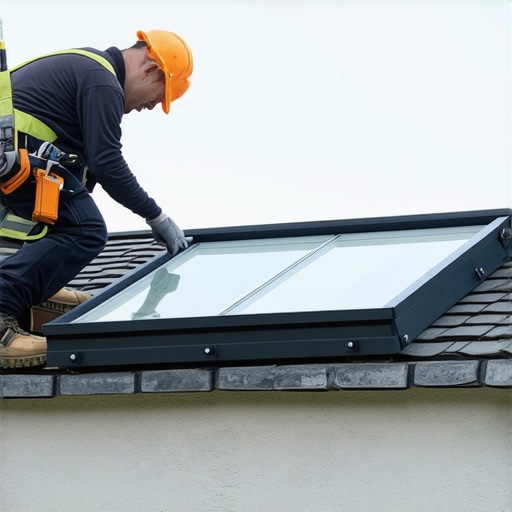
The 3:00 AM Drip: Why Your Skylight Is Ruining Your Sleep
There is a specific sound that keeps homeowners awake during a November Nor’easter. It’s not the wind rattling the siding; it’s the rhythmic, metallic tink-tink-tink of water hitting a plastic bucket in the master bedroom. By the time that water manifests on your ceiling, it has already traveled a marathon through your roofing system. Walking on that roof felt like walking on a sponge. I knew exactly what I’d find underneath: a graveyard of rotted OSB and black mold that had been brewing for three seasons because a ‘pro’ decided to rely on a tube of caulk instead of proper physics.
As we head toward 2026, roofing companies are seeing a massive spike in skylight failures, not because the products are getting worse, but because the installation shortcuts are getting more creative. Most local roofers will tell you the seal is gone and try to sell you a whole new roof. But as a forensic investigator of failed structures, I can tell you that the leak is rarely the glass—it’s the war between the roof deck and the curb. To understand why your skylight is crying, we have to look at the capillary action of water moving sideways under your shingles, defying gravity through sheer surface tension.
“A roof is only as good as its flashing.” – Old Roofer’s Adage
The Physics of the Failure: Why 2026 Standards Matter
In colder climates, we deal with the ‘thermal bridge’ effect. You have a hole in your insulated attic filled with a piece of glass. Warm, moist air from your morning shower rises, hits that cold glass, and turns back into liquid. That’s not a leak; that’s physics. However, when that moisture gets trapped behind the step flashing, it starts the slow rot. We are seeing more ‘shiners’—nails that missed the rafter and hit the open air—acting as conduits for frost. When that frost melts, it looks like a skylight leak, but it’s actually an attic bypass issue.
Fix 1: The Surgical Flashing Reconstruction
The most common sin roofing companies commit is ‘re-using’ old flashing. If a contractor tells you the old copper or aluminum looks ‘fine,’ fire them. To fix a 2026-grade leak, you must strip the shingles back two feet on every side. We install a high-temp ice and water shield—something that can handle the 140°F heat of a summer roof deck without turning into a gooey mess—and wrap it up the curb. This creates a secondary water resistance layer. Then comes the step flashing. Each piece must be woven into the shingle courses. If you see a single long piece of metal, you’re looking at a future failure point. Water is patient; it will find the gap where that metal expands and contracts.
Fix 2: Managing the ‘Cricket’ and Water Diverters
On larger skylights or those positioned mid-slope, the back of the skylight acts like a dam. Leaves, pine needles, and silt build up there, creating a wet sponge that sits against your shingles. In 2026, we are pushing for the mandatory installation of a ‘cricket’ or a diverter on any unit wider than 30 inches. This is a small peaked structure built behind the skylight to split the water flow. Without it, hydrostatic pressure builds up during heavy downpours, forcing water up and under the head flashing. It’s like trying to hold back a flood with a screen door.
Fix 3: Curb Insulation and Vapor Barrier Integrity
A major secret most local roofers won’t tell you is that the leak might be coming from inside the house. If the drywall ‘tunnel’ leading up to the skylight isn’t insulated to the same R-value as the rest of your attic, you’ve created a chimney for heat loss. We are now using spray foam or rigid polyiso board around the exterior of the skylight curb before the flashing goes on. This breaks the thermal bridge. If you don’t stop the heat from hitting the underside of the flashing, you’ll get condensation that rots the ‘square’—the 100 square feet of roofing around the unit—from the inside out.
“The building envelope must be continuous; any break is an invitation for structural decay.” – Architectural Axiom
Fix 4: The Triple-Glazed Argon Upgrade
If your skylight is more than 15 years old, the seals holding the gas between the panes have likely failed. You’ll see fogging or a ‘rainbow’ effect. In 2026, the industry standard has shifted toward triple-glazed units with Low-E coatings. These aren’t just for energy efficiency; they keep the interior pane warm enough to prevent the condensation-induced ‘false leak.’ When replacing the unit, ensure your roofing companies are using deck-mounted units with integrated gaskets. We’ve moved away from the old curb-mounted ‘bubbles’ because they are notorious for air leakage.
The Reality of Warranties and Contractor Selection
Don’t get fooled by a ‘Lifetime Labor Warranty.’ Most of those ‘trunk slammer’ outfits won’t be in business in five years, let alone a lifetime. When vetting roofing companies, ask specifically about their skylight flashing protocol. Do they use a starter strip? Do they replace the apron? If they mention ‘silicone’ as a primary fix, show them the door. Silicone is a Band-Aid for a bullet wound. You want a craftsman who understands how to layer materials so that gravity does the work, not a chemical bond that will crack after one season of thermal expansion. Protecting your home means understanding that water is the ultimate predator—it never stops looking for a way in.