
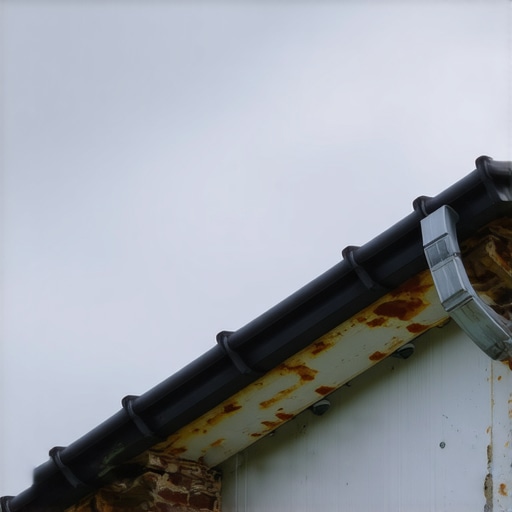
The Forensic Scene: Walking on a Sponge
Last Tuesday, I climbed onto a residential roof in a humid suburb where the homeowner complained about orange streaks staining their pristine white siding. Walking on that roof felt like walking on a sponge; the decking beneath the shingles was so saturated that every step produced a sickening squelch. I knew exactly what I would find underneath before I even pulled my pry bar. The gutters were original, but the house was barely fifteen years old. Most roofing companies would just quote you for a new system and move on, but if you don’t understand the physics of failure, you are just buying a countdown to the next catastrophe.
As we look toward 2026, the industry is seeing a massive uptick in premature gutter failure. It is not just about ‘old’ metal. It is about a specific set of environmental and mechanical interactions that most local roofers ignore because they are too busy chasing the next square of shingles. To fix a problem, you have to look at the chemistry of the runoff and the mechanical integrity of the drip edge.
1. The Asphalt Tea: Acidic Runoff and Micro-Pitting
The first reason your gutters are on a fast track to oxidation is the chemical composition of modern asphalt shingles. As shingles age, they shed more than just granules. They release petroleum-based oils and fiberglass resins that, when mixed with rainwater, create a mildly acidic ‘tea.’ This runoff does not just sit in the gutter; it undergoes capillary action, creeping into the microscopic pores of the metal coating. If your roofing professional installed low-grade galvanized gutters, that acidic water starts eating the zinc coating immediately.
“A roof is only as good as its flashing, and the gutter is the final stage of that flashing system.” – Old Roofer’s Adage
By 2026, we are seeing the results of the ‘builder-grade’ boom from a decade ago. Those gutters used the thinnest possible sacrificial anode layer. Once that zinc is gone, the raw steel beneath is exposed to the atmosphere. This is where mechanism zooming is necessary: at a molecular level, the oxygen in the air begins a relentless assault on the iron atoms, forming iron oxide—rust. This isn’t just a cosmetic brown stain; it is the structural disintegration of the water management system. I have seen local roofers try to caulk over these pits, but that is like putting a Band-Aid on a gunshot wound. The oxidation is happening from the inside out.
2. The Galvanic Marriage of Death: Dissimilar Metals
The second reason for the 2026 rust plague is the Galvanic Scale. I frequently find ‘shiners’—those missed nails—near the gutter line where a hack installer used a stainless steel screw to secure an aluminum gutter to a steel bracket. When two dissimilar metals are joined by an electrolyte (in this case, rainwater), you have created a battery. This is called galvanic corrosion. One metal becomes the anode and the other the cathode. The anode gives up its electrons and literally dissolves into nothingness.
If your roofing companies are not checking the compatibility of their fasteners, they are setting a ticking time bomb. I once inspected a project where the contractor used copper crickets to divert water into aluminum troughs. The result was a chemical massacre. Within three seasons, the aluminum had the structural integrity of wet cardboard. You cannot just mix and match materials because they were on sale at the big-box store. You need a forensic understanding of how these metals interact in a high-moisture environment.
3. Debris Fermentation and the Microbiome of the Gutter
The third reason involves what I call ‘debris fermentation.’ When leaves, pine needles, and bird droppings sit in a gutter that has an improper pitch, they don’t just sit there—they rot. This creates a dense, anaerobic biofilm. This biofilm traps moisture against the metal surface for weeks at a time, long after the rest of the roof has dried out in the sun. This stagnant pool of organic decay creates a localized environment where the pH drops significantly, accelerating the breakdown of even high-quality coatings.
“Water is patient. It will wait for you to make a mistake, and it will use that mistake to tear your house down.” – Forensic Engineering Axiom
Many local roofers install gutters by eye, but if the slope is off by even a fraction of an inch per foot, you get ‘ponding.’ That ponding is the birthplace of rust. By 2026, the accumulation of this bio-sludge in improperly pitched systems will have eroded the interior protective liners of thousands of homes. The fix isn’t just cleaning the gutters; it is a surgical re-pitching of the entire run to ensure that the hydrostatic pressure of the water actually moves it toward the downspout rather than letting it sit and fester.
The Surgery: How to Stop the Rot
If you see the orange bleed starting at the seams or the end caps, the ‘Band-Aid’ of more caulk will only trap moisture and make it worse. The ‘Surgery’ involves a total tear-off of the compromised sections. You need to ensure the fascia boards aren’t already soft. If the wood is ‘oatmeal,’ no screw will hold, and the weight of the water will eventually pull the gutter right off the house. We use heavy-gauge aluminum or, for high-end forensic fixes, stainless steel fasteners that won’t trigger a galvanic reaction. Don’t let a roofing salesman tell you it’s just a cosmetic issue. Rust is the cancer of the roofline; by the time you see it, it’s already deep in the marrow.