
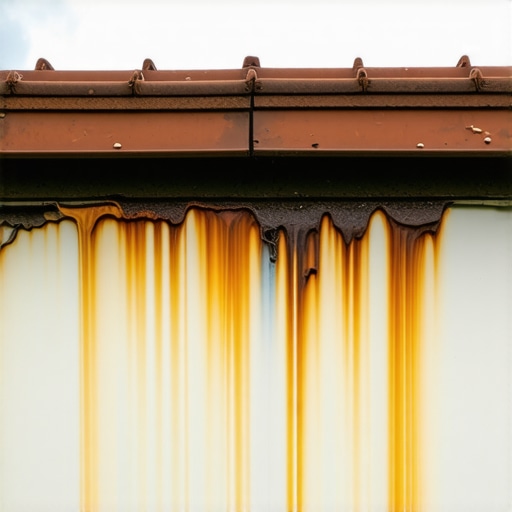
The Autopsy of a Coastal Roof Failure
Walking on a roof in a humid, salt-air environment like Houston or the Florida coast felt like walking on a ticking time bomb. I knew exactly what I’d find before I even set up the ladder. The homeowner was complaining about a minor damp spot on the porch ceiling, but the real story was hiding at the perimeter. When I reached the gutter line and peeled back the first course of shingles, the drip edge didn’t just look old; it had the consistency of wet cardboard. It was a classic case of what local roofers call ‘the orange bleed,’ where the metal has essentially been vaporized by a combination of salt spray and poor installation. This wasn’t just a leak; it was a systemic failure of the roof’s first line of defense.
The Physics of the Drip Edge: Why Metal Fails in the Southeast
In the Southeast’s tropical climate, roofing companies are fighting a constant battle against wind-driven rain and 100% humidity. The drip edge is supposed to be the gatekeeper. It’s an L-shaped or T-shaped metal flashing installed along the eaves and rakes to direct water away from the fascia and into the gutters. However, physics is a cruel mistress. Through capillary action, water can actually travel upward or sideways against gravity, especially when surface tension allows it to cling to the underside of a rusted metal flange. When that metal becomes pitted and porous due to oxidation, it stops being a shield and starts being a wick. It pulls moisture directly into the end-grain of your plywood roof deck. This is why a ‘cheap’ drip edge is the most expensive mistake a contractor can make.
“A roof is only as good as its flashing.” – Old Roofer’s Adage
Sign 1: The ‘Orange Bleed’ and Galvanic Corrosion
The first sign of 2026 roof drip edge rust isn’t a hole; it’s a stain. If you look at your fascia boards—the vertical boards behind your gutters—and see vertical orange or brown streaks, your drip edge is hemorrhaging iron oxide. In coastal zones, this is often accelerated by galvanic corrosion. This happens when the roofing companies use mismatched metals—like aluminum drip edges secured with galvanized steel nails. The salt in the air acts as an electrolyte, creating a literal battery that eats the less noble metal. I’ve seen shiners (nails that missed the rafter) completely rusted through within three years because the moisture trapped between the metal and the wood never had a chance to dry out. If you see that orange bleed, the protective zinc coating on your steel has already sacrificed itself, and the raw iron is now turning back into dust.
Sign 2: The ‘Bird’s Mouth’ Gap and Thermal Expansion
The second sign is a physical deformation I call the ‘Bird’s Mouth.’ As the rust takes hold, it expands. Rust takes up more volume than the original metal. This expansion, coupled with the intense thermal shock of 140°F afternoons followed by 70°F rain squalls, causes the metal to buckle and pull away from the roof deck. When you look up from the ground, you might see the drip edge flaring out like a bird’s beak. This gap is an invitation for wind-driven rain to be pushed up underneath the starter course of shingles. Once water gets behind that metal, it bypasses the secondary water resistance layer entirely. Most local roofers won’t notice this from the ground; you have to get on a ladder and physically probe the edge to see if it’s lost its structural integrity.
Sign 3: The Spongy Perimeter (The Awl Test)
The final and most devastating sign is when the rust has successfully transferred its moisture to the wood. I always carry a forensic awl when I’m inspecting a property for roofing companies. If I can push that awl into the wood behind the drip edge with minimal resistance, the game is over. The rust has acted as a bridge for rot. Water has moved via hydrostatic pressure through the rusted-out pits in the metal and into the fascia and rafter tails. At this point, you aren’t just looking at a ‘drip edge repair’; you’re looking at a full-scale tear-off of the first square (100 square feet) of roofing to replace the rotted plywood and fascia. If the drip edge was installed without a proper cricket or if the shingles weren’t overhung by the standard 1/2 to 3/4 of an inch, the rust is almost guaranteed to be hiding a colony of wood-destroying fungi.
“Roofing systems shall be shed-water in a manner that prevents the accumulation of water on the roof or the infiltration of water into the building.” – International Residential Code (IRC) R905.1
The Fix: Surgical Replacement vs. The Contractor’s Band-Aid
When you call local roofers to address drip edge rust, beware of the ‘caulk and paint’ scam. Slapping a layer of industrial sealant over rusted metal is like putting a designer band-aid on a gangrenous limb. It might look better for a month, but the oxidation process continues underneath, accelerated by the trapped moisture. The only real fix is ‘The Surgery.’ This involves carefully prying up the starter course, removing the rusted metal sections, and installing new, heavy-gauge coastal-grade flashing—preferably stainless steel or high-grade Kynar-coated aluminum in salt-heavy zones. You must ensure the new edge is tucked under the underlayment on the eave but over the underlayment on the rake. If your contractor doesn’t know the difference, they shouldn’t be on your roof. Waiting until 2026 to address a rusted edge that’s already ‘bleeding’ could triple your repair costs as the rot spreads into the structural rafters. Protect your deck, or the deck will eventually fail you.