
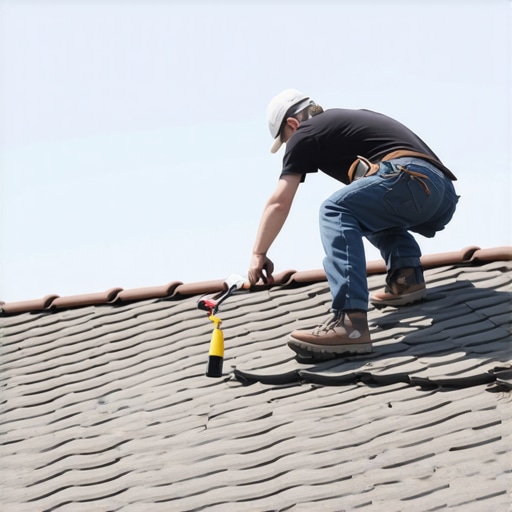
The Anatomy of a Failure: Why Your Ceiling is Dripping
The smell hits you first—that damp, earthy scent of rotting OSB and moldy fiberglass insulation. By the time a homeowner sees a brown ring on their living room ceiling, the battle is already lost. As someone who has spent over two decades crawling across 12-pitch slopes and tearing off the ‘hack jobs’ of cut-rate roofing companies, I can tell you that 90% of those leaks aren’t from the shingles. They are from the transitions. My old foreman used to say, ‘Water is patient. It will wait for you to make a mistake.’ He was right. Water doesn’t just fall; it searches. It uses capillary action to pull itself uphill into your valleys and behind your step flashing, searching for that one shiner—a nail missed by the installer that’s now acting as a direct highway for moisture into your attic. If your local roofers didn’t use the right sealant in 2026, you aren’t owning a roof; you’re owning a ticking clock.
“A roof is only as good as its flashing.” – Old Roofer’s Adage
The Forensic Autopsy of a Leaking Chimney
Let’s look at the physics. In a variable climate where temperatures swing from a frozen midnight to a 140°F roof deck at noon, materials are in constant motion. This is called thermal expansion and contraction. Most roofing companies slap on a cheap tube of thermoplastic caulk and call it a day. But within two seasons, that bead of caulk pulls away from the masonry. Why? Because the sealant lacked the elongation properties to handle the substrate movement. When that bond breaks, hydrostatic pressure pushes wind-driven rain into the gap. Once the water gets past the metal, it hits the roof deck. If that deck is saturated, the plywood begins to delaminate, turning into something with the structural integrity of wet cardboard. This isn’t just a leak; it’s a slow-motion demolition of your home’s skeletal structure.
The 5 Best Sealants of 2026: A Forensic Breakdown
If you are hiring local roofers, you need to demand they use one of these five specific technologies. The industry has moved beyond the ‘black jack’ tar of the 90s. We are now in the era of high-performance polymers that actually bond at a molecular level.
1. High-Solids MS Polymers (Silyl Modified Polymers)
MS Polymers are the undisputed heavyweight champions for 2026. They combine the best of silicone and polyurethane. Unlike old-school sealants, they don’t contain solvents that gassing off and cause the bead to shrink. When a roofer applies an MS Polymer to a cricket—that small peaked structure behind a chimney designed to divert water—it stays flexible. It can stretch up to 500% without tearing. This is vital because the chimney and the roof deck move at different rates. If the sealant snaps, the water wins. These are also ‘wet-surface’ capable, meaning a pro can apply them in the middle of a storm to stop a disaster.
2. High-Density Polyurethane (Architecture Grade)
This is the workhorse of the roofing industry. Polyurethane is known for its insane adhesion. It doesn’t just sit on the surface; it bites into the pores of the brick and the grain of the metal flashing. However, it’s a bear to apply in the cold. In northern climates, if it’s below 40°F, polyurethane becomes thick as peanut butter and won’t flow into the valley properly. But once it cures, it is nearly indestructible. It resists the UV radiation that typically turns cheaper sealants into brittle, cracked dust within three years.
3. Advanced Non-Gassing Silicone
Forget the stuff you buy at the hardware store for your bathtub. Professional-grade roofing silicone is a different beast. Its primary advantage is heat resistance. In the Southwest or during record-breaking summers, roof temperatures can reach 160°F. Silicone is one of the few materials that doesn’t soften or lose its chemical bond at those extremes. The downside? Nothing sticks to silicone—not even more silicone. If a repair is needed later, the old stuff has to be completely scraped off, or the new bead will just sit on top like a greasy noodle.
4. Butyl Rubber Sealants (The Hidden Defense)
You won’t see this on the surface. Butyl is the ‘secret sauce’ used inside the laps of metal roofing and under the flanges of plumbing boots. It never truly hardens. It remains a sticky, gummy mess for decades. This is exactly what you want between two pieces of metal. As the metal expands, the butyl stretches and pulls back, maintaining a vacuum-tight seal. If your roofing companies aren’t using butyl tape under the transition flashings, they are skipping a step that costs $20 but saves $2,000 in future repairs.
5. Liquid-Applied Flashing Membranes
This is the ‘surgery’ of roofing. Instead of just a bead of caulk, this is a fleece-reinforced liquid resin. It is painted onto the flashing and the roof deck, creating a monolithic, seamless waterproof ‘boot.’ It is expensive, and it takes time to apply, but it is the only permanent solution for complex roof geometries where traditional metal flashing can’t be bent to fit. If I’m looking at a roof with a 100% success rate over ten years, I’m looking at liquid-applied membranes.
“Roofing assemblies shall be designed and installed in accordance with this code and the manufacturer’s installation instructions.” – International Building Code (IBC) Sec 1501.1
The ‘Band-Aid’ Trap: Why Caulk Isn’t a Cure
I see it every week. A homeowner calls a ‘trunk slammer’ who climbs up, squeezes a tube of clear silicone over a leak, and charges $300. That is a Band-Aid on a gunshot wound. If the flashing is rusted or the underlying wood is soft, no amount of ‘super sealant’ will fix it. True roofing is about layering. It’s about the square—the 100 square foot measurement of roofing—being installed with proper overlaps. The sealant is the final line of defense, not the only one. When you talk to local roofers, ask them about their flashing methodology. If they say ‘we just caulk it,’ walk away. You want to hear about mechanical fasteners, ‘Z-bar’ counter-flashing, and high-solids polymers.
The Cost of the ‘Cheap’ Choice
Using a $5 tube of builders-grade caulk instead of a $15 tube of 2026 MS Polymer saves a contractor ten bucks per square. But that $10 saving is what leads to a $15,000 insurance claim for a mold-remediated attic. The physics of water moving sideways through capillary action means that a single pinhole in a sealant bead can pull gallons of water into your soffits over the course of a rainy season. Don’t let your roofing project become a forensic study in failure. Insist on the right chemistry, the right application, and the right trade professionals who know the difference between a ‘shiner’ and a sealed system.