
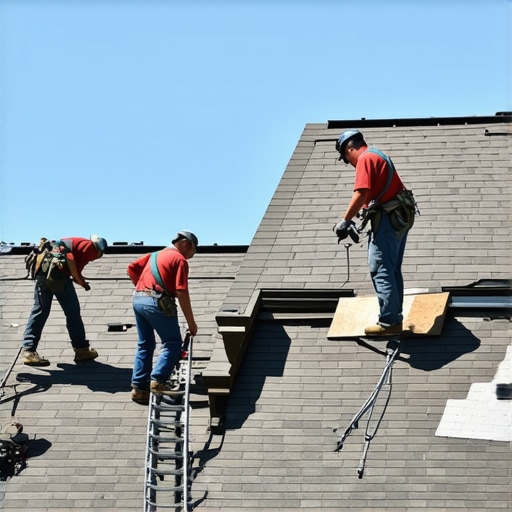
The Forensic Scene: When the Decking Starts to Breathe
Walking on that roof felt like walking on a sponge. I knew exactly what I’d find underneath before I even pulled my flat bar out of my belt. It was a standard 4:12 pitch, look decent from the curb, but the owner was complaining about a phantom rattle every time the wind kicked up over 30 miles per hour. Most local roofers would have just slapped some mastic on the ridge caps and called it a day. But I’ve spent twenty-five years looking at the guts of failed systems, and I knew this wasn’t a surface wound. When I peeled back a square of shingles near the eave, I didn’t see wood; I saw black mold and delaminated plywood that looked like a stack of wet cardboard. The wind wasn’t just hitting this roof; it was inflating it. This is the reality of roofing in high-wind zones as we head toward 2026. The physics of failure haven’t changed, but the storms are getting meaner, and the ‘trunk slammers’ are getting lazier. If you want your home to survive the next decade, you need to understand why roofs actually fail when the pressure rises.
“A roof is only as good as its flashing.” – Old Roofer’s Adage
1. The Physics of the ‘Nail Line’ and Fastener Withdrawal
Most homeowners think shingles blow off because the wind ‘grabs’ them. That’s only half the story. The real culprit is hydrostatic pressure and laminar flow. As wind screams over your roof peak, it creates a vacuum—low pressure on top, high pressure inside the attic. If your roofing companies didn’t nail those shingles exactly in the ‘sweet spot’—that narrow 1-inch strip where the two layers of a laminate shingle overlap—you’ve got a mechanical disaster waiting to happen. In the trade, we call them ‘shiners’ when a nail misses the mark or hits a gap in the decking. By 2026, standard 4-nail patterns will be obsolete for anyone living in a wind-rated zone. We are moving to 6-nail patterns using ring-shank nails. Why? Because a smooth-shank nail has the holding power of a toothpick in a birthday cake once the plywood gets a little age on it. A ring-shank nail bites into the wood fibers, increasing withdrawal resistance by nearly 40%. When the wind tries to peel that shingle back, the nail stays put, and the shingle stays on the house instead of ending up in your neighbor’s pool.
2. The ‘Zip-Loc’ Effect: Starter Strips and Drip Edge Integration
The edge of your roof is the front line of the war. If the wind can get a finger under the first row of shingles, it will unzip the entire slope like a cheap jacket. I’ve seen local roofers use upside-down shingles as a starter course—that’s a rookie move that should get a guy kicked off the job site. A true wind-resistant system requires a dedicated starter strip with a factory-applied adhesive that bonds directly to the drip edge. We’re talking about a chemical weld. The drip edge itself can’t just be tacked on with a few staples. In a high-wind scenario, the metal needs to be heavy-gauge and fastened every 4 inches. This prevents the ‘peel-back’ mechanism. When the wind hits the fascia, it’s forced upward. If that drip edge flexes, it breaks the seal of the starter course, and the laminar flow turns into turbulent lift. Once that happens, the mechanical fasteners are the only thing left, and as we discussed, if they aren’t ring-shanks in the strike zone, you’re toast.
3. Sealed Roof Decks: The Secondary Water Resistance (SWR) Revolution
Let’s talk about the nightmare scenario: the shingles are gone. Maybe a branch hit the roof, or maybe the gust was just too much for the asphalt. In the old days, that meant your living room was about to become an indoor swimming pool. Not anymore. The 2026 standard for high-end roofing involves a Sealed Roof Deck. We’re moving away from cheap felt paper that tears like a wet napkin. Forensic investigators like me want to see a synthetic underlayment or, better yet, a peel-and-stick bitumen membrane applied directly to the plywood seams.
“The primary function of a roof is to shed water, but its secondary, more difficult job is to stay attached while doing so.” – NRCA Technical Manual
This creates Secondary Water Resistance (SWR). Even if the wind strips every single shingle off the decking, the house remains watertight. I once did an inspection after a major blow where the shingles were completely harvested by the wind, but the interior was bone dry because the crew had used a high-temp self-adhering underlayment. That’s the difference between a $500 deductible and a total loss of your personal belongings.
4. The Geometry of the Valley and the Cricket
Water is patient. It will wait for the wind to push it uphill. In a storm, rain isn’t falling down; it’s moving sideways and up. This is where valleys and crickets become critical. A valley is where two roof planes meet, and it handles a massive volume of water. Most roofing companies just weave the shingles together because it’s fast. That’s a mistake. A ‘closed-cut’ or ‘open-metal’ valley is far superior for wind-driven rain. When the wind pushes water across the roof surface, it can get forced under the ‘weave.’ If there isn’t a solid metal flashing or a heavy-duty ice and water shield underneath, that water finds the nail holes and rots the plywood from the inside out. Similarly, any chimney wider than 30 inches needs a cricket—a small peaked structure behind the chimney to divert water. Without it, you get a ‘dead level’ spot where water pools. Add a 70-mph wind, and that water is getting pushed under the counter-flashing every single time. It’s not magic; it’s fluid dynamics.
The Warranty Trap and Picking Your Contractor
I get tired of hearing about ‘Lifetime Warranties.’ To a manufacturer, ‘Lifetime’ usually means the life of the shingle, which they can argue is over the moment a major wind event happens. They’ll blame ‘acts of God’ or ‘improper installation.’ And they’re usually right about the installation. When you are vetting local roofers, don’t ask about the price per square. Ask about their fastening schedule. Ask if they use 1.25-inch or 1.5-inch nails. Ask if they use a starter strip on the rakes as well as the eaves. If they look at you like you’re speaking Greek, show them the door. You want the guy who obsesses over the drip edge and the cricket. You want the forensic-minded pro who knows that 2026 isn’t just a year on the calendar—it’s a benchmark for a new era of storm intensity. Don’t wait for the dining room ceiling to start dripping to realize your roof was built by a ‘trunk slammer’ who didn’t understand the physics of lift. The cost of doing it right is a fraction of the cost of doing it twice.