
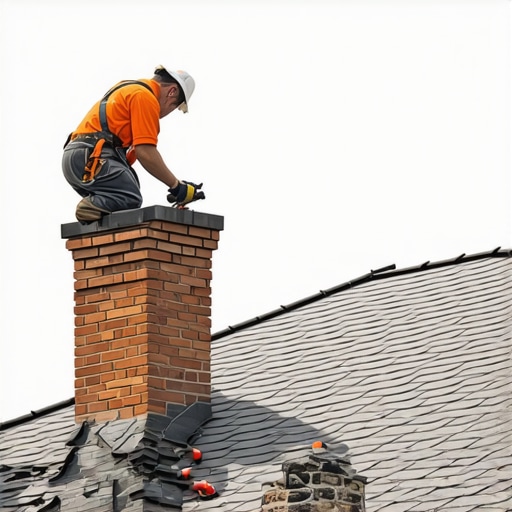
The Anatomy of a Midnight Drip: Why Your Chimney is Winning
You hear it before you see it. That rhythmic tap-tap-tap against the metal damper of your fireplace. By the time you notice a brown stain blooming on the ceiling drywall, the damage isn’t just starting—it’s been maturing for months. As a forensic roofer, I’ve spent two decades crawling into attics where the air smells like wet dog and fermented wood, all because a crew of so-called local roofers treated a chimney like a minor obstacle rather than a structural puncture. My old foreman used to say, ‘Water is patient. It will wait for you to make a mistake.’ He was right. Water doesn’t just fall; it searches. It uses capillary action to climb uphill, it uses hydrostatic pressure to push through pinholes, and it uses the wind to shove itself under your shingles. If you’re looking at roofing companies to solve a 2026 leak, you need to understand that a chimney is a giant hole in your roof’s defense system. In the cold, unforgiving climate of the North, where ice dams turn chimneys into ponds, the physics of failure are brutal. When the temperature fluctuates, your masonry and your wood framing expand and contract at different rates. This ‘thermal bridging’ creates gaps that act like straws, sucking moisture into your home. This isn’t a job for a bucket of tar; it’s a job for surgery.
“Flashings shall be installed in a manner that prevents moisture from entering the wall and roof through joints in copings, through moisture-permeable materials and at intersections with parapet walls and other penetrations.” — International Residential Code (IRC) R903.2.1
Fix 1: The ‘Cricket’ Diverter (Ending the Dead Valley)
If your chimney is wider than 30 inches, and you don’t have a cricket, your roof is a ticking time bomb. A cricket is a small peaked structure built behind the chimney on the high side of the roof. Its job is simple: split the water and send it around the masonry. Without it, you have a ‘dead valley.’ Imagine a fire hose pointed at a brick wall; the water pools, builds pressure, and eventually finds a shiner—a nail missed by the installer that now acts as a direct conduit to your attic floor. When roofing companies skip the cricket, they are inviting the 2026 winter to rot your headers. We don’t just build these out of scrap; we sheath them in Ice & Water Shield that extends at least 24 inches up the roof slope. This membrane is self-healing, meaning when we drive a fastener through it, the rubberized asphalt grips the nail like a vice, preventing that slow-motion rot that turns plywood into oatmeal.
Fix 2: The Two-Part Flashing Dance (Step and Counter)
Most leaks happen because local roofers try to use a single piece of metal for flashing. That’s a rookie move. To handle the settling of a house, you need step flashing and counter-flashing. The step flashing is woven into each course of shingles, while the counter-flashing is embedded into the mortar joints of the chimney itself. This creates a sliding joint. When the wind howls and the house shifts an eighth of an inch, the flashing moves without breaking the seal. If I see a roofer just slathering ‘Goop’ or plastic roof cement around a chimney, I know I’ll be back in two years to fix it properly. The metal should be heavy-gauge copper or lead-coated stainless in coastal areas to prevent galvanic corrosion. Anything less is just a temporary bandage on a sucking chest wound.
Fix 3: The Reglet Cut (No More Surface-Mount Hacks)
Let’s talk about the ‘Reglet.’ This is the trade term for a groove cut directly into the brick or stone with a diamond-blade saw. We tuck the top edge of the counter-flashing into this groove. Why? Because surface-mounted flashing relies on a bead of caulk. In the 140°F heat of a summer roof, that caulk dries out, cracks, and pulls away. Once that happens, gravity does the rest. By ‘letting’ the metal into the masonry, we create a mechanical shed. Even if the sealant fails, the water still has to defy gravity to get behind the metal. It’s the difference between a roof that lasts a square (100 square feet) at a time and one that protects your legacy. Any roofing professional who tells you a surface-mount is ‘just as good’ is selling you a future headache.
“A roof is only as good as its flashing.” — Old Roofer’s Adage
Fix 4: Masonry Porosity and the Invisible Leak
Sometimes, the leak isn’t the roof at all—it’s the bricks. Old common brick is like a sponge. In a driving rain, the brick saturates until it can’t hold any more, and then it weeps into the interior. For 2026, we are seeing more homeowners opt for silane-siloxane deep-penetrating sealants. Unlike old-school ‘paints,’ these don’t trap moisture inside the brick (which leads to spalling in freeze-thaw cycles); they change the surface tension so water beads up and rolls off. If you’ve replaced the flashing and you still see dampness, your masonry is the culprit. Don’t let a ‘trunk slammer’ convince you to replace the whole roof when a professional-grade breathable sealer and a new chimney cap could solve the mystery.
The Cost of the ‘Cheap’ Fix
I’ve seen families lose their entire living room ceiling because they went with the lowest bid from local roofers who didn’t understand the physics of a chimney. They saved $500 on the contract and spent $15,000 on mold remediation and structural repairs. When you evaluate roofing companies, ask to see a photo of their flashing detail. If you see silver ‘Mastic’ or messy beads of silicone, run. You want to see crisp metal lines, tucked reglets, and a properly framed cricket. Water is coming for your home; the only question is whether you’ve built a fortress or a sieve.
The detailed explanation of chimney-related leaks in this post really highlights how complex roof integrity can be, especially with older masonry. I’ve experienced firsthand how neglecting proper flashing and not installing a cricket can lead to major water issues, even when the roof looks fine on the surface. It’s a reminder that quality craftsmanship and attention to detail are essential for long-term durability. I’m curious—has anyone here had success with deep-sealing masonry to prevent leaks, particularly in climates with significant freeze-thaw cycles? Personally, I’ve found that combining a high-quality sealant with proper flashing repairs is often the best way to safeguard against these insidious leaks. It’s clear that saving on the initial bid might cost much more down the line when water damage occurs. Do others think that current building codes are adequately addressing these issues, especially in colder regions? Would love to hear more about what strategies others are using to proactively protect their homes.