
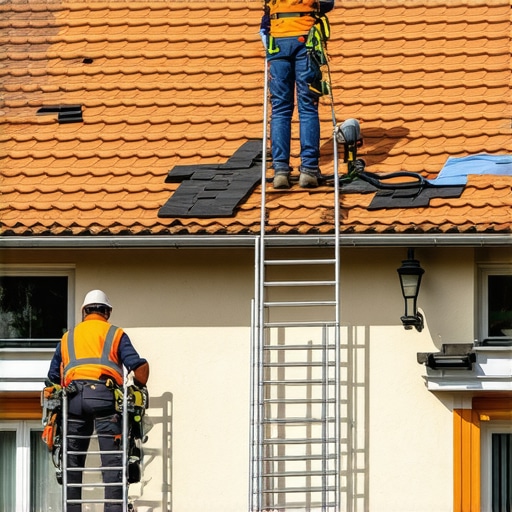
The 2 AM Drip: A Forensic Post-Mortem of Your Roof
You hear it before you see it. That rhythmic tink, tink, tink against the drywall of your ceiling. By the time the brown ring forms on your paint, the battle is already lost. I have spent 25 years climbing ladders and crawling into 140-degree attics where the air is so thick with fiberglass insulation you can taste it. I have seen what happens when local roofers take shortcuts, and I have seen how the physics of water can destroy a home from the top down. My old foreman used to say, ‘Water is patient. It will wait for you to make a mistake.’ He was right. Most people think a roof is just a pile of shingles. It isn’t. It is a complex pressure-management system. When roofing companies talk about slashing repair costs in 2026, they aren’t talking about using cheaper materials; they are talking about forensic prevention. If you want to stop the cycle of endless patches, you have to understand the mechanics of failure.
“A roof is only as good as its flashing.” – Old Roofer’s Adage
The Physics of the ‘Slow Leak’
In the humid, salt-heavy air of coastal regions, the enemy isn’t just rain; it is atmospheric pressure. During a storm, the wind creates a vacuum on the leeward side of your house. This pressure differential literally sucks water uphill. I’ve seen water travel three feet horizontally under a shingle because of capillary action. Most roofing failures occur at the transitions—the valleys, the chimneys, and the vents. If a contractor doesn’t understand surface tension, they aren’t a roofer; they’re a handyman with a ladder.
Tactic 1: The Death of the ‘Shiner’ via Depth-Sensing Pneumatics
A ‘shiner’ is a nail that missed the rafter and is sticking out in the attic. In the winter, that cold nail head becomes a condensation point. It frosts over, then thaws, dripping onto your ceiling. In 2026, high-end roofing companies are using pneumatic nailers with integrated depth sensors and rafter-locating technology. This ensures every fastener is driven flush into structural wood, eliminating the thermal bridging that leads to phantom leaks. If your roofer is just ‘eyeballing it,’ they are leaving you with a ticking time bomb.
Tactic 2: Synthetic Underlayment and the End of Felt Paper
The old-school black felt paper is dead. It rips, it absorbs moisture, and it wrinkles under heat. Modern local roofers have shifted to high-performance synthetic underlayments. These materials are non-breathable on the outer face but allow moisture vapor to escape from the deck. This stops ‘deck rot’—that nasty phenomenon where your plywood turns into something resembling wet oatmeal because moisture was trapped between the shingle and the paper. When I tear off a 20-year-old roof and see gray, weathered wood, I know the underlayment failed long before the shingles did.
Tactic 3: Advanced Cricket Engineering in High-Volume Valleys
A cricket is a small peaked structure built behind a chimney to divert water. Without it, water pools in a ‘dead valley.’ In 2026, we are seeing the use of pre-fabricated, stainless steel crickets. Unlike wood-framed versions that can rot, these are impervious to the standing water that inevitably accumulates during tropical downpours. If you have a chimney wider than 30 inches without a cricket, you don’t have a roof; you have a bathtub attached to your house.
Tactic 4: Self-Healing Granule Technology
UV radiation is the silent killer of roofing. It bakes the oils out of the asphalt, making the shingles brittle. Once they lose their granules, the asphalt is exposed and cracks. The latest tactics involve ‘cool roof’ shingles with ceramic-coated granules that reflect up to 40% of solar heat. This isn’t just for energy bills; it stops thermal shock—the rapid expansion and contraction that happens when a 100-degree afternoon is met with a sudden cold rain. Thermal shock is what snaps seal strips and allows the wind to get a foothold.
“The roof shall be covered with materials that are compatible with each other and the vessel on which they are applied.” – International Residential Code (IRC) R903.1
Tactic 5: Kick-Out Flashing and the Siding Junction
This is where 90% of forensic investigations end. Where a roof edge meets a vertical wall, water must be directed away from the siding. Without a kick-out flashing, water runs down the wall and gets behind the siding, rotting the rim joist and the wall studs. You won’t see this leak for years, but by the time you do, you’re looking at a $15,000 structural repair. Leading roofing companies now mandate one-piece molded kick-outs that cannot be incorrectly bent or installed by a tired apprentice on a Friday afternoon.
Tactic 6: Dynamic Attic Pressure Equalization
An attic is like a pair of lungs. It needs to breathe. If you have too much intake (soffit vents) and not enough exhaust (ridge vents), or vice-versa, you create a pressure imbalance. In 2026, local roofers are using smart-ventilation systems that adjust based on wind speed and temperature. This prevents ‘wind-driven rain’ from being sucked into the ridge vent—a common problem in hurricane zones. If your roofer isn’t calculating the net free ventilating area (NFVA), they are just guessing with your home’s health.
Tactic 7: Galvanic Corrosion Prevention
If you put a galvanized nail through a copper flashing, you have just created a battery. This is called galvanic corrosion. The zinc in the nail will sacrifice itself, dissolve, and leave a hole right where the fastener used to be. Forensic roofing means knowing your metallurgy. In 2026, the best pros use stainless steel fasteners for all perimeter metalwork. It costs three times as much, but it won’t vanish in ten years because of a chemical reaction you can’t even see.
The Final Verdict: Why the Cheapest Bid is a Trap
When you hire roofing companies, you are paying for the invisible details. You are paying for the ice and water shield in the valleys that you’ll never see. You are paying for the step flashing that is woven into every course of shingles instead of a single, lazy strip of ‘L-flash’ globbed with caulk. Caulk is a temporary sealant; metal is a permanent water-shedding system. In 2026, the real way to slash repair costs is to do the job once and do it with surgical precision. If it feels like a sponge when you walk on it, or if you can see ‘waves’ in the ridge line, the forensic evidence is clear: the system has failed. Stop patching the symptoms and start fixing the physics.