
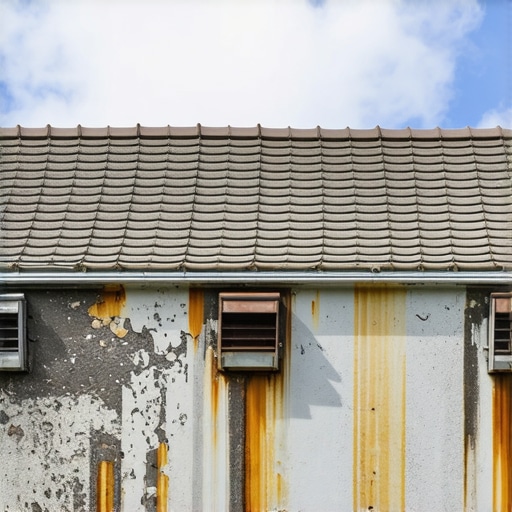
The Orange Stain of Neglect: A Forensic Look at Roof Vent Rust
You’re standing in your driveway, coffee in hand, looking up at your roof. Most people see a sea of shingles, but as someone who’s spent three decades crawling through humid attics and peeling back failed flashing, I see a battlefield. Right now, in the humid corridors of the Southeast, from the Gulf Coast to the Carolinas, a specific type of failure is accelerating. If you see an orange streak bleeding down your shingles from a metal pipe or a square vent, you aren’t just looking at an aesthetic blemish. You’re looking at a structural ticking clock. Local roofers are seeing an uptick in what we’re calling ‘early-onset oxidation’ in systems installed during the building boom of the early 2020s. By 2026, these vents will be the primary entry point for water damage.
“A roof is only as good as its flashing, and the flashing is only as good as the metal it’s stamped from.” – Old Roofer’s Adage
My old foreman used to say, ‘Water is patient. It will wait for you to make a mistake, and then it will invite its friends, Mold and Rot, to the party.’ He was right. When we talk about 2026 roof vent rust, we are talking about a failure of physics. In our tropical climate, the air is thick with salt and moisture. Cheap galvanized steel vents—the kind often used by roofing companies looking to shave a few bucks off a bid—have a thin layer of zinc protection. Once that zinc sacrificial layer is eaten away by the salt aerosol and the 140°F heat of a summer afternoon, the underlying steel begins to weep iron oxide. That’s the rust you see. But the real damage is what you can’t see yet.
Sign 1: The ‘Bleeding’ Flashing and Capillary Action
The first sign of imminent failure is ‘bleeding.’ This occurs when rainwater hits the rusted surface of a static vent and carries iron oxide particles down the slope of the roof. These orange streaks are more than just ugly; they change the surface tension of the shingles. As the rust particles embed themselves in the asphalt granules, they create a microscopic pathway. Through capillary action, water is actually pulled sideways and upwards under the shingle edges. While a healthy shingle sheds water, a rust-stained shingle invites it to linger. If you’re calling local roofers to ‘clean’ these stains, you’re treating the symptom, not the disease. The metal is already porous.
Sign 2: The Interior Collar Decay (The Attic Greenhouse Effect)
The second sign requires a trip into your attic—a place most homeowners avoid like the plague. If you see dark rings on the plywood sheathing around the base of your vent pipes, you have a condensation trap. In our region, the temperature differential between your air-conditioned home and the sweltering attic creates a massive amount of humidity. If the vent is rusted on the outside, it is almost certainly rotting from the inside out. This isn’t just rain getting in; it’s the attic’s own moisture being unable to escape because the rust has narrowed the aperture of the vent. When I perform a forensic inspection, I often find that the ‘Square’—that 100 square feet of roofing—surrounding the vent has turned into a sponge. The plywood isn’t just wet; it’s delaminating. You can literally poke a screwdriver through it with zero effort.
“The primary purpose of a roof is to shed water, but its secondary purpose is to allow the building to breathe. If the lungs of the house—the vents—are clogged with oxidation, the structure suffocates.” – NRCA Manual of Roofing Systems
Sign 3: The ‘Shiner’ and Galvanic Corrosion
The third sign is the most insidious: the failing fastener. In the roofing trade, we talk about ‘shiners’—nails that missed the rafter and are exposed in the attic. But even worse are the nails holding the vent flashing in place. If a contractor used standard galvanized nails to secure a higher-grade metal vent, or vice versa, you get galvanic corrosion. This is a chemical reaction where one metal literally eats the other. By 2026, many ‘COVID-era’ roofs will see these fasteners fail completely. Once the nail head rusts off, the wind-driven rain of a summer thunderstorm can lift the flange of the vent. This is how you end up with a ‘bucket-call’—the moment you realize you need a bucket in your living room because the vent finally gave way during a midnight downpour.
The Forensic Solution: Surgery Over Band-Aids
Don’t let a ‘trunk slammer’ tell you that a bead of caulk will fix a rusted vent. Caulk is a temporary bridge, not a permanent seal. In the forensic roofing world, we don’t believe in Band-Aids. If the metal is compromised, the vent must be cut out and replaced. We recommend moving to polymer-based vents or high-grade stainless steel in coastal areas. It costs more upfront, but it stops the cycle of rot. When you are vetting local roofers, ask them about the ‘Uplift Rating’ of their vents and whether they use secondary water resistance around the penetration. If they don’t mention the ‘Valley’ or the ‘Cricket’—the small diversions we build to keep water from pooling behind large vents—they aren’t looking at the whole system. They’re just looking at their next paycheck. Your roof is a system, not a collection of parts. When one part rusts, the whole system is under threat.