
The Autopsy of a 2025 Failure: Why Most Maintenance Plans Are Worthless
I stepped onto a steep-slope ranch in the Midwest last November, and the deck felt like a trampoline under my boots. The homeowner was convinced they had a simple leak around the chimney. I knew better. As I peeled back a section of the architectural shingles, the smell of rotting cellulose and wet plywood hit me—it was the scent of a slow-motion disaster. I pulled a tab and found a shiner, a nail that had completely missed the rafter. That single mistake had been acting as a cold-conduit for attic moisture for three years. It wasn’t a leak from the sky; it was a physics failure from the inside out. Most roofing companies will sell you a quick patch and a prayer, but if you are looking toward your 2026 maintenance plan, you need to stop thinking about shingles and start thinking about the forensic integrity of your home’s envelope.
1. Deciphering the Ghost Leak: Attic Bypass and Thermal Bridging
Water is patient. It doesn’t always fall from the clouds; sometimes it grows in the dark. In cold-weather zones, the biggest threat for 2026 isn’t a hole in your roofing, but the ‘ghost leak’ caused by attic bypasses. This happens when warm, moist air from your living room finds a path—a light fixture, a wire penetration, or a poorly sealed hatch—into the cold attic space. When that 70-degree air hits the 10-degree underside of your roof deck, it hits the dew point instantly. This leads to condensation that looks exactly like a roof leak. You’ll see water dripping from the valley or pooling on the ceiling, but no matter how many shingles your local roofers replace, the water remains. A real maintenance plan for 2026 must involve an infrared scan of your attic floor to identify these thermal bridges. If you aren’t sealing the air leaks, you are just waiting for your plywood to turn into oatmeal. [IMAGE_PLACEHOLDER]
“Roofing systems must be designed to accommodate the movement of the substrate and the thermal fluctuations of the environment.” – NRCA Technical Manual
2. The Chemistry of the Valley: Combating Capillary Action
Most roofing companies treat valleys as a simple intersection. In reality, a valley is a high-volume hydraulic highway. By the time 2026 rolls around, the sealants used in many ‘discount’ installs from the 2010s will have reached their molecular breaking point. UV radiation scours the polymers, leaving the sealant brittle. Once the sealant cracks, capillary action takes over. This is the physics of water being pulled into tight spaces against the force of gravity. A single leaf caught in a cricket or a valley can divert a gallon of water sideways under the shingles. Your maintenance plan must prioritize the mechanical clearing of these transitions and the application of high-solids tri-polymer sealants. We aren’t talking about a five-dollar tube of caulk from a big-box store; we are talking about industrial-grade bypass protection that maintains elasticity at -20 degrees.
3. The Fastener Autopsy: Avoiding the ‘Square’ of Sorrow
Every square (that’s 100 square feet in trade talk) contains roughly 320 nails. If even 1% of those are ‘high-nailed’ or ‘under-driven,’ your roof is a ticking clock. During my forensic inspections, I look for ‘nail pops’—nails that have backed out due to the constant expansion and contraction of the roof deck. When a nail backs out, it lifts the shingle tab above it just enough to break the wind seal. By 2026, the cumulative effect of thermal shock will have loosened fasteners on roofs that were installed even five years ago. A proactive maintenance plan means walking the roof and hand-sealing any tabs where the bond has failed. This prevents the ‘flapping’ sound that precedes a total blow-off during a spring gale. If your local roofers aren’t checking the nail line, they aren’t doing maintenance; they’re just taking a walk.
“A roof is only as good as its flashing and the integrity of its fasteners.” – Old Roofer’s Adage
4. Gutters and the Eave Connection: The Ice Dam Defense
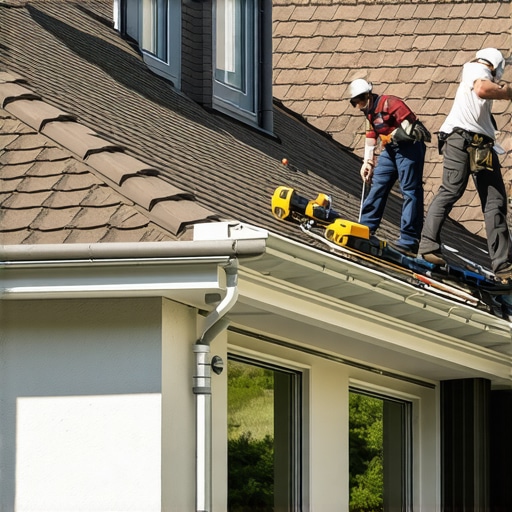
The eave is where the war is won or lost. In regions prone to snow, the transition from the heated wall-line to the cold overhang is the primary site of ice damming. By 2026, many homes will see a degradation in their eave protection. Your maintenance strategy must include a check of the ‘drip edge’ and the first three feet of the roof. If you don’t have a high-temperature ice and water shield membrane that is properly integrated with the gutter apron, you are inviting hydrostatic pressure to push water up and over the top of your shingles. We see this every winter: ice builds up in the gutter, backs up the slope, and finds a way through the nail holes. This isn’t a shingle problem; it’s a detail problem. Maintenance means ensuring your gutters are pitched correctly so water doesn’t sit and freeze, and verifying that your attic ventilation is keeping the deck temperature consistent with the outside air. Stop paying for ‘gutter cleaning’ and start paying for ‘eave system evaluation.’ Your 2026 self will thank you when the thaw hits and your living room stays dry.