
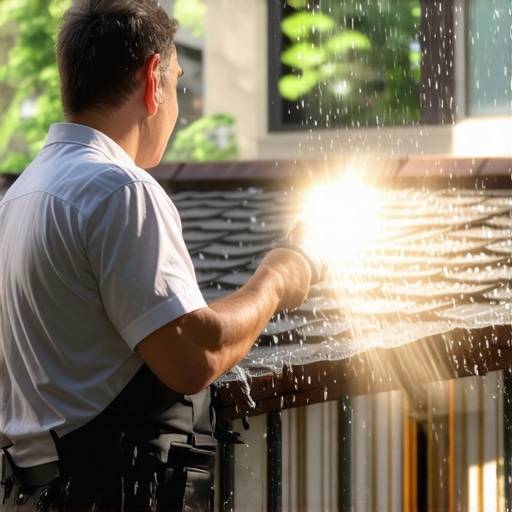
The Forensic Scene: Walking on a Sponge
I stepped onto a roof last November that felt less like a structural assembly and more like a soggy mattress. The homeowner was convinced they needed a simple patch near the chimney. They’d called three roofing companies before me, and each one just threw a tub of plastic cement at the flashing and sent an invoice. But when I pulled back a single tab of an architectural shingle, I didn’t see wood. I saw a black, delaminated pulp that used to be CDX plywood. Walking on that roof felt like walking on a sponge; I knew exactly what I’d find underneath because the physics of failure never lie. This wasn’t a leak from the sky; it was a slow-motion suicide from the attic. Most local roofers see a stain on the ceiling and think ‘hole in the shingle.’ A forensic veteran looks at the attic bypass—those hidden gaps where warm, moist air sneaks into the cold roof deck, condensing into a frost forest that melts the moment the sun hits the shingles. This is the reality of 2026 water entry: buildings are tighter, but roofs are failing faster because they can’t breathe.
“Flashings shall be installed in such a manner so as to prevent moisture from entering the wall and roof through joints in copings, through moisture-permeable materials and at intersections with parapet walls and other penetrations.” – International Building Code (IBC)
1. The Invisible Culprit: Capillary Action and Hydrostatic Pressure
Water doesn’t just fall; it climbs. In the roofing trade, we talk about capillary action—the ability of a liquid to flow in narrow spaces without the assistance of, or even in opposition to, external forces like gravity. When two shingles are overlapped, a tiny gap exists between them. During a wind-driven rain or an ice dam event, water is sucked upward into that gap. If your roofing companies didn’t install an ice and water shield properly at the eaves, that moisture hits the nail line. This is where the shiner—a nail that missed the rafter and hangs exposed in the attic—becomes a primary entry point. As the temperature drops, that shiner gets cold. The warm air from your bathroom fan (which is likely vented into the attic rather than out of it) hits that cold steel, turns into a droplet, and drips onto your insulation. By the time you see a spot on your drywall, that nail has been rusting for three seasons. You don’t have a roof leak; you have a thermal bridge failure. We are seeing more of this in 2026 as high-efficiency furnaces change the pressure dynamics of modern homes.
2. The Cricket and the Valley: Geometrical Failure Points
If you look at where a large chimney meets a steep roof slope, you should see a cricket—a small peaked structure designed to divert water away from the back of the chimney. Without it, the chimney acts like a dam in a river. Debris builds up, holds moisture, and the resulting hydrostatic pressure forces water under the counter-flashing. I’ve seen local roofers try to fix this with five gallons of silicone, but that’s a band-aid on a gunshot wound. The only fix is the surgery: tearing it down to the deck and rebuilding the geometry. The same applies to the valley. In a closed-cut valley, shingles from one side overlap the other. If the roofer didn’t ‘dub’ the corners—cutting a small triangle off the top of the shingle—water running down the valley hits the top edge of the shingle and is diverted sideways, right into the house. It’s a mistake that takes five seconds to prevent but five thousand dollars to fix once the fascia boards start to rot.
“A roof is only as good as its flashing.” – Old Roofer’s Adage
3. Thermal Imaging: Identifying the 2026 Vapor Drive
The third way we identify modern water entry is through infrared thermography. In 2026, we don’t just wait for it to rain. We look for the heat signature of wet insulation. Moist fiberglass holds heat longer than dry cellulose. By scanning a roof at sunset, we can see exactly where the roof deck is holding water. This often reveals that the ‘leak’ is actually vapor drive. In cold climates, if your R-value is insufficient or your ventilation is blocked by blown-in insulation, the underside of your roof deck becomes a laboratory for mold. You’ll see the ‘ghosting’ of rafters on the ceiling—dark lines where the wood is colder than the insulated space. This isn’t a job for a guy with a ladder and a tube of caulk; it’s a structural air-sealing mission. If you’re hiring roofing companies based on the lowest bid per square, you’re essentially paying someone to cover up the evidence of your home’s respiratory failure.
The Cost of the Quick Fix
When I see a ‘trunk slammer’ throwing down a second layer of shingles over an old roof to save the homeowner a few bucks, I see a ticking bomb. A second layer doubles the thermal mass, traps more heat, and prevents the original deck from ever drying out. It’s the ‘bandage’ approach that leads to total deck replacement within five years. True forensic roofing requires understanding that the roof is the top of a lungs-and-circulatory system. If you ignore the air leakage at the top plate or the lack of intake at the soffit, you are just waiting for the next ice dam to turn your living room into a swimming pool. Identifying water entry in 2026 requires looking beyond the shingle and into the physics of the entire building envelope.