
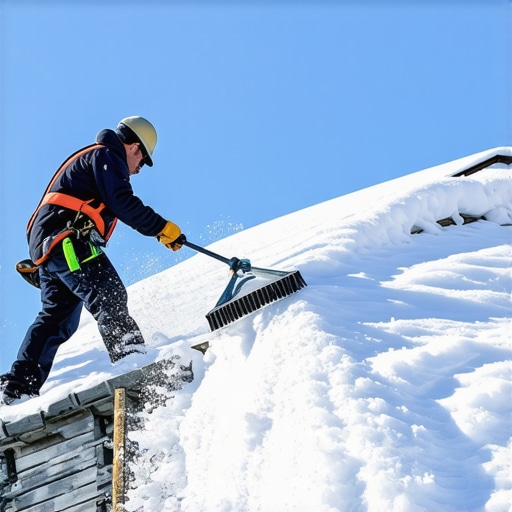
The Forensic Scene: When the Weight Becomes a Liability
Walking on that roof in late January felt like walking on a sponge disguised as a sheet of ice. The homeowners in the valley below didn’t see the disaster brewing; they just saw a picturesque blanket of white. But as a veteran of over 25 years in the roofing trade, I knew exactly what was happening beneath that frozen crust. I could hear the shingles groaning. I could see the slight deflection in the ridge line that signaled the trusses were carrying double their rated dead load. Most local roofers will tell you to just buy a rake and start pulling, but that’s how you end up with a pile of shingles on your lawn and a leak in your kitchen. Roofing companies that actually understand forensic failure know that snow removal is a delicate surgery, not a backyard chore. The weight of a single square—that’s 100 square feet for you civilians—of wet snow can exceed 2,000 pounds. Multiply that across your entire roof deck and you aren’t just looking at a weather event; you’re looking at a structural threat. Water is patient. It will wait for you to make a mistake, and snow is just water in its most deceptive, heavy form.
The Physics of Failure: Why Snow Kills Roofs
To understand why 2026 is going to be a rough year for neglected roofs, you have to understand the mechanism of the ice dam. It isn’t just about the cold. It’s about the thermal bridging happening in your attic. When your insulation is subpar or you have an attic bypass—a fancy term for a hole where your warm interior air leaks into the cold attic—that heat rises and warms the underside of the plywood. The snow directly touching the shingles melts. That water then trickles down the pitch until it hits the eaves, which are cold because they overhang the heated envelope of the house. The water flash-freezes. This creates a dam. Now, the meltwater behind it has nowhere to go. This is where capillary action takes over. Through surface tension, that water is sucked upward, under the shingles, and past the starter strip. If your last roofing company didn’t install a high-quality ice and water shield at least six feet up from the eaves, you’re done. The plywood turns to oatmeal, and the mold starts its slow crawl across your ceiling.
“Ice dams are most likely to occur when the outside temperature is below freezing, there is a significant snow cover on the roof, and the attic temperature is above freezing.” – National Roofing Contractors Association (NRCA)
Tip 1: The Rake is a Scalpel, Not a Sledgehammer
Most local roofers see homeowners out there with metal rakes, banging away at the eaves. Stop. Every time that metal edge strikes a frozen shingle, you are shearing off the ceramic granules. Those granules are the only thing protecting the asphalt from UV radiation. Once they’re gone, the shingle is just a piece of oil-soaked paper waiting to crack. When you use a roof rake, leave two inches of snow on the surface. Don’t try to get it down to the shingle. You want to remove the mass—the weight—without disturbing the actual roofing material. If you feel the rake catch on something, it’s likely a shiner—a nail that’s backed out—or the edge of a shingle. Forcing it will result in a leak come spring. The goal isn’t a clean roof; it’s a lighter roof.
Tip 2: Identifying the Attic Bypass Horror
You can hire the best roofing companies in the world, but if your attic is a furnace, your roof will fail. Forensic investigation often reveals that the biggest enemy of a roof is the house it sits on. Look at your roof after a light dusting of snow. Do you see clear patches around your recessed lights or your bathroom fan vent? That’s a thermal bypass. You’re melting the snow from the bottom up. This creates the perfect environment for the freeze-thaw-wedge cycle. Water gets into a tiny crack, freezes, expands, and makes the crack bigger. By the time 2026 rolls around, these small fissures become wide-open gates for moisture. Sealing these leaks is more important than any snow removal tool you can buy.
Tip 3: The Danger of the Valley and the Cricket
Valleys are the highways of your roof. They collect water from two different slopes and funnel it toward the gutters. In heavy snow, these valleys fill up fast. If your roof has a chimney, there should be a cricket—a small peaked structure behind it—to divert water and snow around the masonry. Without a cricket, snow packs in behind the chimney like a glacier. As it melts and refreezes, it exerts massive hydrostatic pressure against the flashing. I’ve seen chimneys literally pulled away from the roof line because of the weight of ice. Local roofers should be checking these transition points every autumn. If you don’t have a cricket, you’re essentially building a dam every time it snows.
“The roof shall be designed to support the live loads, including snow loads, as set forth in the building code.” – International Residential Code (IRC)
Tip 4: Chemical Warfare on Your Shingles
I see it every year: people throwing rock salt onto their roofs to melt ice dams. You might as well be pouring acid on your shingles. Sodium chloride (rock salt) is corrosive to the nails—those galvanized fasteners holding your roof together—and it destroys the aluminum in your gutters. If you must use a chemical melter, look for calcium chloride. But even then, use it sparingly. The runoff will kill your landscaping and stain your siding. The best way to deal with an ice dam isn’t chemicals; it’s steam. Professional roofing companies use specialized steamers that melt the ice without the high pressure of a power washer, which would strip the shingles bare in seconds.
Tip 5: Knowing the Structural Breaking Point
How much is too much? In most northern climates, a roof is built to handle about 20 to 40 pounds per square foot. Fresh snow is light, maybe 20 pounds per cubic foot. But packed, wet snow? That can be 60 pounds per cubic foot. If you see your interior doors sticking or you notice new cracks in the drywall near the center of the house, that’s the house screaming under the weight. This is when the cynical veteran tells you to stop reading and call a pro. Don’t wait for 2026 to see if your trusses can hold. Get a forensic inspection now. Local roofers who know their craft will look at the deflection in your rafters from the inside of the attic—that’s where the truth is hidden. Underneath the shingles and the snow, the wood tells the story of every storm it’s ever endured. Don’t let the next one be the final chapter.