
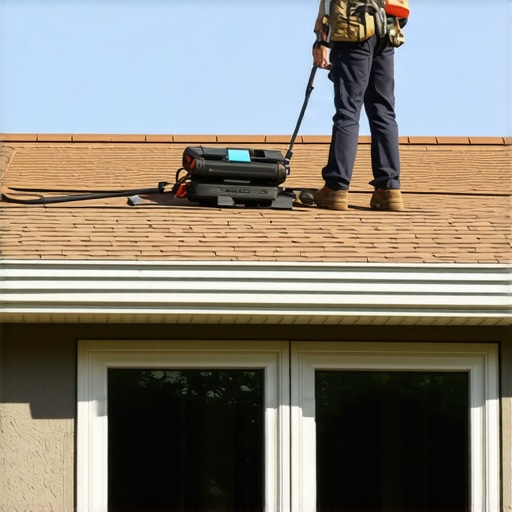
The Forensic Autopsy of a Rotted Eave
Walking on that roof felt like walking on a sponge. I knew exactly what I would find underneath before I even pulled my flat bar out of my belt. The homeowner told me their local roofers had just ‘touched things up’ two years ago, yet here I was, looking at a dining room ceiling that looked like a topographical map of the Everglades. When I finally peeled back the starter course, the fascia board didn’t just look wet—it looked like wet oatmeal. You could put a finger through the wood with less effort than it takes to pop a blister. This is not just a leak; it is a systemic failure of the roof’s perimeter defense system. In the humid, wind-driven rain environments we are seeing more of as we approach 2026, the traditional ways of ‘slapping it together’ are costing homeowners thousands in structural repairs.
The Physics of Failure: Why Your Perimeter is Dying
Water is a patient trespasser. It doesn’t need a gaping hole to ruin your house; it just needs a little bit of surface tension and a lazy contractor. Most roofing companies treat the fascia—the long, horizontal board that caps the end of your rafters—as a cosmetic trim piece. It isn’t. It is the primary shield for your soffit and your interior walls. When rain hits your shingles, gravity should take it into the gutter. But water has a nasty habit called capillary action. It likes to cling to surfaces. If your shingle overhang is too short, or if your drip edge is installed flat against the wood, water will wrap around the bottom of the shingle, crawl up the back of the drip edge, and soak into the top grain of your fascia board. Once that wood hits a 20% moisture content, it becomes a buffet for wood-decay fungi like Basidiomycetes.
“Drip edges shall be provided at eaves and gables of asphalt shingle roofs. Adjacent segments of drip edge shall be overlapped not less than 2 inches (51 mm). Drip edges shall extend not less than 1/4 inch (6.4 mm) below the roof sheathing and extend up back onto the roof deck not less than 2 inches (51 mm).” – International Residential Code (IRC) R905.2.8.5
Fix 1: The ‘Mechanical Kick’ Drip Edge Geometry
The first fix for 2026 isn’t about fancy materials; it’s about the geometry of the drip edge. I’ve seen roofing crews use cheap ‘L-style’ flashing that lays flat against the fascia. That’s a death sentence for the wood. In a high-humidity zone, you need a ‘T-style’ or a drip edge with a kick-out hem. This hem is a small outward bend at the bottom of the metal flange that physically breaks the surface tension of the water, forcing it to drop into the center of the gutter rather than running down the face of the board. When we perform a forensic tear-off, we look for ‘shiners’—those missed nails that went into the fascia instead of the rafter tail. These shiners act as heat conductors, creating condensation points inside the wood that rot it from the inside out. A proper fix involves a heavy-gauge aluminum drip edge with a 45-degree kick-out, installed with stainless steel fasteners to prevent galvanic corrosion.
Fix 2: Diversion via Kick-Out Flashing
If you have a roofline that meets a vertical wall—like where a garage roof hits the second story—you are at risk. Most local roofers simply run the step flashing down and terminate it at the fascia. This dumps 100% of the water from that roof section directly into the end grain of your fascia board. The end grain is like a bunch of tiny straws; it sucks up moisture instantly. The 2026 standard for high-performance roofing requires a kick-out diverter. This is a specialized piece of flashing that angles the water away from the wall and into the gutter. Without it, you aren’t just rotting your fascia; you are rotting the rim joist of your house. I’ve seen roofing companies try to ‘seal’ this gap with a $10 tube of caulk. Caulk is a temporary fix for a permanent problem. In the heat of a 140-degree afternoon, that caulk expands, cracks, and eventually traps water behind it, accelerating the rot.
Fix 3: The Shift to Cellular PVC and Composite Substrates
Let’s talk about the material truth. Pine and cedar are beautiful, but in our current climate, they are high-maintenance liabilities. The third fix is the total replacement of rotted timber with cellular PVC. Unlike wood, PVC doesn’t have a cellular structure that absorbs water. It won’t peel, it won’t rot, and bugs won’t eat it. However, you can’t just slap PVC up there and call it a day. It has a high rate of thermal expansion. If a local roofer pins it too tight without allowing for movement, it will buckle and pop your gutter spikes. You need a contractor who understands ‘the movement.’ We use oversized holes and specific adhesives that allow the material to breathe without opening up gaps for wind-driven rain to enter the soffit. This is the difference between a ‘tailgate warranty’ and a roof that actually lasts thirty years.
“A roof is only as good as its flashing; the shingles are just the skin, but the metal is the skeleton.” – Old Roofer’s Adage
The Trap of the ‘Standard’ Warranty
Don’t get suckered by a ‘Lifetime Warranty’ on shingles. Those warranties rarely cover the fascia or the labor to fix the rot caused by poor installation. When a roofing salesperson starts talking about ‘seamless’ integration, ask them about their drip edge overlap. If they don’t mention a 2-inch minimum overlap or the use of a starter strip to prevent wind-lift, they are just trying to get a signature. You want a forensic-level installation. That means checking the ‘valley’ transitions to ensure water isn’t damming up at the eave. It means ensuring the ‘cricket’ behind your chimney is actually shedding water rather than pooling it toward the fascia corner.
The Cost of Hesitation
If you see a dark stain on your fascia, or if the paint is bubbling, the damage is already done. Wood-decay fungi are like icebergs; you only see 10% of the problem on the surface. By the time the board looks soft, the rafter tails behind it are likely starting to soften too. Fixing a fascia board is a $1,500 job. Fixing six rotted rafter tails and a mold-infested attic is a $15,000 job. Don’t let a ‘trunk slammer’ tell you it just needs a coat of paint. You need a structural fix that respects the physics of water. Get a pro who knows how to use a moisture meter and isn’t afraid to tell you the truth about your roof’s edge.