
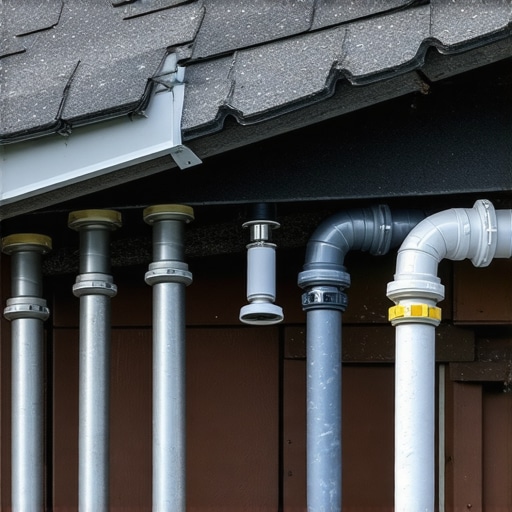
The Anatomy of a Dining Room Flood: Why Your Pipe Penetrations Are Failing
It usually starts with a faint, brownish ring on the ceiling, right above where the plumbing stack runs through the attic. By the time you notice it, the physics of failure have been at work for years. Walking on that roof in late November felt like walking on a sponge; I could feel the structural plywood underneath yielding with every step. I knew exactly what I’d find: a plumbing vent boot that had been baked by the sun, cracked by the frost, and surrendered to the relentless pressure of capillary action. This isn’t just a leak; it is a forensic study in how cheap materials and poor installation techniques create a direct highway for water to enter your home.
When we talk about roofing, most homeowners focus on the field shingles, but 90% of the failures I investigate happen at the penetrations. A pipe is a vertical intrusion through a sloped plane. Gravity wants the water to go down the roof, but surface tension allows that water to ‘hug’ the pipe and find its way behind the flashing. In cold climates, this is exacerbated by the freeze-thaw cycle. Ice forms at the base of the pipe, expands, and slowly pries the neoprene gasket away from the PVC. Once that seal is broken, your attic is no longer a dry sanctuary; it’s a collection basin.
“Flashings shall be installed in a manner that prevents moisture from entering the wall and roof through joints in copings, through moisture-permeable materials and at intersections with vent pipes.” – International Residential Code (IRC) Section R903.2
To stop this, you have to understand the Mechanism of Failure. It’s not just ‘water falling in.’ It is the atmospheric pressure pushing moisture through micro-fissures in aged rubber gaskets. If you’ve hired local roofers who just slap a plastic boot over the hole and call it a day, you’re on a ten-year countdown to structural rot. Here are the five ways we actually stop water entry at pipes using forensic-grade methods.
1. The High-UV Silicone Gasket Upgrade
Standard ‘stock’ boots use a thermoplastic or neoprene rubber that is designed for a 10-year lifespan. On a roof, where temperatures can swing 80 degrees in a single day, that rubber loses its plasticizers and turns brittle. When we perform residential roofing repairs, we swap these for silicone-based boots or high-performance polymers. Silicone doesn’t care about UV radiation; it remains flexible. Without that flexibility, the pipe—which actually moves as your house settles and as the plumbing expands with hot water—will simply tear the boot apart. If your roofer is using the cheap stuff from the big-box store, they are building in a future leak.
2. The ‘Ice & Water’ Wrap Technique
Never rely on the metal flange of the boot alone. A veteran forensic roofer knows that water will eventually get under the shingles adjacent to the pipe. We apply a self-adhering modified bitumen membrane—often called Ice & Water shield—directly to the roof deck, wrapping it two inches up the vertical wall of the pipe itself. This creates a secondary, redundant seal. Even if the shingles around the pipe fail, the water hits that membrane and is diverted back onto the shingle course below. If you suspect your deck is already soft, you might be looking at rotted roof decking fixes before a new boot can even be installed.
3. Installing a Lead Boot for Longevity
If you want a 50-year solution, you stop using rubber altogether. Lead boots are the gold standard. They are malleable, meaning we can beat the lead over the top of the PVC pipe, tucking it inside the vent itself. There is no gasket to rot. There is no sealant to fail. It’s a purely mechanical, gravity-fed system. While it costs more per square, it eliminates the need for future maintenance. Most roofing companies won’t offer this because it requires actual skill with a hammer rather than just driving a few shiners (nails that miss the rafter) into the deck and hoping for the best.
4. The Storm Collar Redundancy
For pipes that experience high vibration or extreme thermal expansion, we install a secondary ‘storm collar.’ This is a metal or plastic umbrella that sits above the primary flashing. We seal it with a high-grade polyurethane sealant—never cheap silicone caulk that peels off like a sunburn. This collar sheds the bulk of the water away from the critical gasket area. Think of it as a belt-and-suspenders approach. In my experience, if a pipe is properly flashed with a storm collar, it can withstand 100mph wind-driven rain without a single drop entering the attic.
5. Correct Shingle Weaving and the ‘Uphill’ Seal
The biggest mistake I see? Roofers who nail the top of the pipe flange over the shingles. This creates a ‘shelf’ that catches water. The top flange of any pipe boot MUST be tucked under the shingle course above it, and the bottom flange must sit on top of the shingles below it. We then apply a bead of sealant in a ‘U’ shape under the shingles on the sides. This prevents capillary action from pulling water horizontally under the shingle. If you see nails exposed on the top of your pipe boot, your roofer was a ‘trunk slammer’ who didn’t understand the basic physics of water flow. If the installation was this sloppy, you might also want to check for shingle lifting across the rest of the roof.
“A roof is only as good as its flashing.” – Old Roofer’s Adage
The Forensic Reality of Delay
Water is patient. It doesn’t need a hole the size of a fist; it only needs a path. Once water gets past that pipe boot, it travels down the outside of the PVC, hits the ceiling joist, and begins the slow process of delaminating the plywood and molding the insulation. By the time you see the stain, you likely have shingle blistering or hidden deck rot that will cost five times more to fix than a simple boot replacement. Don’t let a $150 part ruin a $30,000 roof system. Get a forensic inspection and make sure your pipes are sealed for the long haul.