
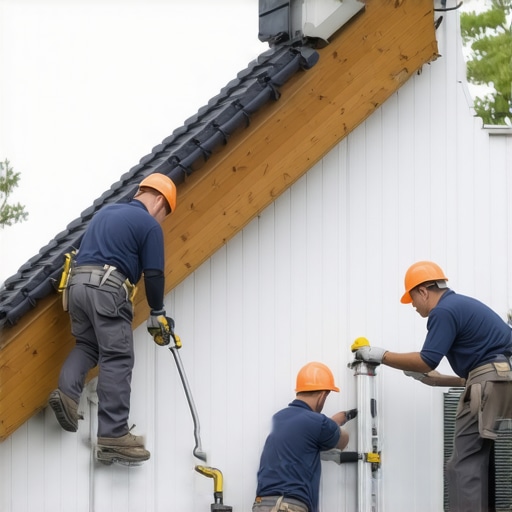
Walking on that roof in Savannah felt like walking on a sodden sponge. I didn’t even need to pull my moisture meter out of the bag; the smell of fermented wood and moldy insulation told the whole story before I even touched a shingle. I knew exactly what I would find underneath: a fascia board so rotten you could put a finger through it, and rafters that were starting to delaminate. The homeowner thought they had a ‘shingle leak,’ but they were wrong. It was a gutter overflow issue that had been quietly eating the house for three seasons. Most local roofers see this every day, but few take the time to explain the forensic reality of why your gutters are failing you during a tropical downpour.
The Forensic Autopsy: Why Gutters Kill Roofs
When you see water cascading over the front of your gutters like a cheap hotel fountain, you aren’t just looking at a nuisance. You are looking at a hydraulic failure. In the Southeast, where we deal with wind-driven rain and sudden 3-inch-per-hour deluges, the physics of water management change. It isn’t just about ‘clogs.’ It is about surface tension and capillary action. When a gutter overflows, the water doesn’t just go forward; it ‘wicks’ backward. It crawls up under the drip edge, saturates the fascia, and finds its way into the attic leaks that eventually destroy your drywall. If your local roofers didn’t install a proper starter course, that water is going straight into your soffits.
“Water is the most common cause of damage to any building. Proper drainage systems are the first line of defense in maintaining structural integrity.” – General Axiom of Building Science
I’ve spent 25 years watching ‘trunk slammers’ slap up a ‘square’ of shingles without checking the pitch of the trough. A ‘square’ is 100 square feet of roofing, and every one of those feet is a collection point for thousands of gallons of water. If that water hits a bottleneck, it backs up. Here is the technical breakdown of how to stop the overflow before you’re paying me to replace your entire deck.
1. The Pitch and the ‘Shiner’ Problem
Gutters are not supposed to be level. That sounds obvious, but you’d be surprised how many roofing companies install them perfectly horizontal because it ‘looks better’ from the curb. Physics doesn’t care about your curb appeal. A gutter needs a minimum of 1/4 inch of slope for every 10 feet of run. If it’s too flat, the water pools, sediment settles, and the weight causes the hangers to pull out of the wood. When those hangers pull out, they leave a ‘shiner’—a missed or exposed nail hole—that acts as a direct straw for water to enter your rafter tails. If you notice your fascia paint peeling, the pitch is likely the first culprit.
2. High-Capacity Sizing for Tropical Deluges
In the Southwest, you might get away with 5-inch K-style gutters. In the Southeast, that’s a joke. When we get a tropical cell moving through, a 5-inch gutter is overwhelmed in minutes. We recommend 6-inch seamless aluminum at a minimum. Why? Because the volume of a 6-inch gutter is nearly double that of a 5-inch. It’s simple math. If your roof has steep valleys—where two roof planes meet—the water velocity is so high it will literally jump over a standard gutter. You need splash guards and oversized troughs to catch that ‘river’ before it hits your foundation. If you hear a thumping sound during rain, you should check for roof creaks caused by weight imbalances from backed-up water.
3. The Drip Edge/Starter Shingle Interface
This is where the forensics get ugly. If your drip edge is installed behind the gutter back-flap, the water will run behind the gutter instead of into it. This is a classic rookie mistake made by cheap local roofers. The water surface-tensions its way back to the wood. You need to ensure the drip edge extends into the gutter. Furthermore, if the shingles don’t have the correct 1/2-inch to 3/4-inch overhang, the water won’t ‘break’ clean into the trough. It will dribble down the fascia. If you find your gutters are clear but the wood is still wet, your shingles were cut too short. This leads to clogged roof drains at the exit points because the asphalt granules have nowhere to go but the bottom of the trough.
4. Downspout Physics and the Bottleneck
You can have the biggest gutters in the world, but if your downspouts are 2×3 inches, you have a bottleneck. I always tell my crews to install 3×4 inch downspouts. A 2×3 downspout can be blocked by a single large leaf or a handful of granules. A 3×4 can pass a tennis ball. If your downspouts are undersized, the water backs up the vertical column, fills the horizontal gutter, and then you have a 400-pound weight hanging off your eaves. This weight causes the roof to sag over time. If you see your gutters pulling away, you might need to check if your gutter sags are caused by these hydraulic backups.
“The IRC Building Code requires that roof drainage shall be provided by gravity and shall discharge at least 5 feet away from the foundation.” – International Residential Code (IRC)
5. Diverters and ‘Crickets’ for Heavy Flow
Most people don’t know what a ‘cricket’ is until their chimney starts leaking. A cricket is a small peaked structure built behind a chimney or any roof obstruction to divert water. The same logic applies to gutters. In areas of extreme flow, we use ‘diverters’ to keep water from overshooting the corners. Without these, the ‘valley’ of your roof acts like a fire hose, shooting water right over the gutter and digging a trench in your landscaping or, worse, flooding your crawlspace. If a storm has already left a mess, you’ll need to know how to handle large debris that might be clogging these critical diversion points.
The Cost of Waiting for the ‘Perfect’ Storm
I’ve seen homeowners ignore a small overflow for years because ‘it only happens when it rains hard.’ Those are the same people who call me when their ceiling is on the floor. Water is patient. It will wait for a tiny crack in your sealant or a slightly loose nail. It will sit there, soaking into the wood, until the structural integrity of your home is compromised. If you’re seeing overflow, don’t wait for a hurricane to test your system. Get a forensic inspection. Real local roofers won’t just look at the shingles; they’ll look at the stains on your fascia and the silt in your gutters. That’s where the truth is hidden.