
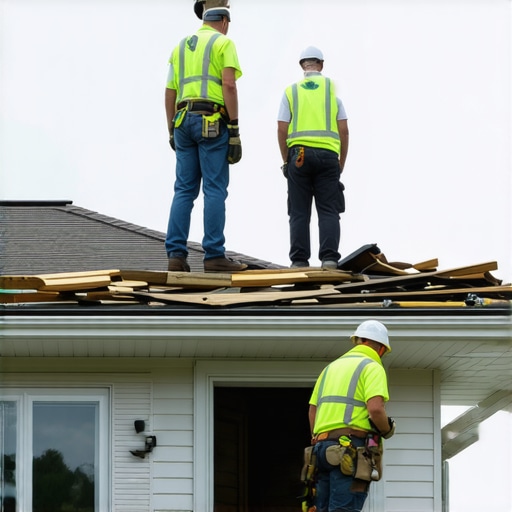
The Silence After the Sirens: Identifying Real Damage
The freight train sound has passed, the sirens have cut out, and you’re standing in your yard looking at a mess of insulation and splintered wood. You see a few shingles in the grass, but your roof looks ‘mostly’ okay from the curb. That’s the most dangerous moment for a homeowner. I’ve spent twenty-five years climbing onto decks after storms in the heart of Dixie, and I can tell you that a tornado doesn’t always take the whole house; sometimes it just breathes on it hard enough to break its spirit. My old foreman used to say, ‘Water is patient. It will wait for you to make a mistake.’ After a tornado, that mistake is usually assuming that if the roof is still there, it’s still working.
“A roof is only as good as its flashing.” – Old Roofer’s Adage
The physics of a tornado on a residential structure isn’t just about wind speed; it’s about the massive pressure differential. When that low-pressure cell moves over your house, the air inside your attic tries to get out—fast. This creates an upward force called uplift. This isn’t just wind blowing shingles off; it’s the roof literally trying to lift off the walls. This force often creates ‘shiners’—nails that were already on the edge of a rafter—which now pull loose, creating a direct path for water. If you see your ceiling starting to dip, you need to look into how to handle sagging attic decking before the whole system collapses under the weight of saturated plywood.
The Storm Chaser Defense: Don’t Get Burned Twice
Within six hours of a major storm, the ‘trunk slammers’ will arrive. They have out-of-state plates, shiny magnetic signs on their trucks, and a pitch that sounds too good to be true: ‘We’ll cover your deductible.’ Let me be blunt—that is insurance fraud in most states, and it’s the first sign you’re dealing with a hack. These guys aren’t roofing experts; they are paper-pushers who hire the cheapest labor possible to slap on a new layer of shingles without ever checking the integrity of the deck. I’ve seen hundreds of these jobs where the crew ignored structural damage just to get the job done in a day and collect the check. To protect your investment, you must understand why avoiding out-of-state roofing crews is the only way to ensure you have a warranty that actually exists in three years.
Mechanism Zooming: Why Your Shingles Failed
Let’s talk about capillary action and wind-driven rain. During a tornado, rain isn’t falling down; it’s moving horizontally at 80 to 130 miles per hour. It gets forced under the laps of your shingles and up over the top of the underlayment. If your local roofers didn’t install a high-quality ice and water shield or a robust synthetic underlayment, that water is now sitting on your plywood. Plywood is like a sponge; once it gets wet, the glues start to delaminate. You won’t see the leak today, but in six months, you’ll have a mold colony that will cost ten times what the roof repair would have. You need to perform a forensic walk-through. Check the ‘valleys’—the internal V-shaped angles of your roof. These are the primary drainage arteries, and if the debris from the storm has clogged the cricket (the small peak behind your chimney), the water will back up and find a way into your living room.
The Insurance Adjuster Game: Functional vs. Cosmetic
When the adjuster shows up, they are looking for ‘functional damage.’ This means the shingle is torn, missing, or the seal is broken. They will try to dismiss ‘bruises’ from hail or minor scuffs as ‘cosmetic.’ Don’t buy it. A shingle that has lost its granules because of high-velocity wind or debris impact is a shingle that has lost its UV protection. It will fail prematurely. This is why you need to know how to spot hidden shingle lifting before the adjuster signs off on a partial repair. A common trick is to ‘spot repair’ a few squares, but after a tornado, the structural integrity of the entire plane is usually compromised. Demand a full inspection of the drip edge and the fascia. If the wind got under the edge, it likely pulled the fasteners through the wood, a phenomenon we call ‘pull-through’ that renders the remaining shingles useless in the next thunderstorm.
“The building code is a minimum standard, not a gold medal.” – Forensic Engineering Axiom
Immediate Action: Patching and Mitigation
You have a legal obligation to ‘mitigate further damage.’ This means you can’t just let it leak for three weeks while you wait for the insurance check. You need to get a tarp on it, but don’t just throw a blue plastic sheet over the ridge and call it a day. It needs to be ‘battened down’ with 1×2 wood strips so the wind doesn’t turn that tarp into a sail and rip more shingles off. If you’re doing this yourself, be incredibly careful with your pitch safety. A roof that is covered in grit and wet granules is slicker than ice. If the damage is localized, like a branch through a porch, you can look into immediate storm patching techniques to get through the night. Always document everything with photos before you cover it up; your adjuster needs to see the ‘before’ to justify the ‘after.’
Choosing the Right Local Roofers for the Long Haul
When you finally sit down to look at quotes, don’t just look at the bottom line. Read the details. Are they replacing the flashing, or are they just ‘re-using’ the old, dented tin? Are they installing a starter course along the eaves and rakes to prevent future uplift? A professional estimate should be several pages long, detailing every material from the type of nails to the ventilation system. If you aren’t sure what you’re looking at, take the time to learn how to analyze a roofing estimate. You want a contractor who talks about uplift ratings and secondary water resistance, not just someone who can get it done ‘fast and cheap.’ In the roofing world, ‘fast and cheap’ is just another way of saying ‘see you again after the next big wind.’